


100th Sunderkand Path Ahmedabad Marks Temple Milestone
Ahmedabad temple prepares for 100th Sunderkand Path after two years of regular recitations
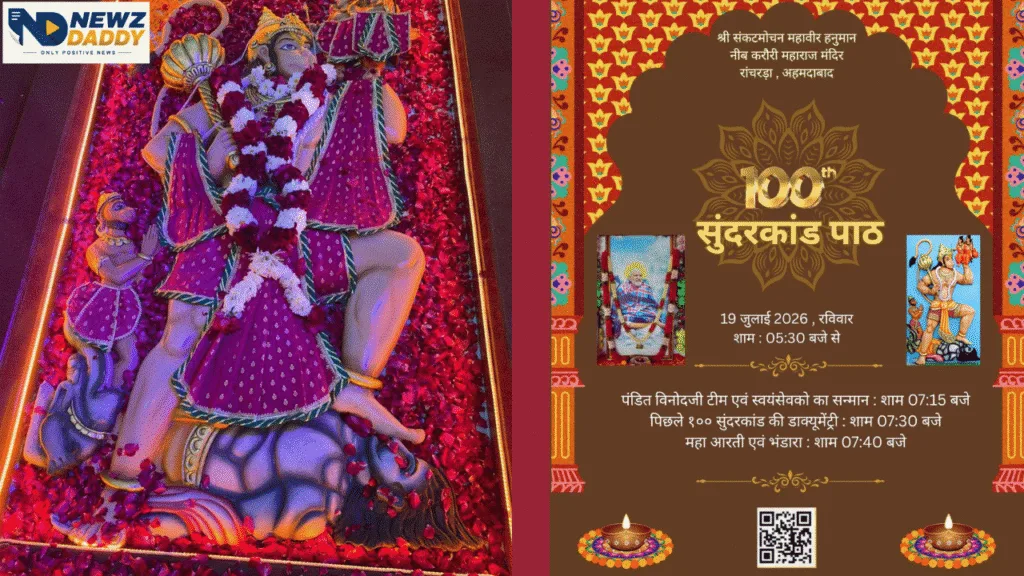
Shri Sankatmochan Mahavir Neem Karori Maharaj Mandir at Rancharda on the western edge of Ahmedabad is set to hold its 100th Sunderkand Path on Sunday, 19 July 2026, at 5.30 pm. The programme marks an important point for the temple, which opened on 23 August 2024 and has organised regular recitations of the Sunderkand from the Ramcharitmanas since its inauguration.
The Sunderkand is one of the most widely read sections of the Ramcharitmanas, written by the 16th-century poet-saint Goswami Tulsidas. It describes Lord Hanuman’s journey to Lanka in search of Sita and is regarded by many Hindu devotees as a source of strength, courage and hope. Across India, families and temples often organise Sunderkand recitations on Tuesdays and Saturdays, days that are closely linked with Hanuman worship.
Temple organisers said every one of the first 100 recitations has been led by Pandit Vinodji and his team. The upcoming gathering is expected to draw devotees from different parts of Ahmedabad who regularly visit the temple to offer prayers to Lord Hanuman and Neeb Karori Maharaj.
Neeb Karori Maharaj, also known as Neem Karoli Baba or Maharajji, was a Hindu spiritual teacher whose followers include devotees from India and abroad. He became widely known through his teachings on devotion, selfless service and remembrance of God. Several temples dedicated to him have been established over the years, with Hanuman worship remaining a central part of many of these places of prayer.
Since the Rancharda temple opened in August 2024, each Sunderkand Path has been accompanied by a different seasonal decoration and offering. Temple volunteers have arranged displays using seasonal fruits, sava mani laddu, kites, jamun, namkeen and different varieties of sweets according to the time of year. Religious festivals, including Raksha Bandhan, Ganesh Utsav, Maha Shivratri and Navratri, have also been observed at the temple with special decorations and community participation.
Alongside religious programmes, the temple has organised activities aimed at bringing different sections of society together. Devotees have received Tulsi plants as part of temple offerings on selected occasions. Children from Andh Jan Mandal have been invited several times to take part in Ram Navami celebrations, Sunderkand Path recitations and other festival programmes. Senior citizens from old-age homes have also been welcomed to participate in temple events.
Such activities reflect a broader tradition followed by many temples in Gujarat, where religious gatherings are often combined with social outreach. Temples frequently serve as meeting places for families, volunteers and charitable groups that organise food distribution, cultural events and community support during festivals.
Dr Praveen Garg, founder of Shri Sankatmochan Mahavir Neeb Karori Maharaj Mandir, said he was looking forward to the completion of the 100th Sunderkand Path. He added that the temple would continue celebrating future festivals with the same spirit and dedication.
Several devotees have remained closely associated with the temple since its opening. Kirtibhai Patel, Bharatbhai Joshi, Rahulbhai Barot, Rushabhbhai Shah and Nirav Patel regularly offer seva at the temple. According to temple representatives, these volunteers have helped organise religious programmes and support visitors attending the recitations.
The temple has gradually become a regular destination for worshippers from different parts of Ahmedabad. Attendance is usually higher on Tuesdays, Saturdays and Sundays, which are considered especially significant for Hanuman devotees. Larger crowds are also seen during major Hindu festivals and special religious programmes.
Ahmedabad has a long tradition of public religious gatherings that bring together people from different neighbourhoods. The city is home to several historic temples and hosts large annual events, including the Jagannath Rath Yatra, one of India’s biggest chariot festivals outside Puri. Religious institutions across the district continue to play an important role in preserving cultural traditions while serving as centres for social and community activities.
The 100th Sunderkand Path is expected to continue that tradition by bringing together devotees for prayer, devotional singing and community participation. For regular visitors, the programme marks two years of continuous religious activity since the temple’s inauguration and recognises the efforts of priests, volunteers and worshippers who have supported the temple’s weekly schedule.
As the temple prepares for Sunday’s gathering, organisers say the focus remains on maintaining the regular practice of Sunderkand recitation while encouraging wider participation in future religious and community programmes. The completion of 100 recitations represents a record of consistent worship rather than a one-day celebration, reflecting the growing role of the Rancharda temple in the spiritual life of many devotees across Ahmedabad.