


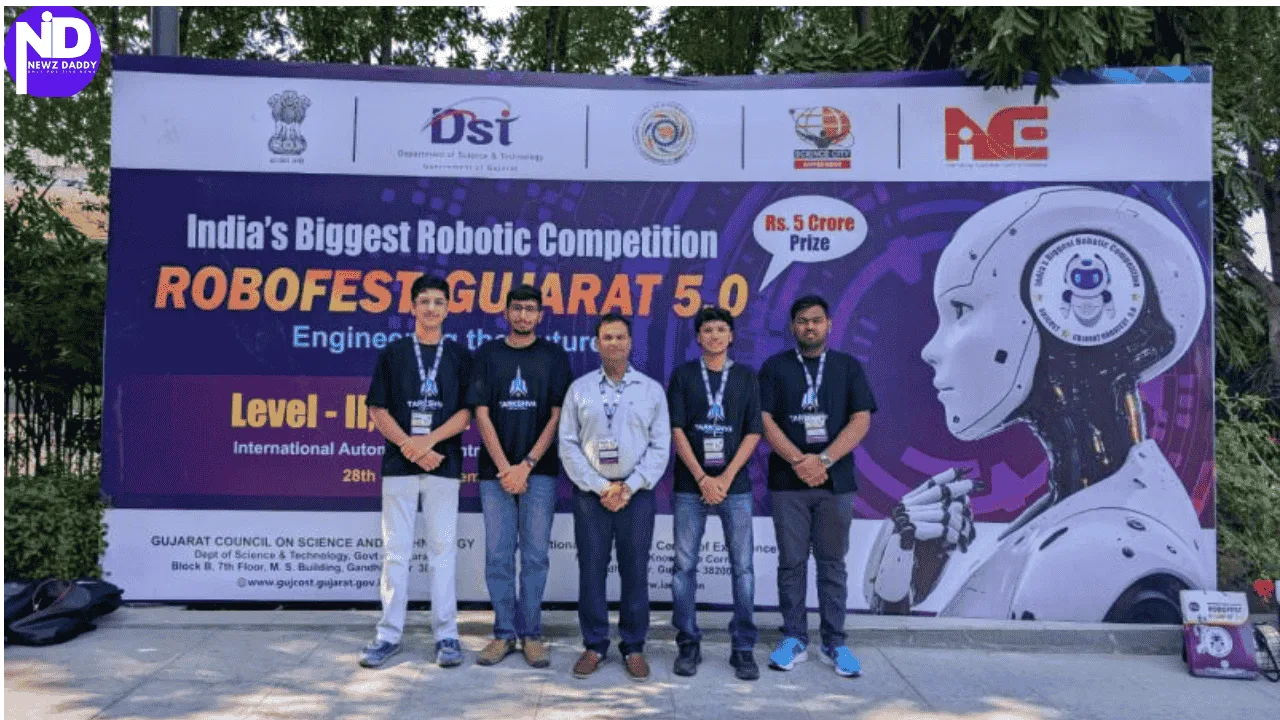
IITRAM Team Bags ₹2 Lakh in Aerial Minefield Navigation
Newz Daddy Educational Updates
IITRAM Student Team Wins ₹2.00 Lakh prize money at ROBOFEST–GUJARAT 5.0 for Aerial Minefield Navigation
A student team from the Institute of Infrastructure, Technology, Research and Management (IITRAM), Ahmedabad, has achieved a significant milestone by winning a prize money of ₹2.00 lakh in ROBOFEST–GUJARAT 5.0, one of India’s largest robotics competitions. The grant has been awarded under the “Aerial Minefield Navigation Challenge”, organised by the Gujarat Council on Science and Technology (GUJCOST), Gandhinagar.
The project has successfully progressed from Level II (Proof of Concept) to Level III (Prototype), as per the official communication from GUJCOST. This selection recognises the technical merit, innovation, and practical relevance of the proposed autonomous aerial system designed for operation in hazardous and GPS-denied environments.
The project focuses on the development of an autonomous multi-UAV system capable of safe navigation, hazard detection, and mission coordination in minefield-like scenarios. The system integrates onboard sensing, embedded intelligence, and inter-drone coordination to reduce dependence on external infrastructure, thereby enhancing robustness and operational reliability.
The student team comprises Husain Lokhandwala, Falgun Baria, Adidev Shah, and Dhyan Patel, all undergraduate students from the Department of Mechanical Engineering, enrolled in the Minor in Drone Technology programme at IITRAM. The project is guided by Dr Ajit Kumar, Assistant Professor, Department of Mechanical and Aerospace Engineering, IITRAM.
Director General of IITRAM, Prof. P.K. Jain, while congratulating the team and faculty mentor, said, “This achievement highlights IITRAM’s growing emphasis on hands-on learning, interdisciplinary research, and student-driven innovation in emerging areas such as drones, robotics, and autonomous systems.”
The win at ROBOFEST–GUJARAT 5.0 places the student team from the Institute of Infrastructure, Technology, Research and Management among a small group of young innovators in India who are working on real-world defence and safety problems using robotics. ROBOFEST–GUJARAT is known for drawing teams from engineering colleges across the country, and its challenges are designed to test not just ideas, but also how well those ideas can work outside a lab. Winning at this level shows that the students’ work meets both academic and practical standards.
The Aerial Minefield Navigation Challenge addresses a serious global issue. Landmines and unexploded devices remain a danger in many regions, even years after conflicts end. Human-led mine detection is slow and risky. Around the world, researchers are turning to drones to reduce danger to people. By using unmanned aerial vehicles, large areas can be scanned faster, and risky zones can be mapped without putting lives at direct risk. The IITRAM project fits well into this growing field of humanitarian and defence technology.
Moving from a proof of concept to a working prototype is an important step in any engineering project. At Level II, teams show that their idea can work in theory or in controlled tests. Reaching Level III means the system is now built and tested more realistically. This jump often requires strong teamwork, careful design, and many trial runs. The progress made by the students reflects not just creativity, but also discipline and problem-solving skills.
The idea of a multi-UAV system is especially important. Instead of relying on one drone, several drones work together and share information. If one drone faces a problem, others can continue the task. This makes the system more reliable. In minefield-like areas, where GPS signals may be weak or blocked, such coordination becomes even more valuable. Onboard sensors and embedded intelligence allow the drones to make decisions on their own, which is a key goal of modern robotics research.
The involvement of the Gujarat Council on Science and Technology, or Gujarat Council on Science and Technology, adds weight to the achievement. GUJCOST supports projects that have social, industrial, or strategic value. By funding this project, the council has shown confidence in its future use and its relevance to national needs. Such support also helps students gain exposure to government-backed research culture early in their careers.
All four students come from a mechanical engineering background, but the project goes beyond one subject. Drone technology brings together mechanics, electronics, coding, and data handling. This reflects a wider shift in engineering education, where students are encouraged to work across fields. Programmes like the Minor in Drone Technology at IITRAM aim to prepare students for industries that are changing fast.
Guidance from experienced faculty plays a key role in student success. Under the mentorship of Dr Ajit Kumar, the team was able to shape their ideas into a working system. Faculty-led student projects often serve as a bridge between classroom learning and real-world application, helping students understand how theory turns into technology.
The words of P. K. Jain reflect the larger direction of the institute. Across India, technical universities are placing more focus on hands-on learning and student-led innovation. Achievements like this show how such an approach can lead to meaningful results. For IITRAM, this success strengthens its reputation as a growing centre for research in drones, robotics, and autonomous systems, while for the students, it marks an important step towards future work in advanced engineering fields.