

RRU C-DOT MoU Drives Bold 5G Security Mission
Newz Daddy Educational Updates
Rashtriya Raksha University and C-DOT Forge Strategic Alliance to Strengthen Indigenous Telecom and National Security Research
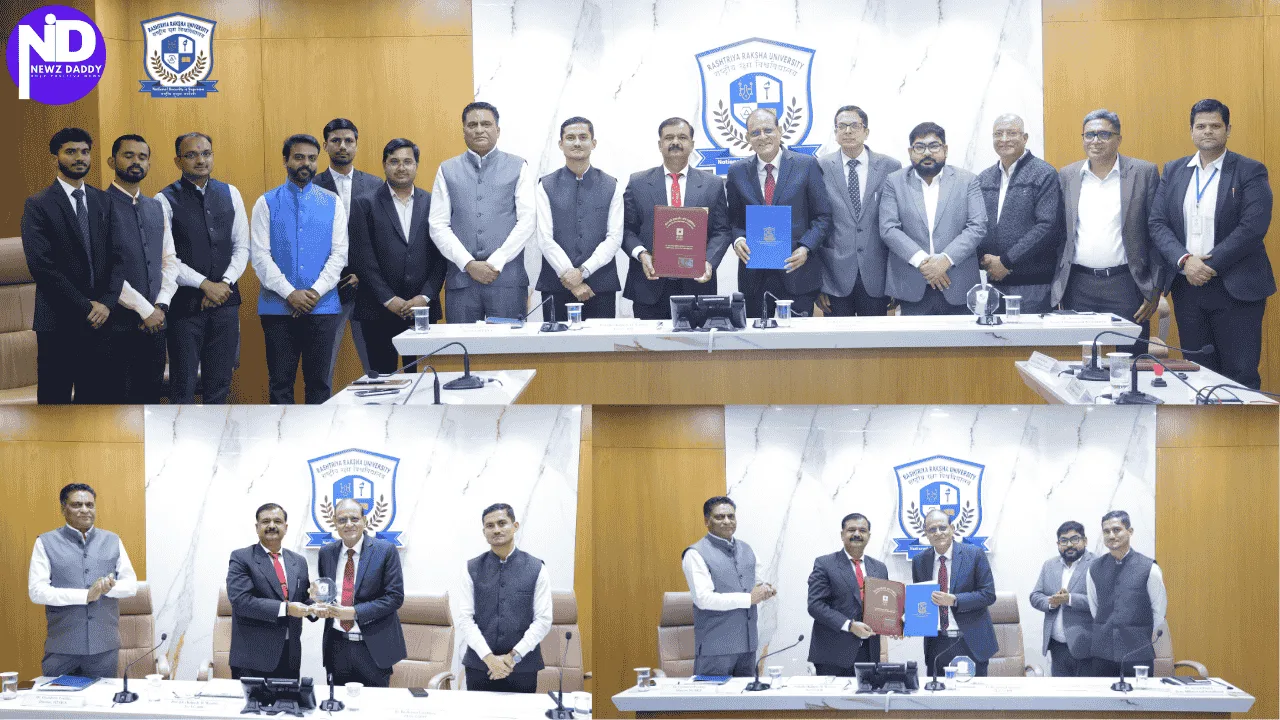
Rashtriya Raksha University (RRU) and the Centre for Development of Telematics (C-DOT) have signed a Memorandum of Understanding (MoU) to promote collaboration in telecommunications research, cybersecurity, quantum technologies, and secure communication systems for national security.
The MoU was signed at the RRU campus in Gandhinagar in the presence of Dr. Raj Kumar Upadhyay, CEO, C-DOT; Prof. (Dr.) Kalpesh H. Wandra, Pro Vice-Chancellor, RRU; Mr Avinash Kharel, Dean – Affiliations and Accreditations, RRU; and Dr Chandresh Parekh, Director – SITAICS, along with senior officials from both institutions.
Rashtriya Raksha University, an Institution of National Importance under the Ministry of Home Affairs, contributes academic expertise, research capabilities, and training leadership in internal security, cyber defence, and technology-driven security solutions. C-DOT, the Government of India’s telecom R&D centre, continues to advance the vision of Atmanirbhar Bharat through indigenous telecom innovation, including the 5G stack, AI-enabled cybersecurity platforms such as TriNetra, and disaster communication technologies.
The collaboration will enable joint research and development, technology testing and validation, capacity-building programmes, student training initiatives, and innovation support in emerging technology domains relevant to national security and critical digital infrastructure.
This partnership reflects the shared commitment of RRU and C-DOT to strengthen India’s secure communication ecosystem through academia–government research collaboration and indigenous technology development.
Dr Rajkumar Upadhyay, CEO, C-DOT, said, “This MoU marks a significant step towards self-reliant innovation in telecom and cybersecurity. C-DOT is proud to collaborate with RRU to deploy TRINETRA and advance mission-critical technologies, empowering the next generation of innovators and defenders. The partnership underscores our commitment to national missions like Digital India, Atmanirbhar Bharat, and cybersecurity resilience”.
Prof. (Dr.) Kalpesh H. Wandra, Pro Vice-Chancellor, Rashtriya Raksha University, Said “We are entering a new era of agentic AI and autonomous cyber threats capable of identifying network vulnerabilities within seconds. With the expansion of 5G and the emergence of 6G technologies, the digital attack surface is expanding rapidly, making indigenous innovation and collaborative research essential for national security.”
India’s telecom journey has changed fast over the past decade. The country now has one of the largest digital user bases in the world. Millions of people use mobile internet every day for banking, education and public services. With the rollout of 5G across major cities, data speeds have improved sharply. But faster networks also bring new risks. Hackers now use smart tools powered by artificial intelligence. These tools can scan systems and find weak spots in seconds. This is why research in cyber defence has become urgent.
C-DOT has played a key role in India’s telecom story since the 1980s. It was created to develop home-grown telecom technology. In earlier years, it helped build rural exchanges that connected remote villages. Today, it works on advanced systems such as 5G technology. Building a 5G stack within India reduces dependence on foreign vendors. It also gives the country better control over data security. Experts say that strong domestic telecom systems are vital for defence forces, police networks and emergency services.
One of C-DOT’s new platforms, TriNetra, uses artificial intelligence to detect cyber threats in real time. Such platforms monitor network traffic and raise alerts if something looks unusual. With cyber attacks growing in number, early detection can prevent major damage. According to global cyber reports, attacks on critical infrastructure such as power grids and telecom networks have increased in recent years. This makes secure communication systems not just a technical need, but a national priority.
Rashtriya Raksha University has a special role in this space. As an Institution of National Importance, it focuses on training officers and experts in internal security and cyber defence. The university runs specialised courses in digital forensics, cyber law and intelligence studies. Students are trained to handle real-life security challenges. By working closely with a telecom research body like C-DOT, students can now gain hands-on experience with live technologies. This helps bridge the gap between classroom learning and field application.
Quantum technology is another area mentioned in the MoU. Around the world, scientists are studying quantum communication because it promises highly secure data transfer. Quantum key distribution, for example, can make it nearly impossible for hackers to intercept messages without being detected. India has already started investing in a National Quantum Mission. Partnerships like this one can help bring academic research and practical deployment together.
Disaster communication is equally important. During floods, earthquakes or cyclones, regular networks often fail. Special telecom systems are needed to restore connectivity quickly. C-DOT has worked on portable communication units that can be deployed in affected areas. Reliable communication during disasters can save lives by helping rescue teams coordinate better.
The mention of 6G shows that both institutions are looking ahead. While 5G is still expanding, research on 6G has already begun globally. Experts believe 6G could offer even faster speeds and connect smart cities, autonomous vehicles and advanced defence systems. However, a larger digital network also means a larger attack surface. This is why secure design from the start is essential.
By bringing together academic strength and government-backed research, this alliance aims to create skilled professionals and strong technology at the same time. In a world where digital threats cross borders easily, building self-reliant and secure systems at home has become a clear national goal.
Must Read:
Rashtriya Raksha University Earns Powerful CAS Recognition
Rashtriya Raksha University MoU with SSB Supaul Transforms Training