


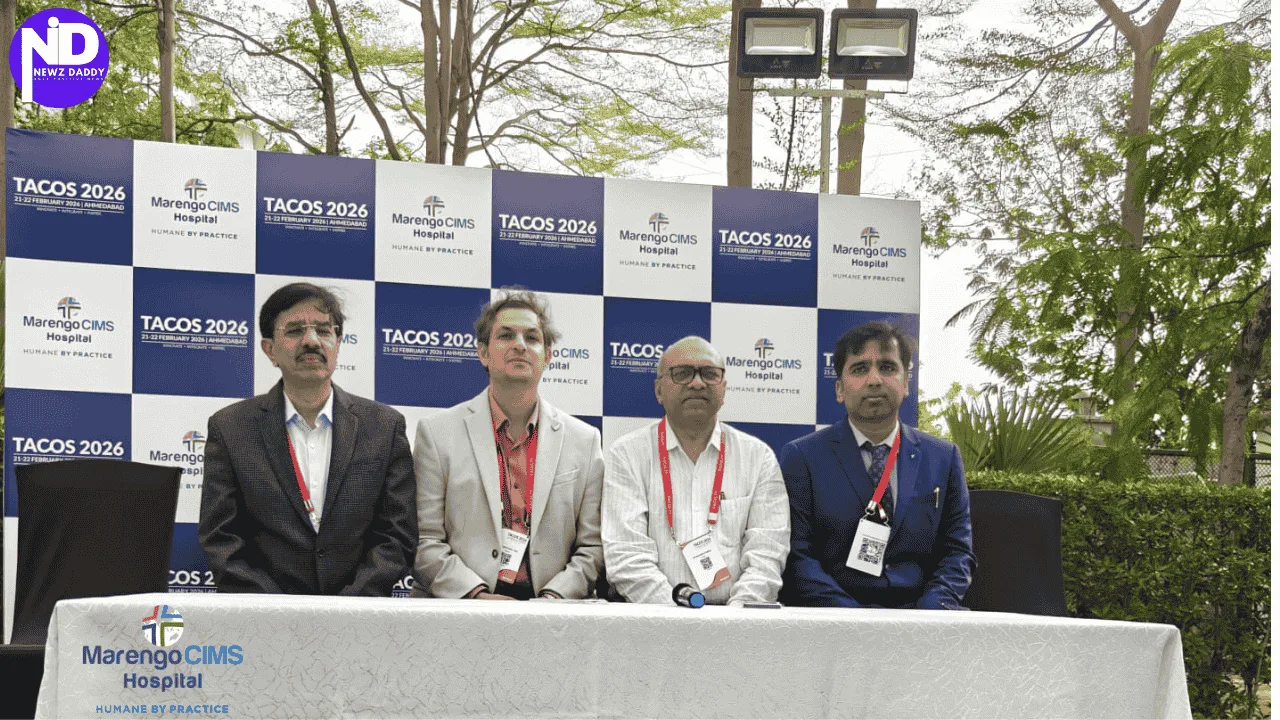
TACOS 2026 Sparks Powerful Hope in Cancer Care India
Marengo CIMS Hospital Successfully Organises TACOS 2026, a Pioneering Initiative for Excellence in The Field of Thoracic & Colorectal Oncology
The Department of Oncoscience at Marengo CIMS Hospital successfully hosted TACOS 2026 (Thoracic and Colorectal Oncology Summit) on 21st–22nd February 2026, bringing together leading oncologists, surgeons, academicians, and healthcare professionals from across the country for a focused academic exchange in thoracic and colorectal cancers.
Thoracic cancers mainly include lung and oesophageal cancers, while colorectal cancer affects the colon or rectum. These cancers are among the most common in India and the world. According to global cancer studies, lung cancer is one of the leading causes of cancer deaths because it is often found late. Colorectal cancer is also rising in India, especially in cities, due to lifestyle changes, poor diet, and lack of screening. Experts say early detection can save many lives, but awareness is still low among the public.
Organised for the first time, TACOS 2026 created a high-impact scientific platform dedicated exclusively to thoracic and colorectal oncology, two rapidly evolving domains in cancer care. The summit witnessed participation from eminent experts across surgical oncology, medical oncology, radiation oncology, pulmonology, and gastro-oncology, reflecting strong national and regional representation.
Cancer care today needs many specialists working together. Surgical oncologists remove tumours. Medical oncologists give chemotherapy and newer treatments like targeted therapy and immunotherapy. Radiation oncologists use high-energy rays to destroy cancer cells. Pulmonologists help manage lung-related problems, and gastroenterologists focus on digestive cancers. This team approach is now seen as the best way to treat cancer because each expert brings different skills. Studies show patients treated by such teams often have better survival and recovery.
The scientific programme featured comprehensive, evidence-based discussions on the latest guidelines, landmark trials, and evolving standards of care. Engaging panel discussions and debates addressed key contemporary controversies, including surgery versus SBRT, minimally invasive approaches, and multimodality treatment strategies, encouraging dynamic academic exchange.
Medical science keeps changing fast. SBRT, or Stereotactic Body Radiotherapy, is a modern treatment that gives very precise radiation to tumours. It is especially useful for lung cancer patients who cannot undergo surgery. Minimally invasive surgery is another major step forward. It uses small cuts instead of large ones. This means less pain, faster recovery, and shorter hospital stays. Multimodality treatment, where surgery, chemotherapy, and radiation are used together, has helped improve survival in many cancer patients.
A major highlight of the summit was the live case-based discussions, where real-world clinical scenarios were deliberated with expert insights and practical decision-making approaches. The conference also actively engaged young oncologists through quiz competitions, abstract presentations, and interactive sessions, fostering the next generation of oncology professionals.
Case-based learning is now very important in medical education. Instead of only reading books, doctors learn from real patient cases. This helps them understand how to make decisions in difficult situations. Young doctors also benefit from presenting research. This builds confidence and improves knowledge. India needs more trained cancer specialists because the number of cancer patients is increasing every year.
Emphasising a multidisciplinary approach, TACOS 2026 reinforced the importance of collaborative, team-based cancer care and precision oncology. The summit successfully bridged the gap between emerging research and its practical clinical application, with a clear focus on improving patient outcomes in lung, oesophageal, and colorectal cancers.
Precision oncology is a new way of treating cancer. It studies the patient’s genes and tumour type to give the best treatment. This makes treatment more effective and reduces side effects. Immunotherapy is one such modern treatment. It helps the body’s own immune system fight cancer. Many patients with advanced lung cancer are now living longer because of these new therapies.
The event served as a vital academic forum for knowledge sharing, professional networking, and fostering meaningful collaborations in oncology practice.
Such conferences also help doctors learn from each other. When doctors share their experience, it improves overall healthcare. Patients benefit because doctors bring back new ideas and treatments to their hospitals. This helps improve cancer care in cities like Ahmedabad and also in smaller towns.
Dr Abhishek Jain, Conference Director, stated that TACOS 2026 was envisioned as a dedicated academic platform to advance thoracic and colorectal oncology through meaningful dialogue, evidence-based discussions, and multidisciplinary collaboration, adding that the summit successfully translated the latest research and innovation into practical strategies aimed at improving patient outcomes.
Experts say research is the backbone of cancer treatment. Clinical trials help doctors find better treatments. Many new medicines used today were once part of such trials. India is now playing an important role in global cancer research.
Dr. Nishant Sanghavi, Conference Director, stated that TACOS 2026 marked a significant step towards uniting national and international expertise in colorectal oncology, emphasising that the platform enabled meaningful scientific exchange and collaborative learning while contributing towards improving patient outcomes across India and strengthening cancer care standards.
Colorectal cancer can often be prevented if found early. Simple tests, such as a colonoscopy, can detect early changes. Doctors advise people above 45, especially those with a family history, to undergo screening. A healthy diet, exercise, and avoiding smoking also reduce risk.
Dr Manish Gandhi, Surgical Gastroenterologist, stated that TACOS 2026 is more than a conference; it is a convergence of vision, expertise, and innovation. By bringing together leaders across disciplines, the aim is to transform cutting-edge science into real-world impact, foster meaningful collaboration, and redefine the future of thoracic and colorectal cancer care with a shared commitment to better patient outcomes.
Surgical care has improved greatly in recent years. Robotic surgery is now used in some complex cancer cases. It allows surgeons to operate with high precision. This improves safety and recovery.
Mr Mayur Dave, Facility Director, MCIMS, stated that as a healthcare service provider across multiple states, cities, and overseas locations, the organisation is committed to supporting advanced treatment protocols and super speciality clinical excellence through collaborative clinical platforms and creating an ecosystem to share knowledge among clinicians as a continuous process. He also thanked the media for spreading awareness.
Awareness remains the strongest weapon against cancer. Doctors say many lives can be saved if people seek medical help early and follow regular screening. Events like TACOS 2026 play an important role in improving knowledge among doctors and spreading hope among patients.