


Acharya Bharatmuni Sanskrit Samaroh Inspires Pride
Grand Opening of Two-Day ‘Akhil Bharatiya Acharya Bharatmuni Sanskrit Samaroh’ at Dr Babasaheb Ambedkar Open University
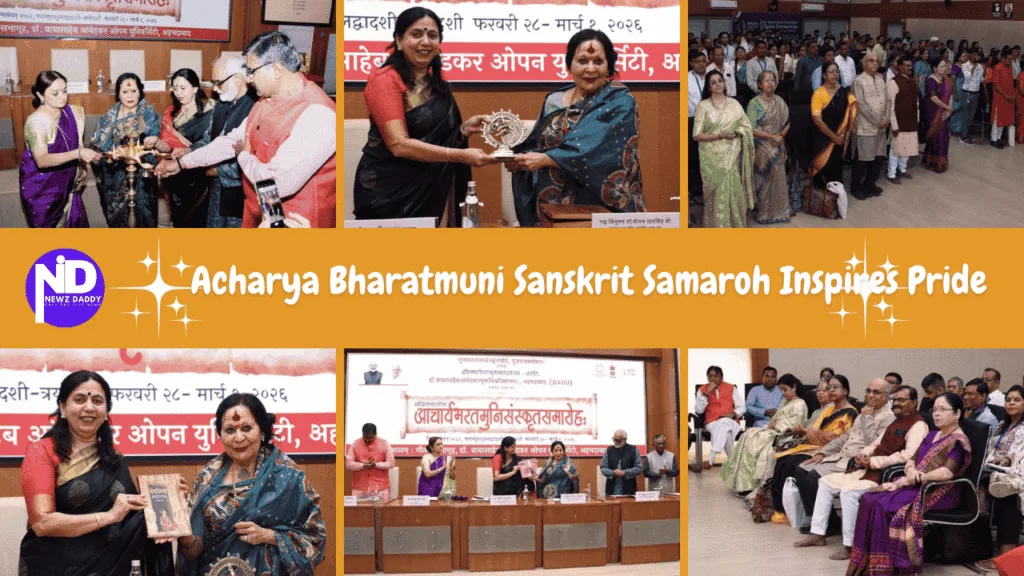
The two-day “Akhil Bharatiya Acharya Bharatmuni Sanskrit Samaroh” began today with great pride at the ‘Jyotirmay Campus’ of Dr Babasaheb Ambedkar Open University (BAOU), Ahmedabad. The event is organised with the support of the Gujarat State Sanskrit Board, Government of Gujarat. The Samaroh is being held on 28 February and 1 March, 2026.
Dr Babasaheb Ambedkar Open University is one of Gujarat’s leading open universities. It was set up in 1994 and is named after Dr B. R. Ambedkar, who believed education is the key to equality. The University gives learning chances to students who cannot attend regular colleges. Over the years, it has also taken many steps to promote Indian culture, Sanskrit learning, and traditional knowledge. The Jyotirmay Campus in Ahmedabad has become an important place for academic and cultural events.
The Samaroh is named after Acharya Bharatmuni, who is known as the author of the ancient book Natyashastra. This book was written more than 2,000 years ago and is one of the most important texts on Indian theatre, dance, and music. It explains acting, expressions, body movements, music, stage design, and emotions. Even today, many classical dances like Bharatanatyam, Kathak, and Odissi follow the ideas of Natyashastra. Because of this, Bharatmuni is respected as the father of Indian performing arts.
On the first day, during the opening session, Padma Vibhushan Dr Sonal Mansingh (famous dancer and scholar of Natyashastra), Dr Sandhya Purecha (Chairperson, Sangeet Natak Akademi), and Dr Sachchidanand Joshi (Member Secretary, Indira Gandhi National Centre for the Arts, Delhi) were present with honour. In the presence of Gujarat State Sanskrit Board Chairman Shri Himanshu Paliwal and the University Vice Chancellor Prof. (Dr) Ami Upadhyay, the guests formally opened the programme by lighting the lamp.
Lighting the lamp is an old Indian tradition. It stands for the victory of light over darkness and knowledge over ignorance. It is done at the start of important cultural and academic programmes. This act shows respect for learning and wisdom.
Padma Vibhushan Dr Sonal Mansingh (Chief Guest) expressed pride in Indian art and mother tongue. She said that the Guru has a very important place in the Natyashastra. She said art stays alive only when it expresses itself according to the country, time, and situation.
Dr Sonal Mansingh is one of India’s most respected classical dancers. She is known for her work in Bharatanatyam and Odissi dance. She has spent many years teaching and protecting Indian dance traditions. She has received the Padma Vibhushan, which is India’s second-highest civilian award. Her work has helped spread Indian culture across the world.
While presiding over the Samaroh, Vice Chancellor Prof. (Dr) Ami Upadhyay shared information about the efforts made by the University to promote Sanskrit and Indian art traditions.
Sanskrit is one of the oldest languages in the world. Many great Indian books like the Vedas, Upanishads, Ramayana, and Mahabharata are written in Sanskrit. It is often called the mother of many Indian languages. Even today, Sanskrit words are used in Hindi, Gujarati, and many other languages. Events like this Samaroh help keep the language alive among young students.
Shri Himanshu Paliwal (Chairman, Gujarat State Sanskrit Board) said that the Board is committed to reviving Sanskrit and theatre traditions in Gujarat. He said the Board will take full responsibility to ensure that scholars do not face financial problems in research or work.
The Gujarat State Sanskrit Board works to promote Sanskrit education in schools and colleges. It supports students, teachers, and researchers. It also organises seminars, workshops, and cultural programmes. Such support is important because research in ancient subjects needs time and financial help.
Dr Sachchidanand Joshi stressed the need to protect and edit Indian manuscripts. He also asked people to stay aware of their cultural heritage.
India has lakhs of old manuscripts written on palm leaves, paper, and cloth. Many of them are hundreds of years old. These manuscripts contain knowledge about science, medicine, arts, maths, and philosophy. Organisations like the Indira Gandhi National Centre for the Arts work to save and study these valuable records so that future generations can learn from them.
Dr Sandhya Purecha said that Natyashastra is a path that makes life meaningful. She appreciated the efforts to promote Natyashastra education under the New Education Policy.
The Sangeet Natak Akademi, where she serves as Chairperson, is India’s national academy for music, dance, and drama. It was set up in 1953. It works to protect and promote India’s performing arts. It also gives awards to artists and supports training and research.
At the beginning of the programme, Prof. Yogendra Parekh spoke in the welcome speech about the University’s academic and creative activities.
At the end, Dr Vinodkumar Majirana gave the vote of thanks. The entire session was smoothly conducted in Sanskrit by Sanskrit Department teacher Dr Payal Chavda. Speaking in Sanskrit in modern times is special and shows deep knowledge of the language. It also inspires students to learn and use Sanskrit.
The presence of scholars like Dr Mahesh Champaklal and Dr Girish Thakar was inspiring. Such scholars have spent many years studying Indian arts, theatre, and literature. Their experience helps guide young learners.
After the opening session, Shri Krishnendu Saha gave a wonderful Odissi dance performance of Ganesh Vandana and Dashavatar.
Odissi is one of India’s oldest classical dances and comes from Odisha. It is known for its graceful movements, hand gestures, and expressions. Ganesh Vandana is a prayer to Lord Ganesha, who is worshipped at the start of new work. Dashavatar shows the ten forms of Lord Vishnu. These dance performances are not just entertainment. They are also a way to share stories, culture, and devotion.
The grand opening of this Samaroh shows the strong effort to protect and promote Sanskrit and Indian performing arts. Such events help connect the past with the present and inspire the future generation to respect and continue India’s rich cultural heritage.
Must Read:
ASPIRE 2026 Sparks Inspiring Energy and Unity on Campus
Gujarat Law Society Centenary Inspires the Future of Gujarat