


Adani Green Energy Growth Breaks Records in India
Adani Green Energy’s Growth Powers India’s Green Shift with Confidence
Adani Green Energy Ltd (AGEL) has reported a strong year, with its biggest ever greenfield capacity addition of 5.1 GW and a 23% year-on-year rise in core EBITDA to Rs 10,865 crore. This performance comes at a time when India is pushing hard to increase its renewable energy share to meet climate goals and reduce dependence on fossil fuels.

Across India, demand for clean electricity is rising fast. The government aims for 500 GW of non-fossil fuel capacity by 2030. In this context, AGEL’s total operational capacity reaching 19.3 GW, a 35% jump, shows how large private players are helping close the gap. Industry reports from energy think tanks often note that utility-scale solar and wind projects are now cheaper than new coal plants, which is one key reason behind such rapid expansion.
The company’s greenfield capacity addition of 5.1 GW, compared to 3.3 GW in FY25, reflects a sharp rise in project execution. Experts often point out that land availability, grid connection, and financing remain major hurdles in India. So, achieving such growth suggests strong project planning and supply chain control. The Khavda region in Gujarat, where a large part of this capacity has been added, is widely seen as one of the best renewable energy zones due to high solar radiation and strong wind patterns.
AGEL’s ESG performance also stands out. Securing a CareEdge ESG 1+ rating with a score of 87.3 places it among the top-rated companies in India. Global investors are increasingly using ESG scores to decide where to invest. Reports from financial institutions show that companies with strong ESG ratings often get easier access to global capital at better rates. The JCR BBB+/Stable rating, matching India’s sovereign rating, also signals confidence in the company’s financial health.
The company’s energy sales rose by 34% to 37,567 million units. This growth reflects both higher capacity and improved plant performance. Renewable energy experts often highlight that better forecasting tools and digital monitoring have improved output reliability. AGEL’s revenue from power supply rose 22% to Rs 11,602 crore, while EBITDA grew 23%, showing strong cost control.
An EBITDA margin of 91% is notably high. In the renewable energy sector, margins tend to be strong once projects are operational because fuel costs are almost zero. Analysts often say that the key lies in managing initial capital costs and ensuring high plant utilisation. AGEL’s use of advanced technologies and data-driven operations seems to be playing a role here.
Cash profit rising to Rs 5,399 crore shows steady financial strength. This is important because renewable projects require heavy upfront investment. A stable cash flow helps companies fund future expansion without relying too much on debt.
The installation of 1,376 MWh of battery energy storage at Khavda is another major step. Battery storage is becoming critical as renewable energy is not constant. Solar works during the day, and wind varies. Energy storage helps balance supply and demand. Globally, countries like the US and China are investing heavily in large-scale battery systems. India is also pushing for storage through policy support and incentives.
Mr. Sagar Adani’s statement highlights how the company sees itself not just as a power producer but as part of a larger energy system. The mention of pumped hydro storage in Andhra Pradesh fits into this wider approach. Pumped hydro is often called a “natural battery” and is considered one of the most reliable storage solutions for large-scale use.
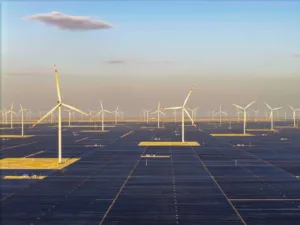
The Khavda project deserves special attention. Spread over 538 square kilometres, it is one of the largest renewable energy developments in the world. For comparison, it is several times larger than many major cities. Large-scale projects like this help reduce costs through scale and improve efficiency. The use of robotic solar panel installation and waterless cleaning shows how automation is becoming common in modern renewable plants.
The deployment of bifacial solar panels, which capture sunlight from both sides, is another advanced feature. Industry studies show that such panels can increase output by up to 10–15%, depending on conditions. The use of 5.2 MW wind turbines also reflects a shift towards larger, more powerful machines that generate more electricity per unit.
AGEL’s operational strategy includes real-time monitoring through its Energy Network Operation Centre. This approach is now common among leading global renewable firms. It allows quick response to faults and helps maintain high plant availability.
Generating 106% of the committed electricity under PPAs shows strong reliability. Power buyers, including state utilities, prefer suppliers who can exceed commitments, as it helps them manage demand more effectively.
The company’s ESG recognitions, including top global rankings and awards, align with a broader trend where renewable energy firms are being closely watched for sustainability practices beyond just clean power generation. Water use, land impact, and community engagement are now key areas of focus.
Overall, AGEL’s FY26 performance reflects both strong execution and favourable industry trends. As India continues its clean energy transition, companies that can scale quickly, manage costs, and adopt new technologies are likely to lead the sector.