


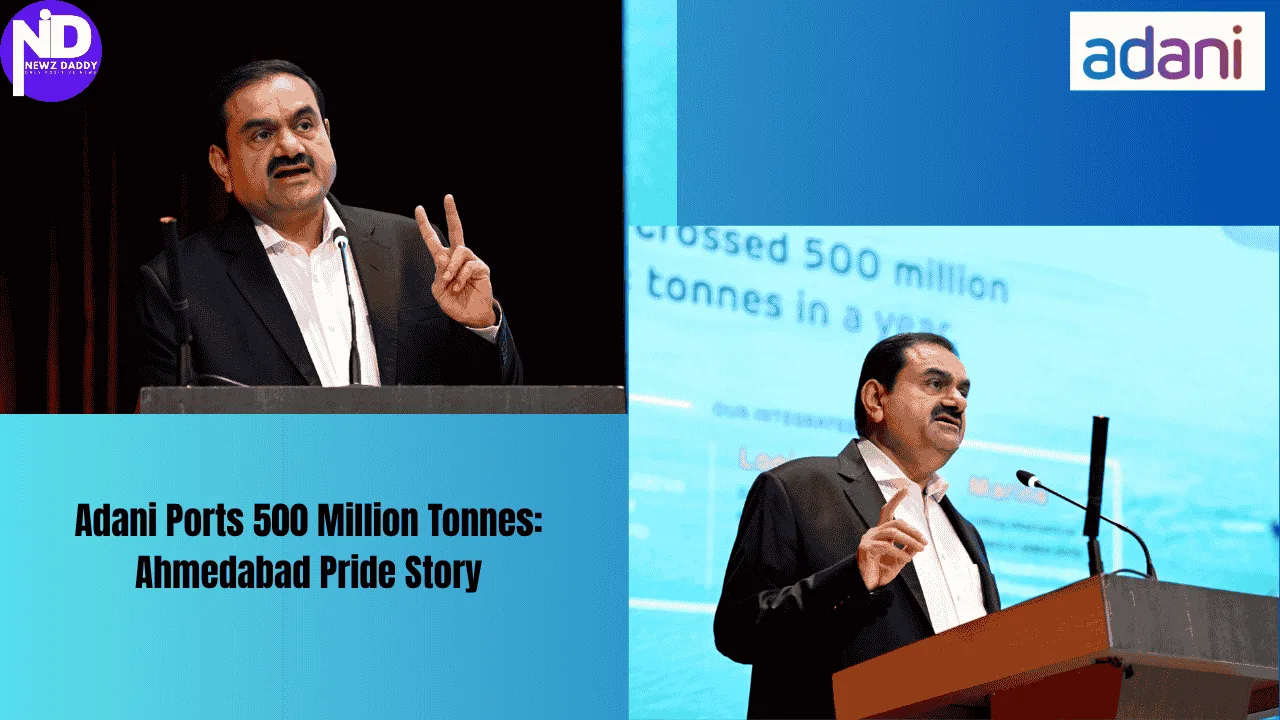
Adani Ports 500 Million Tonnes: Ahmedabad Pride Story
Chairman Gautam Adani’s Address
Commemorating APSEZ’s 500 Million Tonnes Milestone
03 April 2026, Adani Corporate House, Ahmedabad
Namaskar.
It is often said that an explorer is shaped by the path he undertakes, just as the path awaits an explorer worthy of it.
I have long believed that there are no final destinations in the life of an explorer. There are only moments of pause, when you look back with wonder at the distance you have travelled, and then find within yourself the strength to begin again.
Today is one such pause, a rare moment to look back, to absorb the magnitude of what we have built and to reflect on the extraordinary achievement of APSEZ crossing 500 million tonnes of cargo.
But achievements of this scale are never just about numbers. They are about legacy. Numbers measure performance. Legacy measures something deeper. It measures the audacity of vision, the endurance of belief, and the courage to target what most would not even dare imagine.
In every business across the Adani Group, we hit targets. We break records. We redefine industries. But today is different, because the APSEZ journey, for me, is deeply
personal. And, as I look back at the long road behind us, I ask myself the inevitable question – how did we come this far?
Great organisations are built twice. First, in the mind – through hope, through self- belief, through conviction – and second, in the real world, where dreams are
constructed, moment by moment, brick by brick, hand by hand.
Therefore, milestones such as the one we celebrate today can never be measured in business terms alone.
They are about our people – about those who chose to believe in me, to walk with me and to build with me.
They are about our memories – of struggles, of victories, of setbacks – all of which came to define the Adani spirit.
They are about our stories hidden in years of sacrifice. These never appeared in the news headlines, but for me, these were the true headlines of the Adani saga.
Mundra gave our vision its first physical form. It is here that our belief became reality, courage became commitment, and conviction became concrete.
For me, as the founder of this Group, this is a deeply humbling moment – because,
somewhere on the journey to 500 million tonnes, this milestone stopped being about any one individual. It became a tribute to all of you – the men and women of APSEZ, who turned a bold dream and a daring journey into a living legacy.
I still clearly remember many trips, driving overnight in an old Contessa car, from
Ahmedabad to Mundra, with Malay beside me. There were really no roads to Mundra in the 1990s, and even I am amazed that we did it. Because no one in their right mind would have driven through the night to a place that, at the time, looked less like the
future of ports and Indian logistics and more like a giant, endless marshland at the very edge of western India.
And yet, perhaps that was our greatest advantage. We were in our late twenties, and our optimism had not yet learned the discipline of risk. At that age, you do not fully understand the meaning of failure. And sometimes, that is exactly what gives you the courage to attempt what others would dismiss as impossible.
वो लम्बे रास्ते, वो रातें, वो यार का साथ,
अंधेरों में भी थमी नहीं, हमारे सपनों की बात।
थक कर रुकना तो – हमारी फितरत में न था,
बस दिल में एक ही फ़िक्र थी – मुकद्दर बनना था।
In those moments of doubt, Malay would do what no management consultant or
motivational speaker could ever have done better. He would sing the title song from one of the greatest films of my generation.
रोते हुए आते हैं सब – हँसता हुआ जो जाएगा,
वो मुकद्दर का सिकंदर – जानेमन कहलाएगा!
Somehow, in the middle of that vast emptiness, the philosophy of a song celebrating Alexander the Great became our own private anthem. And perhaps, without even fully realising it, this gave voice to something deep within us – the stubborn belief that if destiny does not come to you on its own, then you must go out and build it yourself.
Because the truth about all great institutions ever built is this: You do not begin because the future is fully visible. You begin because your conviction is stronger than your doubt.
That, my friends, is the story of Mundra.
Mundra was the spark. This spark became the nucleus of APSEZ. APSEZ became the nucleus of the Adani Group. And the Adani Group became the nucleus for Indian
infrastructure.
From the shores of India, the idea then scaled to Hazira, to Dahej, to Kandla, to Dhamra, to Krishnapatnam, to Kattupalli, to Gangavaram, to Ennore, to Karaikal, to Vizhinjam – and then beyond India’s shores to Australia, Israel, Sri Lanka, Tanzania.
What we built is not a collection of assets. It is a living network of 19 ports and terminals. One system. One operating philosophy. One overriding purpose of Nation Building.
Like the nervous system of a rising nation, each node strengthens the next, each
connection multiplies the value of another, and each expansion makes the whole system more resilient, more intelligent, and more alive.
The greatest ability we developed was not how to build ports. It was how to build flow.
Flow of cargo. Flow of connectivity. Flow of industry. Flow of confidence. Flow of national momentum.
But, somewhere along this journey, another realisation became just as important for me. As the network expanded, it became clear that this was no longer about one founder, one command centre or one individual’s force of will. No institution of such scale can be built this way. No network this vast can run on central instruction alone.
The real magic was happening elsewhere. It was happening on the berth, in the yard, on the rail siding, in the marine channel – it was all happening at the last mile. Year after year. Month after month. Day after day. Shift after shift. Hour after hour. That is how this institution was actually being built.
Over time, along with our expansion, one truth became even more evident. Great infrastructure companies are not managed from a distant centre. It is brought alive by people closest to reality, by people who see the problem before the dashboard does, by people who act before delay becomes disruption, by people whose gut and experience keep systems functioning.
Ultimately, it is human effort at the last mile that allows infrastructure to function.
That is why our 500 million tonnes milestone must be spoken in the language of dignity for those who execute the last mile:
The crane operators move with precision under the constant pressures of productivity and safety.
The marine teams who keep vessels, tides, channels and schedules aligned.
The planners and logistics teams who manage complexity across a hundred moving variables.
The maintenance teams whose expertise prevents failure before failure ever appears.
और सबसे बढ़कर, उन श्रमिक भाइयों को – जो अपने घर से हजारों किलोमीटर दूर आकर काम करते हैं –
जो महीनों तक साइट के कैंप में रहकर – अपने बच्चों का बचपन दूर से ही गुजरते देखते हैं –
लेकिन हर महीने घर पैसे भेजकर – अपने परिवार के चेहरे पर मुस्कान बनाए रखते हैं।
Let us never forget that this person is not some invisible line item buried in a budget. He is part of the foundation on which all of this stands. It is his labour, his discipline and his sacrifice that make today’s celebration possible and give us the confidence to build for tomorrow.
अभी तो बस ज़मीन नापी है – हौसलों का आसमान बाकी है
तुम्हारी ही बाजुओं के दम पर – कई और बड़े इम्तिहान बाकी हैं।
ये 500 मिलियन टन की सिद्धि – अपने श्रमिकों के नाम करता हूँ।
तुम्हारे पसीने की हर बूंद को – झुककर प्रणाम करता हूं।
If people closest to reality are the ones who create the magic, then our duty is to build an institution worthy of them – an institution that pushes ownership to the point of action, an institution where bureaucracy does not suffocate initiative, an institution
where respect is a daily operating principle.
That is how our systems will scale – not by increasing control from the top but by increasing judgment, capability and ownership close to the ground.
As many of you know, across all our businesses, we are redesigning the way we
organise ourselves. We are moving towards a three-layer structure to flatten hierarchy and empower the frontline.
Let me clearly say that this is not about cost reduction. It is about empowerment. The organisations that will win in the future will not be the ones with the tallest hierarchies. They will be the ones with the fastest reflexes – and that can only happen when decision-making moves closer to the point of action.
That is how low-friction organisations are built – not by forcing compliance across multiple layers, but by creating a culture of empowerment where accountability is embraced with pride.
The same philosophy must extend beyond our people to our partners – because, as we flatten our organisation, we must deepen the quality of the ecosystems around us and treat our partners with the same dignity that we treat our own teams.
In the long run, the strongest enterprises are never built by weakening their partners.
When our partners are financially healthy, they bring commitment, resilience and
confidence into the system. They invest better. They execute better. They stand stronger in difficult times. When that happens, we create a chain of mutual dependence that
strengthens everyone.
This must become our Group’s new operating philosophy – a philosophy where velocity comes from empowerment, stability comes from dignity, and long-term strength comes from relationships of mutual prosperity.
APSEZ is already showing the way. Under the leadership of Karan and Ashwani Gupta, this transformation has begun to take real shape. That should make all of us proud, because it shows that APSEZ is not just performing in the present – it is preparing to lead in the future.
Talking about the future, India is entering an era in which logistics capacity will become its strategic power. That is why our ambition for the next five years is not just bold – it is essential.
Keep in mind that it took us 16 years to get to our first 100 million tonnes. The second 100 million came in five years. The third in just three years. And the fourth and fifth 100 million tonnes were added in only two years each.
What this shows is that, once vision and execution begin to align, momentum starts to compound. That compounding is now defining our journey – a journey where we are firmly on track to reach a staggering one billion tonnes by 2030.
Our logistics operations and marine services will grow even faster, expanding fivefold over the same period. This is ambition at an extraordinary scale – and no one is better equipped than us to make it real.
As I close, let me return to where I began. I said at the start that an explorer has no final destination – only rare moments of pause when he looks back in wonder at how far he has come and then finds within himself the conviction and drive to begin again.
So, let this evening not be remembered only as the moment we celebrated 500 million tonnes. Let it be remembered as the moment we paused to renew our belief and set
our sights on the next horizon. One billion tonnes by 2030! That is now our mission.
हमने मुंद्रा की लहरों से सीखा… किनारों पर ठहरना क्या,
निकल पड़े उस राह पर… जहाँ लक्ष्य है आसमाँ।
रुकना हमारी फ़ितरत नहीं… उठना हमारी पहचान है,
एक शिखर के बाद – दूसरे की तलाश… यही अदाणी की उड़ान है।
And that is who we are.
Arrival is never the end. It is the signal to begin the journey again.
The best of APSEZ is still ahead of us.
The best of the Adani Group is still ahead of us.
And the best of India is still ahead of her.
Thank you. Jai Hind.