


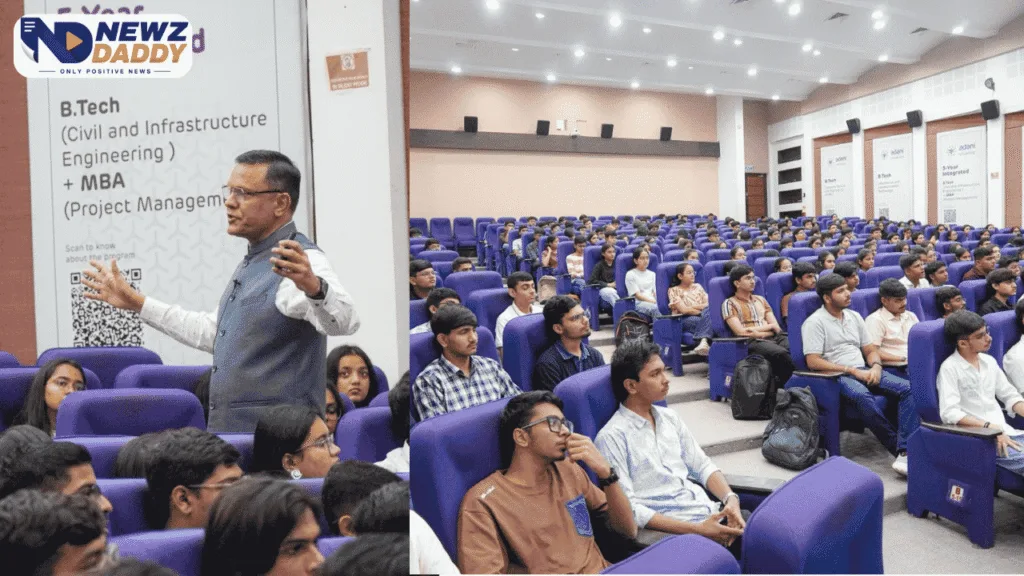
Adani University Induction Programme 2026 Prepares Future Engineers
Adani University Induction Programme Introduces New Engineering Students to Academic and Industry Life
Adani University has completed a three-week induction programme for students joining its Bachelor of Technology (B.Tech.) and Integrated Programmes, giving new entrants an early introduction to university studies, engineering careers and industry expectations before the start of the academic year.
The programme ran from 13 July to 31 July and combined online learning with activities on the university campus. It included foundation classes, lectures by academics and industry professionals, mentoring sessions and orientation programmes designed to help students understand academic systems, student support services and campus life.
Engineering colleges across India now place greater focus on structured induction programmes. The All India Council for Technical Education (AICTE) has encouraged higher education institutions to organise student induction activities that help first-year students adjust to university life, strengthen communication skills and understand professional ethics before beginning regular coursework.
According to Adani University, this year’s induction was organised in three stages. Students first completed an online Bridge Course covering Mathematics, Physics and Communication Skills. The university then held a week of online lectures led by experts from academic institutions and industry before bringing students to campus for practical sessions and interactions.
Speaking about the programme, Prof. (Dr.) Dhaval Pujara, Provost, Adani University, said:
“University is where knowledge begins to find real-world application. Through this induction programme, students were introduced to new ideas, emerging technologies and the importance of learning beyond the classroom. Our goal is to help them develop into engineers who think critically, innovate responsibly and use their knowledge to solve real-world challenges.”
The academic sessions covered subjects that continue to shape engineering education in India. These included artificial intelligence, renewable energy, engineering innovation, research and emerging technologies.
Among the speakers were Prof. Kavi Arya of IIT Bombay, Dr Soukat Kumar Das of NIT Rourkela, Dr Rishabh Abhinav of PSE2 Consulting, UK, Prof. Nigam from Pandit Deendayal Energy University, and Dr Kaustav Bakshi of IIT Indore. Their lectures introduced students to developments in engineering research and to the growing role of technology in solving practical problems.
India’s engineering sector has been changing rapidly during the past decade. Artificial intelligence, clean energy systems, automation, data science and advanced manufacturing have become major areas of study. Universities are responding by updating their curriculum and exposing students to these fields at an earlier stage of their education.
The campus phase of the induction programme brought students face to face with senior industry leaders who discussed careers, leadership and professional development.
Among those addressing students were Mr Arun Bansal, Chief Executive Officer of Adani Airport Holdings Limited (AAHL), Mr Jigish Doshi, Chairman of Vishakha Group, and Mr Ajay Kumar Tomar, Joint President and Group Head, Cadre Excellence and Leadership Development, Adani Group.
Their sessions focused on leadership, innovation, resilience and the value of continuous learning in a workplace that continues to change because of new technologies and evolving business needs.
Students also took part in mentoring sessions and team-building activities while meeting members of the university’s leadership. Such programmes are increasingly seen as important because many students enter university directly after school and often need support in adapting to a more independent academic environment.
The orientation programme introduced students to the university’s academic framework, examination process, research facilities, digital learning platforms, competency development initiatives and student support services.
Separate sessions explained the institution’s anti-ragging measures, the Prevention of Sexual Harassment (POSH) policy, and responsible use of social media. These topics have become a standard part of university orientation programmes across India as higher education institutions seek to create safer and more inclusive campuses.
The inclusion of anti-ragging awareness follows long-standing national efforts to prevent harassment on campuses. Universities are expected to implement strict anti-ragging regulations, while POSH guidelines aim to create a safe environment for students, faculty members and staff.
Adani University, based in Ahmedabad, Gujarat, offers programmes in engineering, technology, infrastructure, management and related disciplines. The institution has expanded its academic activities in recent years while building links with industry through guest lectures, internships and research collaborations.
Industry interaction has become a common feature of engineering education because employers increasingly look for graduates with technical knowledge as well as communication, teamwork and problem-solving skills. Early exposure to experienced professionals allows students to understand how classroom learning connects with workplace expectations.
The emphasis on renewable energy and artificial intelligence during the induction also reflects wider changes in India’s economy. Government policies promoting clean energy, digital infrastructure and advanced manufacturing have increased demand for engineers with skills in these areas. As a result, universities are introducing students to these subjects from the beginning of their academic journey rather than waiting until later years.
For many first-year students, the transition from school to university can be challenging. Orientation programmes are intended to reduce that gap by helping students understand academic standards, available support systems and campus culture before regular classes begin.
The induction programme at Adani University sought to achieve that objective by combining academic preparation with practical guidance from educators and business leaders. As the new academic session begins, students who attended the programme will now move into their engineering studies with an understanding of university expectations, emerging technologies and the wider role engineers play in addressing real-world challenges.