


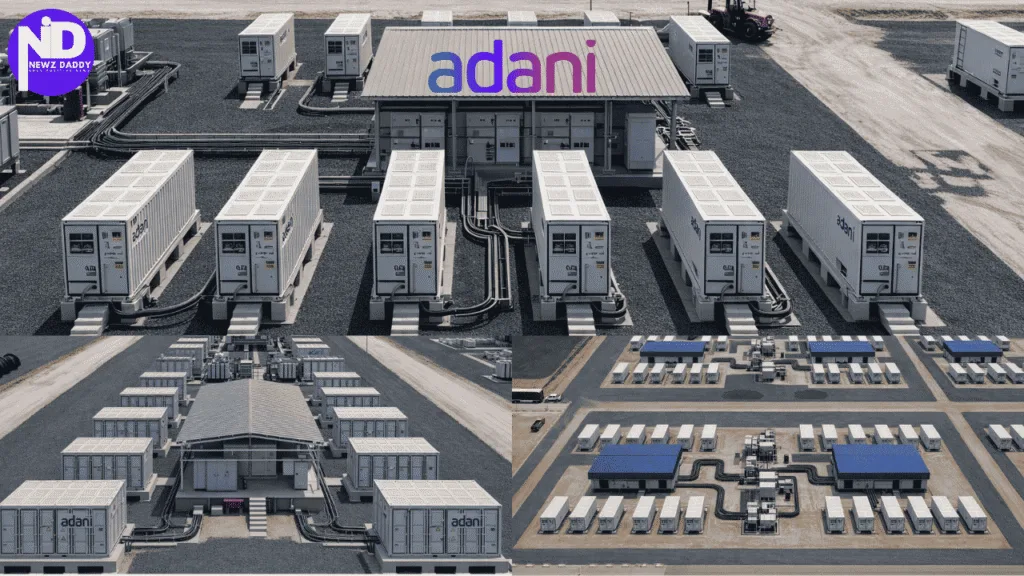
Adani’s Khavda Battery Plant Brings Big Clean Energy Hope
Gujarat’s Mega Battery System Boosts the Reliable, Clean Power Supply
Adani Green Energy Ltd (AGEL) has commissioned a cumulative 3.37 Gigawatt-hour (GWh) Battery Energy Storage System (BESS) at Khavda in Gujarat. The company says this is the world’s largest single-location battery storage deployment outside China and one of the fastest completed utility-scale battery projects in the world. The project was finished within just ten months after on-site construction started.
The deployment includes the 1.37 GWh battery capacity that AGEL had already commissioned in March 2026. With this latest expansion, the total operational battery storage capacity at Khavda has now reached 3.37 GWh. Industry experts believe such large storage systems are becoming very important as countries move faster towards renewable energy and cleaner power systems. India is also increasing its focus on battery storage as solar and wind energy continue to grow quickly across the country.
The commissioning is being seen as an important step for India’s renewable energy sector because battery storage can help solve one of the biggest problems linked with solar and wind energy. Renewable power generation changes depending on sunlight, wind speed, weather conditions and time of day. Battery systems store extra power when production is high and supply electricity when demand rises or renewable generation drops. Energy experts have often explained that storage systems help keep power grids stable during peak hours and sudden demand increases.
According to AGEL, the 3.37 GWh BESS can store enough clean energy to supply nearly one million homes for a full day. The company also said the system can support electricity demand equal to cities like Indore and Chandigarh or even the entire state of Goa during peak hours. The battery storage can also continuously power more than 12 million LED bulbs for around ten hours. Analysts tracking India’s energy market say such projects may help improve electricity reliability in future summers when demand rises sharply across states.
Mr Sagar Adani, Executive Director of AGEL, said large-scale energy storage would play a major role in India’s next phase of clean energy growth. He stated that battery storage infrastructure is becoming necessary to deliver round-the-clock renewable power. He also said the Khavda battery project would help create more flexible and dependable energy systems for the future.
The Khavda renewable energy project itself is already one of the largest clean energy developments in the world. AGEL is developing a massive 30 GW renewable energy park there by 2029. At present, nearly 9.9 GW is already operational. Energy industry reports suggest that Khavda is quickly becoming one of the most important renewable energy hubs in India because of its huge scale and integrated infrastructure.
The BESS project uses advanced energy management systems along with lithium-ion battery technology. Such systems help improve efficiency, grid response time and power reliability. Global energy companies are increasingly investing in battery storage because many countries are trying to reduce dependence on fossil fuels while still ensuring a stable electricity supply. Several international studies have shown that battery storage will become one of the key pillars of future power systems.
India’s battery storage sector is also expected to grow rapidly over the next few years. According to industry estimates and government-linked studies, India may require more than 400 GWh of energy storage capacity by 2031-32 as renewable energy use expands further. Experts say Gujarat is already emerging as one of the leading states for battery storage projects because of its strong renewable energy network and industrial demand.
AGEL has now announced plans to add over 10 GWh of battery storage capacity during FY27 and increase this to 50 GWh over the next five years. Market observers believe this signals a major shift in India’s renewable sector, where companies are now focusing not only on generating green power but also on storing and supplying it more reliably. Reports in the energy sector suggest that battery storage could become as important as solar panels and wind turbines in the coming decade.
The Khavda project is also drawing attention internationally because China currently leads the world in large battery storage systems. Industry reports noted that the largest single-site electrochemical battery storage facility in China has a capacity of around 4 GWh. AGEL’s Khavda deployment now stands among the biggest projects globally outside China.