


Ahmedabad Hosts RF and Antenna Design Seminar Boost
Adani University Hosts IEEE-Led Seminar on RF and Antenna Design, Launches Student Chapter
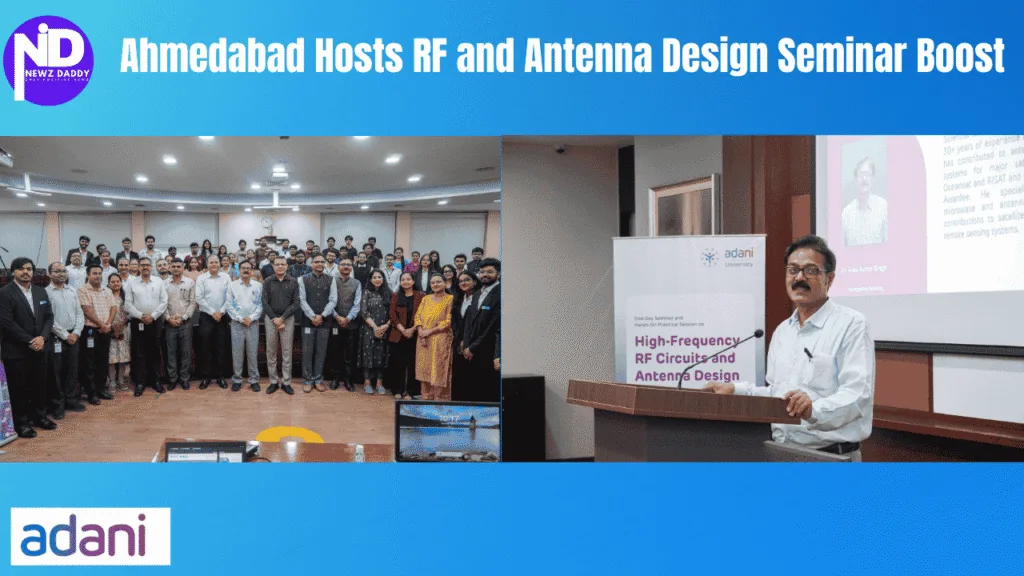
Adani University has strengthened its focus on application-led engineering education by hosting a specialised seminar on high-frequency radio frequency (RF) circuits and antenna design in collaboration with the Institute of Electrical and Electronics Engineers (IEEE) Antennas and Propagation Society and Microwave Theory and Techniques Society Gujarat Joint Chapter.
The programme brought together students and professionals at a time when radio frequency and antenna technologies are central to next-generation communication systems. Today, almost every wireless system depends on RF design. Mobile networks, satellite links, GPS systems, and even Wi-Fi routers rely on strong antenna performance. Experts across the telecom industry often stress that poor antenna design can reduce network speed and signal quality by up to 30 percent. This shows why such seminars are becoming more common in engineering institutions.
The inauguration of the IEEE Antennas and Propagation Society Student Chapter at the university marks a step towards deeper research engagement and structured peer learning. Student chapters like these often play a key role in shaping careers. Globally, IEEE student members get access to research papers, conferences, and mentorship from industry leaders. Many students who join such chapters early go on to work with leading companies like Qualcomm, Nokia, and ISRO. It also helps students build confidence by presenting their work in front of experts.
Opening the session, Dr Krupali Donda highlighted the growing relevance of RF design across communication platforms, from terrestrial networks to space-based systems. In recent years, RF engineering has seen rapid growth due to the 5G rollout. Countries like India are expanding their 5G coverage quickly, and early research on 6G has already started. These new systems require higher frequencies, which makes antenna design more complex. Engineers now work with millimetre-wave frequencies, which can carry more data but need precise design and testing.
The seminar progressed from conceptual foundations to applied learning, reinforcing the need for industry-aligned technical education. Many engineering graduates struggle with practical skills despite strong theoretical knowledge. Reports from industry bodies often point out that only about 40 to 50 percent of engineering students are ready for core technical jobs. Hands-on seminars like this help close that gap by giving real-world exposure. Students learn how concepts work outside textbooks, which improves their job readiness.
Industry perspective was anchored by participation from the Space Applications Centre, a key centre of the Indian Space Research Organisation (ISRO). Chief Guest Dr Vijay Kumar Singh shared insights into advancements in antenna technologies and their role in communication and space applications. India’s space sector has grown rapidly, especially after successful missions like Chandrayaan and the expansion of satellite services. Antennas play a major role in these missions, as they help send and receive signals across long distances in space. Even a small design error can affect communication between satellites and ground stations.
Prof. Dhaval Pujara expanded on design principles and emerging trends, connecting theory with deployment realities. In real-world systems, engineers must consider size, cost, efficiency, and durability while designing antennas. For example, antennas used in smartphones must be small but still deliver strong performance. On the other hand, radar systems used in defence need high power and long-range capability. This balance between theory and practical use is what modern engineering education is trying to achieve.
A practical session led by Alok Kumar Singhal introduced participants to antenna simulation using ANSYS HFSS, a widely used electromagnetic simulation software in RF and antenna design. Tools like HFSS are now standard in the industry. They allow engineers to test designs in a virtual environment before building actual models. This saves both time and cost. Many global companies depend on simulation tools to reduce errors and speed up product development. Students who gain early experience with such tools often have a strong advantage during job placements.
The hands-on module enabled participants to translate theoretical concepts into functional design approaches. Learning by doing is one of the most effective ways to understand engineering. Studies in education show that students remember up to 75 percent of what they practise, compared to much lower retention from lectures alone. This makes workshops and lab-based sessions very important in technical fields.
With applications spanning 5G and emerging 6G networks, satellite communication, and radar systems, the seminar highlighted the strategic importance of RF technologies. Governments and private companies are investing heavily in these areas. For example, the global 5G market is expected to grow rapidly in the coming years, creating thousands of jobs in RF design and testing. Defence systems, weather monitoring, and aviation also depend on radar and antenna technologies.
By integrating expert-led sessions with practical exposure, the initiative reflects Adani University’s continued effort to align academic learning with evolving industry and research needs. Events like this not only build technical skills but also help students understand where the future is heading. For many participants, this seminar could be the starting point of a career in one of the most important fields of modern technology.