


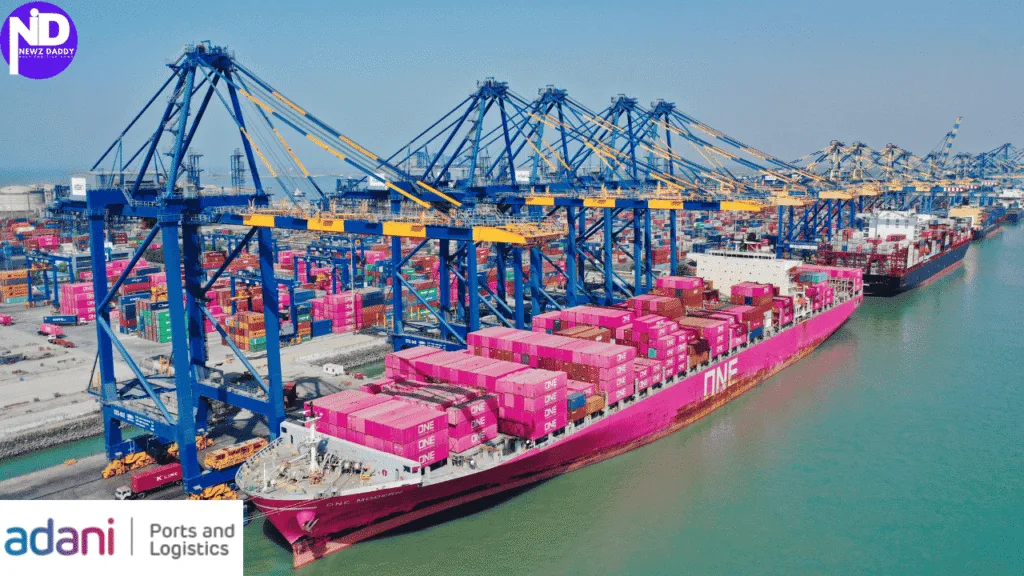
APSEZ NQXT Acquisition Powers India’s Global Port Rise
Newzdaddy Business Updates
On proforma basis, FY26 EBITDA guidance now at ₹22,350-23,350Cr from ₹21,000-22,000 Cr; cargo volume at 545 MMT-555 MMT from 505 MMT-515 MMT With the acquisition of North Queensland Export Terminal (NQXT), APSEZ is on track to achieve 1 Billion tonne of cargo volume by 2030 The acquisition adds a cash generating asset to APSEZ’s international portfolio along the East-West trade corridor NQXT is a critical export gateway for producers in resource-rich Queensland with a current capacity of 50 MTPA
Adani Ports and Special Economic Zone Limited (APSEZ), India’s largest Integrated Transport Utility, has completed the acquisition of 100% interest in NQXT Australia pursuant to the completion of all conditions precedents, including approvals from the ‘majority of minority’ shareholders, Reserve Bank of India, Foreign Investment Review Board of Australia, amongst others. APSEZ has allotted 14,38,20,153 equity shares of face value ₹2 each to the seller, Carmichael Rail and Port Singapore Holdings Pte Ltd, on a preferential basis.
This acquisition marks a major step in APSEZ’s global expansion strategy. Over the past decade, Indian port operators have steadily increased their presence overseas to support global trade and reduce dependence on domestic cargo alone. With NQXT now part of its portfolio, APSEZ strengthens its position as a key player in international logistics, particularly in the Asia-Pacific region.
“Closure of NQXT’s acquisition is a significant milestone in APSEZ’s growth trajectory towards 1 billion metric tonne cargo by 2030”, said Mr Ashwani Gupta, Whole-time Director & CEO, APSEZ. “NQXT is an excellent asset with distinct geographical advantages, strong growth prospects, and an enviable sustainability track record. NQXT will enhance our presence along the East-West trade corridor, along with our other international ports in Israel, Colombo and Tanzania. I am delighted to welcome NQXT to the APSEZ family and look forward to strengthening our impact on the global trade landscape”.
The East-West trade corridor is one of the busiest shipping routes in the world, connecting Asia with Europe, Africa, and Australia. Ports located along this corridor benefit from steady cargo movement, especially bulk commodities such as coal, minerals, and agricultural products. NQXT’s location on Australia’s east coast makes it a vital link between resource-rich regions and global markets.
NQXT is a high-growth, cash-generating asset, driven primarily by take-or-pay contracts with customers. During FY25, NQXT had a contracted capacity of 40 million tonnes and delivered A$228mn EBITDA (on a proforma basis, NQXT represents 6% and 7% of APSEZ’s FY25 revenue and EBITDA, respectively).
Such long-term contracts provide stable income and reduce financial risk. In the ports and logistics sector, predictable cash flow is crucial for funding infrastructure upgrades and maintaining operational efficiency. Analysts note that assets like NQXT help companies balance market cycles and protect earnings during global trade slowdowns.
Queensland is one of Australia’s most resource-rich states, known for coal, minerals, and agricultural exports. NQXT serves as a key export gateway for producers in the region, helping them reach international buyers efficiently. With a current capacity of 50 million tonnes per annum, the terminal has room for future expansion as demand grows.
The revised FY26 guidance reflects confidence in the asset’s performance. APSEZ now expects higher EBITDA and cargo volumes on a pro forma basis, indicating that the acquisition will add immediate value. Industry experts say this move aligns with APSEZ’s long-term vision of becoming a global transport utility rather than just a port operator.
As global trade patterns shift and supply chains diversify, Indian companies are increasingly investing overseas. APSEZ’s growing international footprint shows how Indian infrastructure firms are competing on a global scale. The NQXT acquisition is not just a business deal but also a sign of India’s rising role in global trade logistics.