


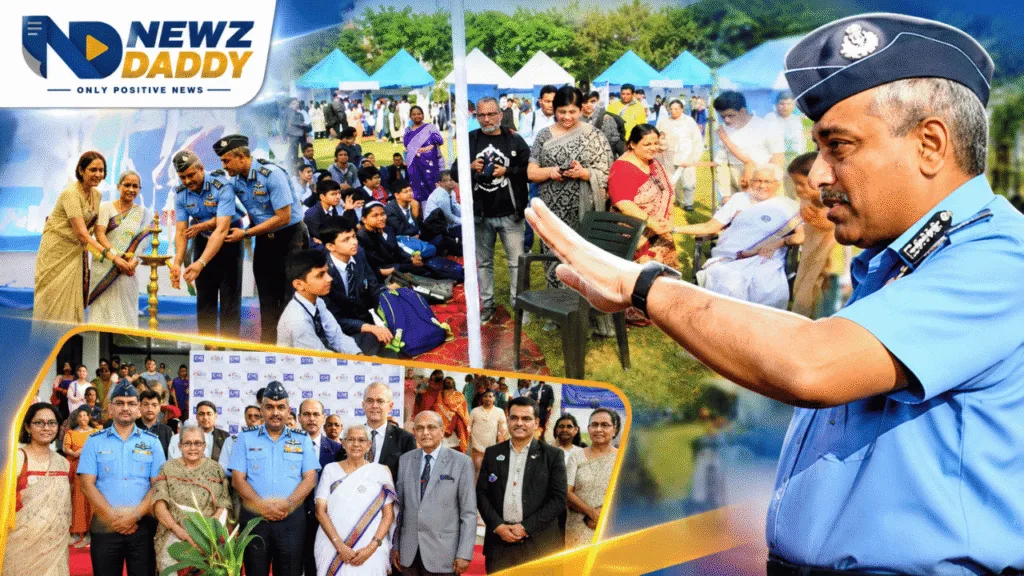
Ashutosh Dixit Returns to His Lucknow School for Science Fair
Air Chief Marshal Ashutosh Dixit Revisits Lucknow School, Urges Students to Take an Interest in Science and Space Research
Air Chief Marshal Ashutosh Dixit, Chief of the Air Staff of the Indian Air Force, returned to his former school, City Montessori School (CMS), in Lucknow to attend its two-day Vigyan Mela as the chief guest. His visit brought him back to the classrooms where he spent his school years and allowed students to hear about India’s growing space programme from one of the country’s senior military leaders.
The science fair was held at the CMS Golf City campus. During his address, Ashutosh Dixit spoke about India’s achievements in space research, including the Aditya-L1 solar mission and the Gaganyaan human spaceflight programme. He also referred to Group Captain Shubhanshu Shukla, another former CMS student who travelled to the International Space Station in 2025.
Ashutosh Dixit message to the students centred on the value of education, curiosity and hard work. He urged them to develop a sound academic foundation, face difficult tasks with discipline and perseverance, work with others and keep learning about new technology.
For CMS students, the visit also offered a connection between their school and two major areas of national achievement: India’s defence services and its space programme.
Air Chief Marshal Ashutosh Dixit’s visit carried a personal connection. He studied at the Rajendra Nagar branch of City Montessori School before joining the National Defence Academy. He was commissioned into the fighter stream of the Indian Air Force on 6 December 1986.
Ashutosh Dixit took charge as the 29th Chief of the Air Staff on 31 October 2026. His career has covered flying operations, aircraft testing, military training and defence planning. He has more than 3,500 hours of flying experience on several aircraft, including the Mirage-2000, MiG variants and Jaguar.
Ashutosh Dixit has also held senior positions in the Indian Air Force, including Vice Chief of the Air Staff, Air Officer Commanding-in-Chief of Central Air Command and Chief of Integrated Defence Staff.
His return to CMS offered a chance to discuss how education can prepare young people for careers in fields that require scientific knowledge and technical skills. Military aviation, for instance, depends on knowledge of physics, mathematics, engineering and computer systems.
The school’s Vigyan Mela provided a setting for such discussions. Science fairs give students an opportunity to present their work, explain experiments and understand how classroom lessons apply to practical problems.
One of the subjects discussed by Dixit was India’s Aditya-L1 mission, developed by the Indian Space Research Organisation (ISRO).
Launched on 2 September 2023 aboard the Polar Satellite Launch Vehicle (PSLV-C57), Aditya-L1 is India’s first space-based observatory dedicated to studying the Sun. The spacecraft entered its planned halo orbit around the Sun-Earth L1 point on 6 January 2024.
The L1 point is around 1.5 million kilometres from Earth. Its position allows the spacecraft to observe the Sun continuously, without interruptions caused by the Earth blocking its view.
Aditya-L1 carries seven scientific instruments, known as payloads. Four observe different layers of the Sun, while the remaining three study particles and magnetic fields in the surrounding space.
The mission studies solar flares, the Sun’s outer atmosphere and coronal mass ejections. These events can affect satellites, radio communications, navigation systems and power networks on Earth.
Understanding solar activity is therefore useful for countries that depend on satellite-based services and communication systems.
The mission also gives Indian scientists access to observations that can support research into the Sun and its effect on the space environment.
Dixit also referred to Gaganyaan, India’s planned human spaceflight programme.
ISRO is developing the technology needed to send Indian astronauts into low Earth orbit using an Indian launch vehicle and bring them safely back to Earth.
The programme requires several systems to work together. These include a human-rated launch vehicle, a crew module, life-support equipment, emergency escape systems and recovery arrangements.
Astronaut safety remains a central part of the work. A spacecraft carrying people must meet strict standards for its engines, structure, temperature control, communication and emergency systems.
ISRO’s programme includes uncrewed test flights before the first crewed mission. These flights will help engineers check the spacecraft and its safety systems without putting astronauts at risk.
Work continued during 2026. On 16 October, ISRO announced that it had completed a series of tests involving the separation of the Crew Module and Service Module. This operation is required before the crew module returns to Earth.
The Gaganyaan programme is also expected to create opportunities for Indian scientists, engineers, research institutions and industries working in advanced technology.
Another name mentioned during the school address was Group Captain Shubhanshu Shukla, a former CMS student who became an astronaut.
In June 2025, Shukla travelled to the International Space Station (ISS) as the pilot of Axiom Mission 4 (Ax-4). The spacecraft launched on 25 June 2025 and docked with the ISS on 26 June.
He became the first Indian to visit the International Space Station and the second Indian to travel into space after Wing Commander Rakesh Sharma, who flew aboard a Soviet spacecraft in 1984.
Shukla spent 18 days in space and took part in scientific experiments involving human health, plant growth and other research areas. His work included studies related to muscle changes, seed germination and the behaviour of biological material in microgravity.
His experience also has a direct link with India’s future human spaceflight plans. Knowledge gained from astronauts working in space can help scientists understand how the human body responds to long periods away from Earth.
Shukla’s school background gives CMS students another example of a former pupil entering a field that demands years of training and technical preparation.
City Montessori School was founded in Lucknow in 1959 by Dr Jagdish Gandhi and Dr Bharti Gandhi. It began with five children and has grown into a large school network across the Uttar Pradesh capital. Its present-day network has 22 campuses and more than 65,000 students, according to the school’s published information.
The annual Vigyan Mela gives students a chance to learn about scientific subjects outside regular classroom lessons. Such activities can help children understand how scientific ideas are tested and used in daily life.
Ashutosh Dixit’s advice to students placed emphasis on curiosity, academic preparation, discipline and perseverance. He also spoke about teamwork and the need to understand technology.
These lessons have practical value for students considering careers in aviation, engineering, space research, medicine and other scientific fields. Many such careers require years of study, careful training and the ability to solve difficult problems.
India’s work in solar research and human spaceflight also shows the range of opportunities available to the next generation. Students interested in these fields will need a sound understanding of mathematics and science, along with the ability to keep learning as technology changes.
For CMS, the visit brought together two former students whose careers have taken them into very different areas of national service. One now heads the Indian Air Force, while the other has travelled to the International Space Station.
The meeting gave students a chance to hear how their school education connects with careers in India’s defence and space programmes.