


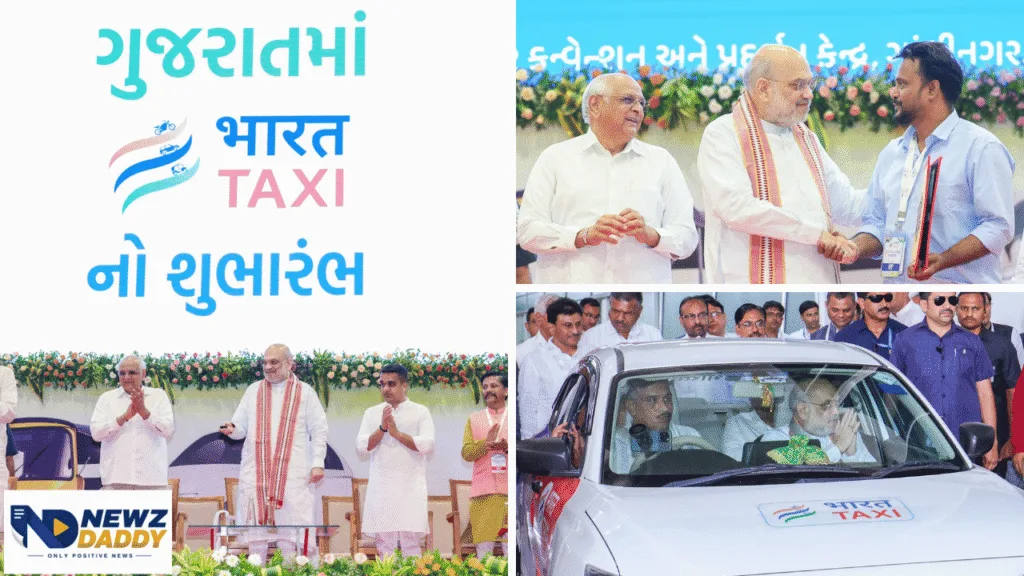
Bharat Taxi Gujarat Launch Marks New Driver-Owned Model
Amit Shah Launches Cooperative Ride-Hailing Service Bharat Taxi in Gujarat
Union Home Minister and Minister of Cooperation Amit Shah, on 27th June 2026, launched Bharat Taxi in Gujarat, marking the formal rollout of what is being described as India’s first cooperation-based, driver-owned ride-hailing service. The launch event took place at the Mahatma Mandir Convention and Exhibition Centre in Gandhinagar and brought together government officials, cooperative leaders and thousands of drivers associated with the platform.
The initiative enters India’s fast-growing app-based transport market at a time when drivers working with private ride-hailing companies have frequently raised concerns over commission charges, falling earnings and limited control over pricing and working conditions. Bharat Taxi seeks to offer a different ownership structure by placing drivers within the cooperative system rather than treating them only as service providers.
The service was first introduced quietly in Gujarat in December 2025 before being expanded across the state. According to figures shared during the launch, more than 1.5 lakh drivers, known within the platform as “Saarthis”, have already joined from Gujarat. Across India, the platform says it has attracted over 7 lakh drivers and served more than 37 lakh customers. Around 3,500 rides are currently being completed each day in Gujarat alone.
Operations are now active in 14 major cities across Gujarat, including Ahmedabad, Surat, Vadodara, Rajkot, Dwarka, Somnath, Valsad, Anand, Jamnagar, Bhavnagar, Nadiad, Junagadh, Mehsana and Amreli. Organisers have set a target of extending services across the entire state within the next month.
More than 4,000 drivers from Gujarat attended the programme in Gandhinagar, where top-performing Saarthis received certificates and share certificates recognising their participation in the cooperative ownership structure. Memorandums of Understanding were also exchanged between participating institutions and organisations linked to the project.
The model is based on the idea described as “Saarthi Hi Maalik”, meaning the driver is also the owner. Under this system, drivers can become shareholders in the platform rather than paying commissions to an external company. Earlier this year, Amit Shah said drivers could purchase a share in the cooperative for Rs 500 and participate in future profit distribution, drawing comparisons with the growth of India’s dairy cooperatives.
Bharat Taxi is operated by Sahkar Taxi Cooperative Limited, which was registered under the Multi-State Cooperative Societies Act, 2002, on 6 June 2025. The organisation was established with support from some of India’s largest cooperative institutions, including the National Cooperative Development Corporation (NCDC), Gujarat Cooperative Milk Marketing Federation, better known through the Amul brand, National Dairy Development Board (NDDB), National Agricultural Cooperative Marketing Federation of India (NAFED), Indian Farmers Fertiliser Cooperative Limited (IFFCO), Krishak Bharati Cooperative Limited (KRIBHCO), National Bank for Agriculture and Rural Development (NABARD) and National Cooperative Exports Limited (NCEL).
The launch reflects the Ministry of Cooperation’s wider effort to extend cooperative ownership into sectors beyond farming and dairy production. Since the creation of the Ministry of Cooperation in 2021, the government has encouraged cooperative models in exports, seed production, organic farming, storage infrastructure and digital services. Bharat Taxi represents one of the most visible attempts to apply that approach to urban transport.
India’s ride-hailing market is currently dominated by companies such as Uber, Ola and Rapido. Industry estimates place the size of the sector at around 2 billion US dollars, with forecasts suggesting it could grow several times over the next decade as smartphone use and digital payments continue to expand in smaller cities and towns. Most existing platforms charge commissions that drivers say can significantly reduce their earnings. Bharat Taxi says it will operate on a zero-commission model, allowing drivers to keep the full fare while contributing through membership fees and cooperative participation.
Passengers using the service can book bikes, auto-rickshaws and cabs through the platform. The organisation says it will follow a surge-free pricing policy and has partnered with the Gujarat Police to strengthen passenger safety measures. Drivers are also expected to receive access to insurance, loans, pension support and government social security schemes through the cooperative framework.
Among those present at the launch were Gujarat Chief Minister Bhupendra Patel, Minister of State for Home Harsh Sanghavi, Secretary of the Ministry of Cooperation Dr Ashish Kumar Bhutani and Gujarat Cabinet Minister Jitubhai Savjibhai Vaghani, along with representatives from the cooperative sector and associated institutions.
Gujarat has historically been one of the strongest centres of India’s cooperative movement, largely because of the success of organisations such as Amul and the dairy cooperative network that transformed rural incomes in the state. Supporters of Bharat Taxi believe a similar ownership model could offer drivers greater financial stability and a larger role in decision-making within the platform economy.
The coming months are likely to determine whether a cooperative approach can compete with established technology companies in India’s crowded mobility market. For now, Gujarat has become the testing ground for an experiment that aims to combine digital transport services with one of the country’s oldest economic movements, the cooperative sector.