


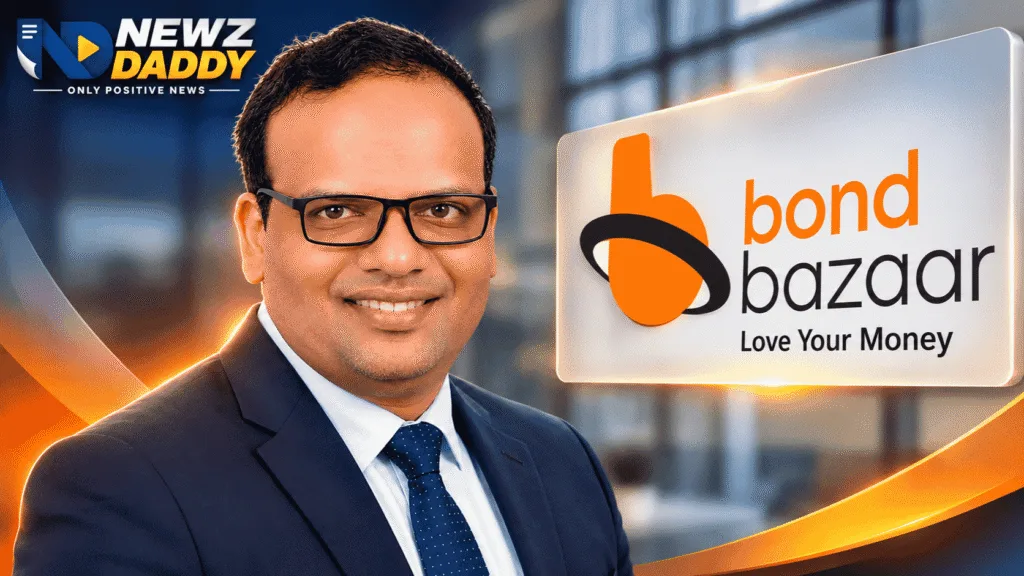
Bondbazaar Appoints S. Sambath Kumar as CEO
Bondbazaar Turns To An Experienced HDFC Securities Executive As It Seeks Wider Reach
Bondbazaar has appointed financial services professional S. Sambath Kumar as its Chief Executive Officer (CEO), placing an experienced industry executive in charge of its plans to expand its online fixed-income investment business in India.
Kumar brings more than 25 years of experience in financial services, business development, product strategy and distribution. He joins Bondbazaar after serving as Chief Distribution Officer at HDFC Securities, where he handled product initiatives aimed at increasing the company’s distribution reach.
Before joining HDFC Securities, he worked as Segment Head of Business Development at Reliance Capital Asset Management Ltd. He has also been associated with Spark Capital.
His appointment comes at a time when financial technology companies are seeking a larger share of India’s retail investment market, including the corporate bond segment. Bondbazaar provides an online platform through which individual investors can access government and corporate bonds. Kumar will be responsible for the company’s business plans, technology platform and distribution network.
The company says its platform offers market-linked pricing, real-time buying and selling, zero brokerage and investment options starting at ₹100. These features are intended to make fixed-income products accessible to people who may not have previously invested in bonds.
India’s bond market has traditionally attracted banks, insurance companies, mutual funds and other large financial institutions. Individual investors have had a much smaller presence, particularly in corporate bonds. Online platforms are now trying to change this by making bond-related information and transactions easier to access.
According to a June 2026 report by The Economic Times, retail investors were putting around ₹1,500 crore to ₹2,000 crore a month into corporate bonds. This was five to six times the estimated monthly investment of about ₹300 crore a year earlier. The growth was linked to increased investor education, advertising and a wider choice of bond issuers. The figures point to rising interest in this part of the debt market.
The size of India’s corporate bond market, however, shows how much room there is for individual investors. The Economic Survey 2024-25 reported that corporate bond issuances reached ₹7.3 lakh crore between April and December 2024. It also pointed out that the market remained smaller in relation to the economy than those of several other countries.
The survey put India’s corporate bond market at around 18 per cent of gross domestic product (GDP). The comparable figures were 80 per cent for South Korea and 36 per cent for China. It also found that private placements accounted for almost all corporate bond fundraising. Such placements generally involve selected investors and can limit access for ordinary retail buyers.
This gap has encouraged regulators and financial companies to look at ways of bringing more individual investors into the debt market.
The Securities and Exchange Board of India (SEBI) introduced a regulatory framework for Online Bond Platform Providers (OBPPs) in November 2022. The framework requires platforms operating in this category to register with SEBI and follow rules governing their activities. The move was aimed at bringing greater supervision to online bond transactions and improving investor protection.
The Reserve Bank of India (RBI) had taken a separate step a year earlier. On 12 November 2021, it launched the RBI Retail Direct Scheme, allowing individual investors to buy and sell government securities through an online account. The scheme covers Treasury Bills, Government of India dated securities and State Development Loans, among other eligible instruments.
These developments have opened more routes for individuals who want to invest in debt products. They have also given investors access to information and trading facilities that were once harder to find outside traditional financial institutions.
Bondbazaar is entering this market with an offering that includes government and corporate bonds. Its stated minimum investment of ₹100 could attract people who want to begin with a small amount. However, investors need to understand that the minimum amount advertised by a platform does not mean every bond is available at that price. Individual securities have their own terms, prices and minimum purchase requirements.
There are also differences between government and corporate bonds. Government securities carry the credit backing of the government that issues them, while corporate bonds depend on the financial strength of the company borrowing the money. A corporate issuer may fail to make interest payments or repay the principal. Investors must therefore examine the issuer’s credit rating, repayment date, interest rate and other conditions before investing.
Bond prices can also change when market interest rates move. An investor who sells a bond before its maturity date may receive more or less than the purchase price, depending on market conditions. Corporate bonds can also be harder to sell quickly if there are few buyers.
These factors will remain important as online platforms compete to attract first-time bond investors. Easy access and low entry amounts may encourage more people to explore fixed-income products, but investors still need to understand the risks attached to each security.
Kumar said he sees considerable scope for increasing individual participation in India’s fixed-income market. Commenting on his appointment, he said:
“I am delighted to join Bondbazaar at an exciting stage in its growth journey. India’s fixed-income market offers significant opportunities to deepen retail investor participation, and technology will be key to unlocking this potential. Our focus will be on strengthening the platform, expanding our reach and delivering a seamless, transparent, and trusted investment experience for investors across India.”
Under his leadership, Bondbazaar plans to work on its technology platform, improve the online investment experience and expand its distribution network. The company will also seek to reach more retail investors who are looking for alternatives to traditional savings and equity-based investments.
For Kumar, his previous experience at HDFC Securities and Reliance Capital Asset Management brings familiarity with financial products and their distribution. His new role will involve translating that experience into business growth for Bondbazaar.
The company’s progress will depend on its ability to attract investors while maintaining clear information about bond prices, returns, credit ratings and associated risks. As more people explore fixed-income investments, the quality of information available to them will remain an important part of their investment decisions.
Also Read:
Government Clears HDFC Bank to Accept Capital Gains Deposits