


Borrowed Earth – The Most Emotional Art Show
The Most Meaningful And Deep Portrayal of The Borrowed Earth Show Ever Seen At Amdavad Ni Gufa
In the heart of Ahmedabad, a new exhibition is stirring the souls of those who walk through the doors of Amdavad ni Gufa. Filmmaker and artist Tanmay Shah has unveiled his latest work, ‘Borrowed Earth’, a six-day event that began this Tuesday. It is much more than just a collection of art; it is a powerful reminder that we do not own the ground beneath our feet. Instead, we are merely minding it for those who come after us.
The exhibition features 26 striking paintings and 26 evocative photographs. It has already drawn a large crowd of students, thinkers, and art lovers. The atmosphere is one of quiet reflection as visitors move between the vibrant canvases and the still, captured moments of the natural world.
Tanmay Shah spent six months working with acrylic paints to bring these pieces to life. His goal was to move the conversation away from “owning” nature and toward “protecting” it. This idea is supported by many global environmental movements. For instance, the concept of “Intergenerational Equity” is a major part of international law. It suggests that every generation holds the Earth in common with other generations. By using bold colours and sharp lines, Shah forces us to look at the fragile state of our planet.

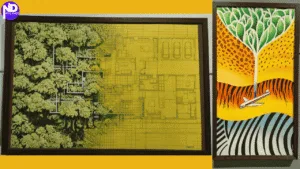
During the opening, Shah explained that he wanted to create a space where people could stop and think about how they live. This mirrors a growing trend in the art world known as “Eco-art.” Experts in journals like Nature Climate Change have often noted that while scientific data is important, it is art that touches the human heart and inspires real change in daily habits.
Dr Parekh’s involvement highlights how seriously the global community views the intersection of culture and policy. Organisations like the World Economic Forum often discuss how “cultural leaders” can help shift public opinion on the environment. When an artist uses bold, attractive colours to depict a serious crisis, it makes the message easier to digest without losing its power.
Beyond the Canvas: A Lens on the World
While the paintings explore human feelings and philosophy, the 26 photographs on display offer a different kind of truth. These images were taken by Shah over eight years in many different countries. They show us the sheer scale and beauty of the world we are trying to save.
One of the most talked-about photos shows the Northern Lights in Alaska. Shah explained to the audience that this beautiful green glow is actually solar radiation hitting the Earth’s magnetic field. This scientific phenomenon, known as the Aurora Borealis, is a perfect example of the “delicate conditions” that keep us alive. Scientific blogs often describe the magnetic field as a “shield” that protects our atmosphere from solar winds. Seeing it captured in a photograph reminds us that our planet has its own natural defences, but they are part of a system we must respect.
Another interesting piece in the photography section mentions the 72 scientists and engineers whose names are engraved on the Eiffel Tower. Shah uses this to remind us that even our greatest human achievements are built on a deep understanding of the laws of nature and the limits of our materials. It is a nod to the fact that science and art must work together to build a sustainable future.
‘Borrowed Earth’ is not Shah’s first time sharing his vision. It follows his previous exhibitions, ‘Sambandh’ in 2013 and ‘Concoct’ in 2017. However, this exhibition feels particularly timely. With global temperatures rising, more people are looking for ways to connect with environmental issues on a personal level.
Visitors at the Gufa have shared that the exhibition made them think about their own “carbon footprint”—a term used to describe the amount of carbon dioxide released into the atmosphere because of one’s own energy use. By looking at these paintings, people are starting conversations about the small choices they make every day, like using less plastic or saving water.
The exhibition remains open daily from 4 pm to 8 pm until April 5, Sunday. It serves as a gentle but firm invitation to every citizen to look at the world not as a resource to be used up, but as a beautiful, borrowed gift that we must return in good condition.