


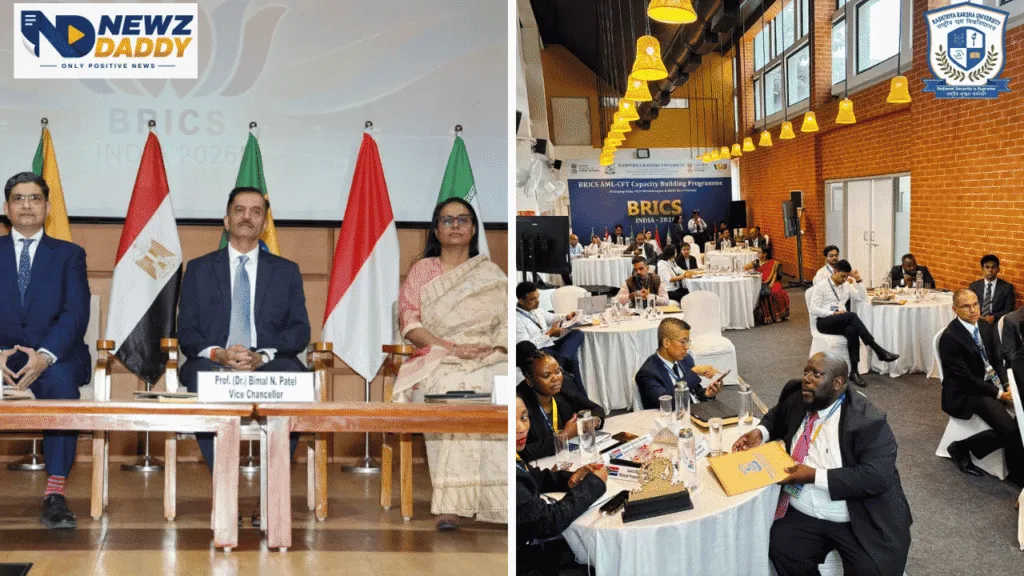
BRICS Training Begins at RRU in Gandhinagar Ahead of Summit
RRU hosts BRICS Training on Money Laundering and Terror Financing Ahead of Delhi Summit
Officials dealing with money laundering, terrorist financing and financial investigations have gathered at Rashtriya Raksha University (RRU) in Lavad, Gandhinagar, for a five-day training programme being held under India’s 2026 BRICS Chairship.
The programme, titled “Emerging Risks, FATF Methodologies and BRICS Best Practices”, runs from 7 to 11 September. It brings together policymakers, Financial Intelligence Units, supervisory authorities, law-enforcement bodies and prosecution agencies. According to the organisers, more than 50 officers from over 25 countries are taking part.
The timing puts the meeting close to the 18th BRICS Summit, which India will host at Bharat Mandapam in New Delhi on 12 and 13 September. India took over the BRICS Chairship on 1 January 2026. It has previously chaired the grouping in 2012, 2016 and 2021.
The RRU programme is being held in collaboration with the FATF Cell of the Department of Revenue under the Ministry of Finance. It deals with issues that have become harder for financial investigators as money moves through digital platforms, virtual assets and increasingly complex company structures.
Prof. Dr Bimal N. Patel, Vice Chancellor of RRU, welcomed the participants at the opening session. He said the meeting provides a chance for officials working on money laundering investigations, prosecutions and criminal profiling to share experience across borders.
He also pointed to the difficulty of dealing with financial crime when transactions, people and companies can be spread across several countries. He said professional links between investigators and regulators are needed when cases cross national borders.
The programme is being held as India prepares for the final stage of its BRICS Chairship. India’s theme for 2026 is “Building for Resilience, Innovation, Cooperation and Sustainability”. More than 350 BRICS meetings and high-level engagements have been held in over 25 Indian cities during the chairship year, according to the Indian government.
RRU’s opening session also included remarks from Mr Sunil Kavishwar, Director of the School of Criminal Law and Military Law at the university. He said economic security has become closely linked with national security and that differences in the way countries apply anti-money laundering rules can leave gaps that criminal groups may exploit.
The five-day programme will examine the Financial Action Task Force’s fifth-round assessment process. FATF began the fifth round of mutual evaluations in 2024 using a methodology adopted in 2022. The present system places greater weight on whether a country’s laws and controls work in practice, rather than only checking whether rules exist on paper.
For countries undergoing FATF reviews, this distinction matters. The assessment process looks at both technical compliance and the results produced by national systems. The newer procedures also give countries a shorter cycle for addressing weaknesses identified during assessments.
Virtual assets will receive attention during the RRU programme. FATF said in July 2026 that many countries have introduced rules for virtual assets, but implementation remains uneven. Its latest review found that 83% of surveyed jurisdictions had passed laws to implement the Travel Rule, up from 73% in 2025. Eleven more jurisdictions said implementation was under way.
The Travel Rule requires information about the sender and recipient to move with certain virtual-asset transfers. It is intended to help authorities and financial institutions trace suspicious transactions and identify those involved.
Participants at RRU will also discuss AI-enabled fraud, deepfakes, synthetic identities, trade-based money laundering and the use of virtual assets. Other sessions will deal with cross-border asset recovery and the identification of Ultimate Beneficial Owners behind companies whose real controllers may be difficult to identify.
The programme includes country presentations, expert sessions and a visit to the International Financial Services Centres Authority (IFSCA) at GIFT City. IFSCA, which was created in 2020 under the International Financial Services Centres Authority Act, regulates financial products, services and institutions in India’s International Financial Services Centre. Its headquarters are at GIFT City in Gandhinagar.
The visit also comes at a time when AML, CFT and KYC rules remain an active part of financial regulation at GIFT IFSC. IFSCA updated its AML, CFT and KYC guidelines in February 2026.
RRU has made international training part of its work since becoming an Institution of National Importance under the Ministry of Home Affairs. Government figures show that the university has conducted 61 specialised training programmes involving more than 2,000 participants from 85 countries.
The university has also worked in areas linked to financial crime, cybersecurity, policing and other security subjects. The training programme therefore places its Gandhinagar campus in direct contact with officials working on financial crime across BRICS countries and partner jurisdictions.
India’s current BRICS year adds another reason for the meeting. The 18th BRICS Summit will bring leaders of member and partner countries to New Delhi on 12 and 13 September. The summit is also taking place in the year BRICS marks two decades since its creation.
For officials attending the RRU sessions, the immediate task is more practical: understanding how investigators, regulators and prosecutors in different countries can work together when illicit money crosses borders. The discussions in Gandhinagar will end on 11 September, one day before the BRICS leaders begin their meeting in New Delhi.