


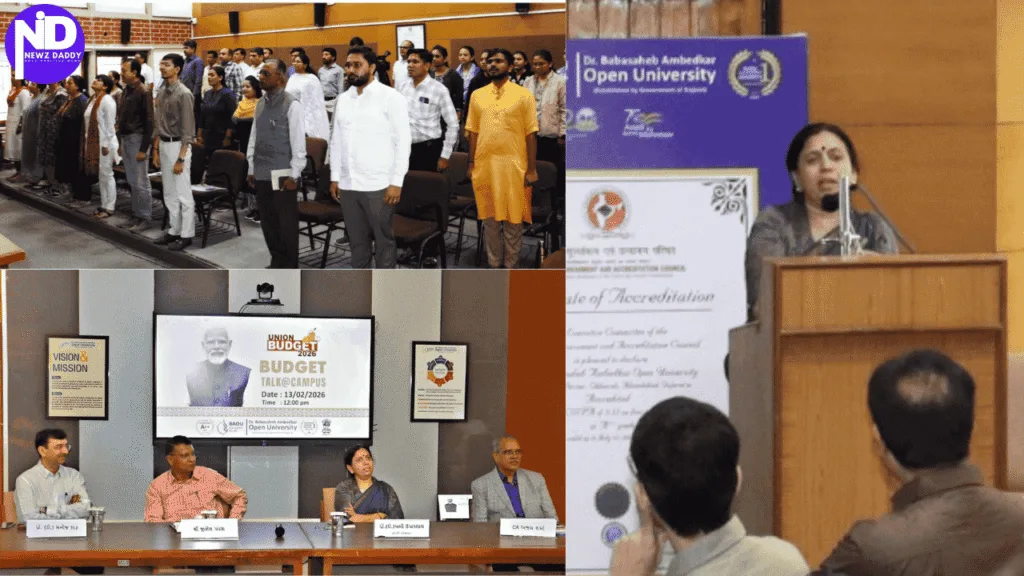
Budget Talk @ Campus Boosts National Pride
Newz Daddy Educational Updates
Budget Talk @ Campus Shares a Powerful Vision For Viksit Bharat 2047
Dr Babasaheb Ambedkar Open University, Ahmedabad, held a special “Budget Talk @ Campus” programme on 13 February 2026. The event was organised by the School of Commerce and Management. It was held to explain the Union Budget 2026 announced by the Government of India and to help people understand the vision of Atmanirbhar Bharat.
The Union Budget is the Government’s yearly financial plan. It shows how much money the country expects to earn and how it plans to spend it. It covers areas such as education, health, defence, farming, jobs and infrastructure. For students, understanding the Budget is important because it affects scholarships, research funding, start-up support and job opportunities. By holding such a programme, the University helped students connect classroom learning with real national policies.
The main aim of the event was to inform students and academic staff about the economic and development policies in the Budget and to give them proper guidance. In recent years, the Government has focused strongly on digital growth, skill development and support for small businesses. Many Budget announcements are linked to training young people in new skills such as Artificial Intelligence, data science and green energy. This makes such campus discussions useful, as they prepare students for future careers.
The programme began with the lighting of the lamp by the dignitaries. This was followed by the national song ‘Vande Mataram’ and the University song. In Indian academic events, lighting the lamp is a traditional way to mark a new beginning. It symbolises knowledge and hope. Including national and university songs helps create a sense of unity and pride among students and staff.

In her speech, Vice-Chancellor Prof. (Dr) Ami Upadhyay spoke about India’s ancient knowledge and modern technology. She said that from the rich spiritual knowledge of the Vedic period to today’s Artificial Intelligence, India can accept change successfully, and this is the Government’s vision. Across the country, there is a strong focus on combining tradition with innovation. India is investing in digital public platforms, online education and research in AI. At the same time, there is renewed interest in traditional knowledge systems, yoga, Ayurveda and classical studies. This balance is seen as a way to build a strong and confident nation.
She also said that when government welfare schemes reach the last person in society, it shows true inclusive development. In recent Budgets, the Government has increased spending on rural housing, clean drinking water, sanitation and direct benefit transfers. Digital payment systems and Aadhaar-linked schemes have helped money reach people directly. This reduces delays and improves transparency. Inclusive growth means that farmers, women, small traders and students all benefit from national progress.
The keynote speaker, CA Ajay Sharma, explained the complex parts of the Budget in simple words. The Union Budget often includes tax changes, new schemes and rules for investment. For many people, these details can seem confusing. Chartered Accountants play an important role in helping businesses and individuals understand tax laws and financial planning. By breaking down the Budget into easy points, the speaker helped students see how policies affect daily life, from income tax to start-up funding.
Government representative Jigneshbhai Pandya said that the Budget is not just a financial document but reflects the Prime Minister’s vision of ‘Viksit Bharat 2047’. This vision aims to make India a developed nation by the year 2047, which marks 100 years of independence. The focus areas include strong infrastructure, modern railways, better roads, clean energy, advanced manufacturing and quality education. Large investments in highways, ports and digital networks are meant to boost trade and create jobs. The idea is to build a strong base now so that future generations benefit.
Prof. (Dr) Manoj Shah, Director of the School of Commerce and Management, explained the purpose of the programme. He briefly spoke about investment and different aspects of Budget 2026. Investment plays a key role in economic growth. When the Government invests in public projects, it creates demand for goods and services. When private companies invest in factories and technology, they create jobs. Budgets often include steps to attract both domestic and foreign investment, such as tax relief or support for start-ups and small businesses.
At the end of the programme, Dr Dhaval Pandya delivered the vote of thanks, and Ms Hardi Bhatt conducted the event smoothly. Such campus discussions do more than share information. They build awareness among young people about national economic policies. They also help students understand that nation-building is not only the work of leaders. It depends on responsible citizens who pay taxes honestly, use resources wisely and take part in democratic processes.
Through this event, the University created a space where policy met education. Students were able to hear experts, ask questions and link theory with real-life decisions. In a time when economic changes happen quickly, such open conversations on campus help shape informed, confident and responsible citizens.