


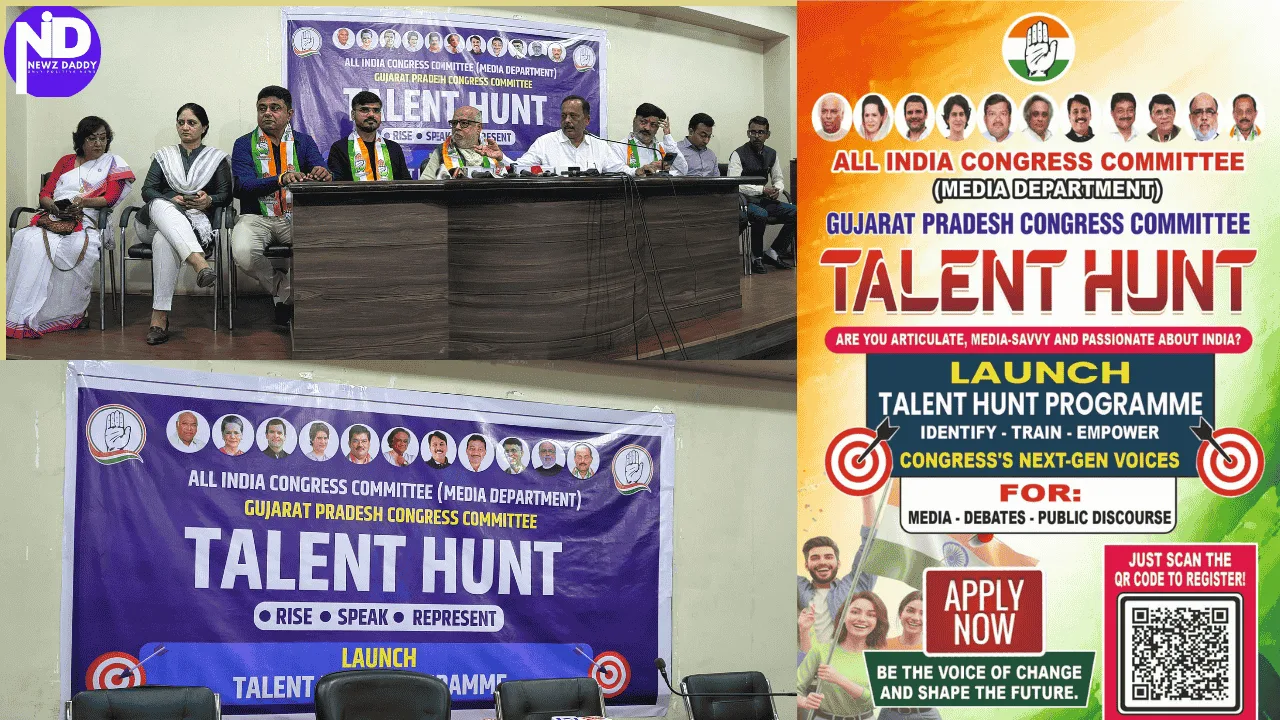
Congress Talent Hunt Programme Brings Youth to the Frontline
Congress Talent Hunt Programme prepares leaders for media challenges
The Program Details:
Launch Date in Gujarat: 04 February 2026
Last Date To Fill Form: 20th Feb, 2026
Talent Hunt For: Spokesperson, Media Panellist, Research Coordinator or Publicity Coordinator
Form Link: https://docs.google.com/forms/d/e/1FAIpQLSfCkuo9PdMIWIe4ckh2JQhVSe3n4I-YRBoM6q-LaGx6IX1dRw/viewform
The launch of the ‘Talent Hunt Programme’ by the All India Congress Committee comes at a time when political communication in India is changing fast. Today, public opinion is shaped not only through rallies and print media but also through television debates, social media clips, podcasts, and short videos. Political parties across the world now invest heavily in trained spokespersons who can speak clearly, stay calm under pressure, and explain complex issues in simple language. The Congress party’s decision to focus on identifying and training such speakers shows an effort to modernise its communication approach while staying rooted in its core values.
The press conference at Rajiv Gandhi Bhavan highlighted the party’s intent to strengthen democracy by giving young people and committed workers a platform. Many young Indians today want to take part in public life but lack access, training, or guidance. Programmes like this help bridge that gap by offering a clear process where talent is identified on merit rather than background. Similar talent development programmes are common in political parties in countries like the United Kingdom and Australia, where young members are trained in public speaking, policy understanding, and media interaction.
By stating that the programme is an initiative of Rahul Gandhi and Mallikarjun Kharge, the Congress leadership is sending a clear message that communication and ideological clarity are top priorities. Rahul Gandhi has often spoken about listening to young voices and encouraging internal democracy within the party. This programme fits into that wider effort by allowing new faces to emerge and represent the party at different levels.
The focus on media-ready and ideologically committed workers is important. In recent years, political debates in India have often become loud and aggressive, with facts sometimes taking a back seat. Trained spokespersons who understand the Constitution, social justice, and economic issues can help raise the quality of public debate. Research in political communication shows that calm, fact-based responses build more trust among viewers than angry or unclear arguments.
The meeting held under the leadership of Harishankar Gupta, with spokespersons and office bearers,s shows that the programme is being planned carefully. Coordination among the party’s different wings is necessary to ensure that selected candidates are supported after training and given real opportunities to speak. Wishing the programme success, Mukul Wasnik and Amit Chavda underlined the importance of organisation and unity, which are key to any long-term political initiative.
The programme’s aim to counter one-sided narratives reflects a wider challenge faced by opposition parties in India. Studies on media coverage have shown that ruling parties often receive more visibility. To balance this, opposition voices need to be clear, confident, and consistent. Training spokespersons to handle tough questions and present facts simply can help ensure that alternative views reach the public.
Guidance from senior leaders like Jairam Ramesh, Pawan Khera, and Supriya Shrinate adds credibility to the programme. These leaders have long experience in policy, communication, and digital outreach. Their involvement suggests that participants will receive not only speaking training but also lessons in understanding data, laws, and social issues. Such skills are useful not just for politics but also for civic engagement.
The structured selection process shows seriousness. Online registration through a QR code makes the programme accessible, especially to young people who are comfortable with digital tools. Physical interviews across four zones of Gujarat ensure that candidates from different regions get a fair chance. Final interviews at Rajiv Gandhi Bhavan by an expert panel will help judge real abilities rather than popularity.
Assessing debate skills, clarity of thought, and expression is a standard method used in many leadership programmes worldwide. Clear thinking helps speakers stay focused, while good expression ensures that messages reach people from all backgrounds. Giving selected candidates roles at the national, state, district, and Assembly levels also creates a clear growth path, which can motivate more workers to participate sincerely.
The appeal to Gujarat’s youth and workers is significant. Gujarat has a long political history and a strong culture of debate. Encouraging young people to speak up for democracy and the Constitution helps keep these values alive. Political participation at a young age often leads to more informed and responsible citizenship later in life.
The presence of many senior leaders, spokespersons, and media panellists at the event shows broad support within the party. Their involvement also means that new spokespersons will have mentors to guide them. In journalism and politics alike, mentorship plays a key role in shaping confident and ethical communicators.
Overall, the ‘Talent Hunt Programme’ reflects the Congress party’s effort to invest in people, ideas, and communication. By focusing on training, inclusiveness, and factual debate, the programme aims to build a reliable public voice for the party while offering young and committed workers a meaningful role in strengthening Indian democracy.