


Dandi Path Walk Rekindles India’s Quiet Freedom Fire
Walking Where Freedom First Found Its Feet
Dandi Path Walk reminds India that freedom must be walked, not watched
The morning at Sabarmati Ashram is marked by a stillness that gently slows the mind. This place has always asked visitors to pause and reflect. Built on simple ideas of self-rule, truth, and restraint, the Ashram was not just Gandhi’s home but his moral workshop. It was from here, on 12 March 1930, that Mahatma Gandhi began the Salt March with 78 followers. That walk was planned with care, not force. Gandhi believed that a calm step, repeated every day, could weaken even the strongest empire. History later proved him right.


On 3 January 2026, gathering at the same spot carried deep meaning. Nearly a hundred years later, the act of walking still speaks loudly in India’s memory. Grand structures do not mark the Dandi Path. It is marked by stories. Walking it again is not about copying the past, but about listening to it. Many historians note that Gandhi chose walking because it allowed direct contact with people. Villagers could see him, speak to him, and feel part of the struggle. That connection remains the heart of this route.
Standing beneath Gandhiji’s image before departure echoed the way he often began his days, with prayer and silence. Gandhi believed that prayer was not about religion alone, but about discipline and clarity of thought. The quiet start reflected his belief that real change begins inwardly. The idea of simplicity and frugality was central to his life, from his clothing to his food. Those values feel even more relevant today, in a fast-moving world driven by excess.

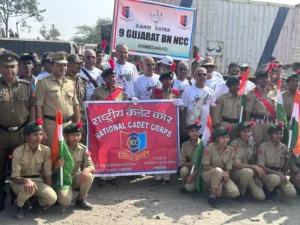
The first stretch along the Sabarmati riverfront brought an important contrast. The riverfront itself is modern, clean, and busy, yet it runs beside an Ashram built on restraint. The Sabarmati River has long been part of Ahmedabad’s life, supporting trade, settlements, and spiritual practice. Gandhi often walked along its banks, believing rivers reminded people of patience and continuity. As the city slowly faded into villages, the road revealed how India carries many times at once, past and present sharing the same space.
The presence of NCC cadets added a powerful layer to the march. The National Cadet Corps was created to build discipline, unity, and service among young Indians. Seeing young cadets walk with the tricolour showed how national values are passed on quietly, not through speeches but through example. Gandhi always trusted the youth. He believed young people dared to question injustice and had the energy to rebuild society.
Public reactions along the way mirrored what Gandhi experienced in 1930. Then, too, people watched silently, unsure at first, then curious, then inspired. The Salt March succeeded because it used an everyday act. Salt was chosen because every Indian used it, rich or poor. Today, walking serves a similar purpose. It requires no wealth, no power, only commitment.
The halt near Aslali carried historical weight. During the original march, Gandhi used village stops to explain civil disobedience. He spoke in simple language, asking people to take responsibility for their actions. He believed freedom was not only about removing British rule but about building self-respect and ethical living. That message remains clear even now.
Images from the march reflect a calm and inclusive patriotism. The tricolour appears not as a banner of victory but as a reminder of duty. Gandhi once said that true patriotism leaves no one out. It stands for justice, not pride alone. The mix of walkers, cadets, soldiers, and locals reflected that idea in practice.
The physical strain between Aslali and Navagam highlighted an often-forgotten fact. Gandhi was 61 when he began the Salt March. Doctors had advised rest, but he chose movement instead. He believed age did not limit moral responsibility. That belief continues to inspire older citizens to remain active in public life.
Reaching Navagam echoed the relief felt in 1930. For Gandhi, each village reached proved the journey was possible. At the Yatri Niwas, the setting sun and blooming bougainvillaea offered a gentle close to the day. Nature often featured in Gandhi’s writings. He saw beauty as a quiet teacher of balance.
The young boy dressed as Gandhiji captured something timeless. Gandhi often said he wanted his ideas to outlive him, not his image. Yet moments like this show how memory and future can meet simply, without force.
As night settled, reflection replaced tiredness. The Salt March awakened Indians to their strength. Walking the same path today reminds us that freedom is not finished business. It lives through daily choices, ethical living, and conscious remembrance. The road ahead leads to Nadiad and then Dandi, but the journey truly began here, where freedom once found its feet and still learns to walk.