


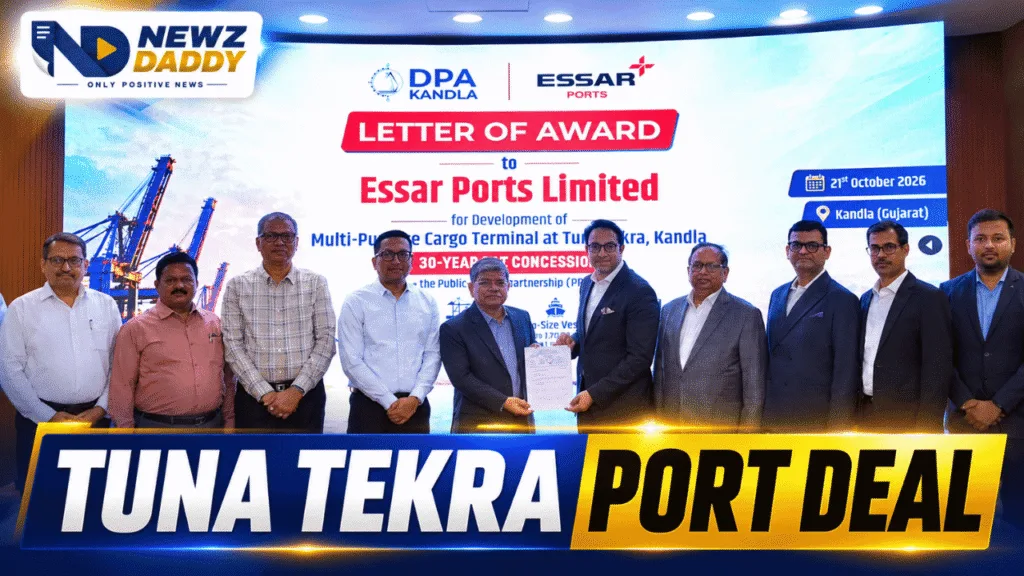
Essar Ports Wins Tuna Tekra Terminal Contract at Kandla Port
Essar Ports wins ₹2,276 Crore Contract for New Cargo Terminal at Kandla
The 18.33-million-tonne facility at Tuna Tekra will have four berths and handle large cargo ships under a 30-year concession.
Essar Ports Limited has received a Letter of Award from the Deendayal Port Authority (DPA) to build a multipurpose cargo terminal at Tuna Tekra, near Kandla in Gujarat. The project has an estimated cost of ₹2,276.06 crore and will operate under a 30-year Build, Operate and Transfer (BOT) agreement.
Essar Ports emerged as the highest bidder in a global competitive bidding process. The planned terminal will handle up to 18.33 million tonnes of cargo a year, adding capacity to one of India’s busiest major ports.
The project cost includes more than ₹1,552.57 crore to be invested by Essar Ports and ₹723.49 crore from the Deendayal Port Authority. Under the BOT model, a private company builds and operates a facility for an agreed period before transferring it to the public authority under the terms of the concession.
The award marks a new step in the development of cargo facilities at Tuna Tekra, where the port authority is working on separate plans to expand container handling.
The proposed terminal will have four berths, each measuring 300 metres. Together, they will provide 1,200 metres of berth space for ships loading and unloading goods.
The facility is designed to receive vessels of up to 170,000 deadweight tonnes (DWT), with a maximum draft of 18 metres. Deadweight tonnage measures the total weight a ship can carry, including cargo, fuel and supplies. Draft refers to the depth of a ship below the waterline, which determines how much water depth it needs to enter a port safely.
The terminal will handle multipurpose cargo rather than containers or liquid cargo. Such facilities can serve different types of goods, including bulk materials and other freight that requires suitable handling and storage arrangements.
A larger vessel can carry more cargo in a single voyage. This can help reduce the number of ship movements needed for a given volume of goods, although the actual benefit will depend on cargo demand, loading facilities and transport links beyond the port.
The port authority will provide shared infrastructure for the project. This includes dredging the access channel, berth pockets and turning circles, along with a common approach road. Dredging removes material from the seabed to create the depth needed for ships to enter, turn and berth.
The terminal must follow applicable environmental rules and the Green Port Policy.
The new terminal forms part of a wider plan to increase cargo-handling capacity at Deendayal Port, which serves Gujarat and several inland states. Its transport links connect businesses in northern and western India with overseas markets.
According to the port authority’s 2025 administrative report, Deendayal Port handled 150.16 million tonnes of cargo during the 2024-25 financial year, ranking second among India’s major ports by cargo volume. It handled 3,732 ships during the same period.
These figures explain the need for more cargo-handling space as trade grows. Additional berths could help the port manage different types of goods while reducing pressure on existing dry-cargo facilities.
The Indian government had outlined plans for a multipurpose cargo berth and a separate container terminal at Tuna Tekra in 2022. The multipurpose facility was planned to handle goods such as coal, food grains, fertilisers, ores, minerals and steel. Moving some cargo operations from the existing Kandla facilities to Tuna Tekra was also part of the earlier plan.
The two facilities serve different purposes. A multipurpose terminal handles various categories of freight, while a container terminal specialises in standardised shipping containers.
Tuna Tekra is also the site of a separate container terminal project awarded to a company linked to DP World. Announced in 2023, that project has a planned annual capacity of 2.19 million twenty-foot equivalent units (TEUs), the standard measure used to count container capacity.
In March 2026, the Ministry of Ports, Shipping and Waterways announced approval for a ₹472 crore road overbridge and related road works at Tuna Tekra. The planned connection is intended to serve both the container terminal and the multipurpose cargo berth.
These projects show why road and marine infrastructure must develop alongside port capacity. Faster loading and unloading at a berth will offer limited benefits if trucks cannot move goods away from the port efficiently. Rail connections, road access and sufficient space for cargo storage will also affect how well the facilities perform.
For manufacturers, exporters and importers, better cargo movement could help reduce delays. The final effect on transport costs will depend on operating efficiency, cargo volumes and the time needed to move goods between ships, storage areas and inland destinations.
Ashish Rajgarhia, CEO of Essar Ports, said the award marked a new phase for the company. He said, “The Tuna-Tekra project marks a defining moment for Essar Ports as we embark on a new journey to rebuild and expand our ports business. With an investment of approximately ₹2,000 crore, this project will serve as the foundation for our next phase of growth. We are particularly proud to take forward a project whose foundation stone was laid by Honourable Prime Minister Shri Narendra Modi ji. Through this investment, we reaffirm our commitment to building world-class maritime infrastructure and contributing to the Prime Minister’s vision of Viksit Bharat 2047.”
The statement refers to an investment of approximately ₹2,000 crore, while the announced contribution by Essar Ports exceeds ₹1,552.57 crore within the total estimated project cost of ₹2,276.06 crore.
Mr V. Srinivasan, Operating Partner-Infrastructure at Essar Group, said: “Essar Ports is entering an important phase of its growth journey, focused on expanding its portfolio, strengthening its operational capabilities and creating sustainable long-term value. Our strategy is to build on our established expertise in port infrastructure while pursuing opportunities that support India’s growing trade and infrastructure requirements. We remain committed to disciplined investments, operational excellence and building a stronger, future-ready business that delivers lasting value for all stakeholders, including our shareholders.”
Essar Group has more than five decades of business experience across energy, infrastructure, metals and mining, technology and retail. Essar Ports operates around 60 million tonnes per year of port capacity across Gujarat, Indonesia and the United Kingdom.
The new award gives the company a larger role in India’s port sector. Its success will depend on completing construction, meeting environmental requirements and running the terminal efficiently once it opens. For Deendayal Port, the test will be whether the added capacity helps cargo move more quickly and supports businesses that depend on reliable shipping services.