


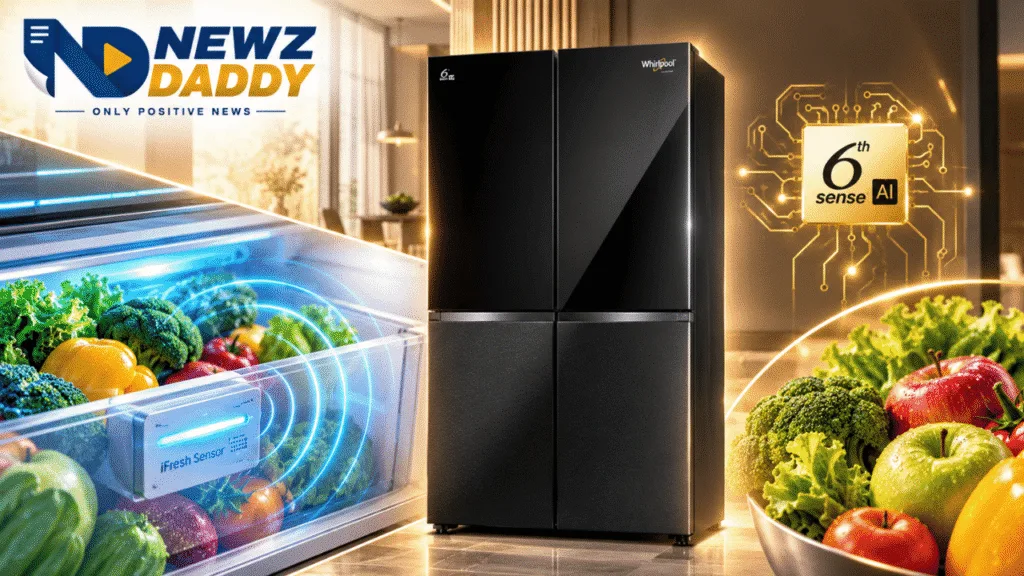
Freshness Detection Comes to Whirlpool’s Luxury Fridges
Whirlpool’s New Refrigerator Technology Aims to Warn Households Before Fresh Food Spoils
Whirlpool of India has introduced a refrigerator technology that can detect changes in the freshness of fruit and vegetables and alert users when their produce may be nearing over-ripening. The system, called Freshness Detection Technology, uses the company’s 6th Sense AI and is being offered in its new Luxuriem range of four-door refrigerators.
The company says the technology is a first for India. It has been developed to address a common problem in Indian kitchens, where families often buy fruit and vegetables in bulk during weekly shopping trips and store them in the refrigerator for several days.
Once produce is placed inside, some items may begin to ripen without showing clear signs of change. Food kept at the back of a crisper drawer can remain unnoticed until it is too late to eat.
Whirlpool says its new system can alert users before that happens, allowing them to check their food and decide what should be eaten first.
Nakul Tewari, Vice President of Marketing at Whirlpool of India, said the company had studied the way Indian consumers store and manage fresh food.
“The Indian consumer today is extremely time-challenged. Despite the advent of Q-Com, they still prefer buying vegetables and fruits in bulk. Once these fruits and vegetables are kept inside the refrigerator, they often get pushed to the back and naturally start ripening, leading to either wastage or consumption post peak freshness. This is by far the biggest consumer pain point today with respect to refrigeration, and they wish for a solution which would alert them before fruits and vegetables start spoiling.”
The system uses Whirlpool’s iFresh Sensor Engine, with an iFresh Sensor fitted inside the refrigerator’s crisper drawer.
The sensor tracks ethylene, a natural gas released by many fruits and vegetables as they ripen. The amount released can change as produce ages.
Whirlpool says its 6th Sense AI checks the ethylene levels every 10 seconds. When the system detects a rise linked to over-ripening, it sends an alert to the user.
The warning is meant to help people check their stored food before visible signs of spoilage appear. The refrigerator also has a screen interface that shows the freshness status of produce stored in the crisper.
The technology does not mean that every fruit or vegetable will remain fresh for a fixed number of days. Its main purpose is to identify changes in the produce and alert users when they may need to take action.
Fresh produce does not ripen at the same rate. Some fruits release more ethylene than others, while certain vegetables produce lower amounts.
Whirlpool says its Full-Spectrum Produce Detection system has been developed to recognise differences in ethylene emissions across a range of food items.
The company lists apples, pears, kiwis, avocados and peaches among high-ethylene emitters. Lettuce, cabbage, broccoli and cauliflower are among the low-ethylene emitters included in the system’s design.
Whirlpool says it worked with food scientists to study how the technology responds to the range of fruits and vegetables eaten in Indian households across different regions and seasons.
This matters because Indian families often store several kinds of produce together. A system that tracks only one type of fruit or vegetable would offer limited help to households with varied food habits.
The refrigerator also uses feedback from consumers to adjust its alert system.
When a warning appears, users can check their produce and reset the notification. Whirlpool says the system records this feedback and uses it to adjust future alert levels to match household preferences.
The company describes this as adaptive learning, with the AI using information from repeated checks to improve how it responds to changes in stored produce.
The system is designed to work within the refrigerator, using its sensors and software to monitor food in the crisper drawer.
Whirlpool says the technology reflects its approach to using AI for everyday household needs. Whether it reduces food waste in homes will depend on how well the alerts work and how consumers respond to them.
Freshness Detection Technology is part of Whirlpool’s Luxuriem four-door refrigerator range, which was launched in India in 2026.
The company has expanded the range with models in 645-litre, 651-litre and 654-litre capacities. Prices start at Rs 98,000.
The refrigerators will be available in premium finishes through retail stores and online platforms across India.
The Luxuriem range also builds on Whirlpool’s existing refrigeration technologies. In September 2026, the company announced the range with 360-degree Triple Cooling Technology.
Whirlpool has used sensor-based systems in its refrigerators for several years. Its earlier 6th Sense Intellifresh technology, introduced in 2016, used sensors to monitor internal load and outside temperature and adjust cooling.
The new freshness detection system adds another task: tracking changes in produce stored inside the refrigerator.
Food waste remains a concern for households that buy more fresh food than they can use before it spoils. A warning system could help consumers identify items that need attention and plan meals around them.
However, the technology’s real value will depend on how accurately it detects changes in freshness across different types of produce, and whether alerts arrive early enough for families to use the food.
Whirlpool has not provided independent figures showing how much food waste the new system could prevent in Indian homes.
For consumers, the price will also matter. With the Luxuriem range starting at Rs 98,000, the technology is aimed at buyers considering premium refrigerators.
The launch marks a new step in refrigerator design in India, where manufacturers have long focused on cooling, storage space and energy use. Whirlpool is now adding a feature intended to help people keep track of the food they store.
For families who regularly stock up on fresh produce, the test will be simple: whether the refrigerator can give them enough warning to use their food before it spoils.
Must Read:
Disney Adventure Sets Sail: Bringing Disney Magic to Asia in 2025