


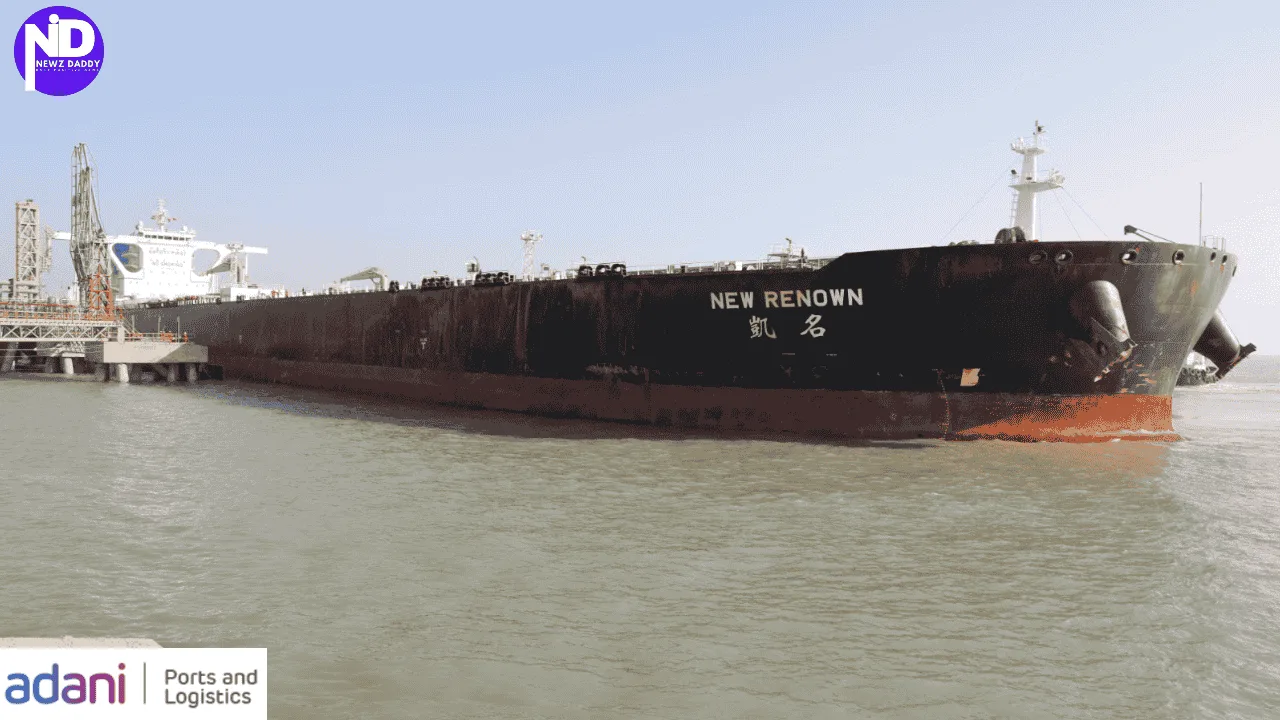
Fully Laden VLCC at Mundra Port Changes India’s Oil Game
Adani Ports’ Mundra Berths Nation’s First Fully Laden Very Large Crude Carrier
In a defining moment for India’s maritime and energy infrastructure, Adani Ports and Special Economic Zone Ltd. (APSEZ) today announced the berthing of India’s first-ever fully laden Very Large Crude Carrier (VLCC) at its Mundra Port. With the docking of Mt New Renown, which has a total cargo capacity of 3.3 lakh m³ (cubic metres), Mundra became the first port in India to handle a fully laden VLCC at berth.
This moment is important because VLCCs are among the largest ships in the world and are usually handled offshore due to their massive size and deep draft. Many Indian ports have depended on offshore transfer systems for decades. By bringing a fully loaded VLCC directly to the jetty, Mundra has crossed a technical barrier that few ports globally have managed to overcome.
This development also highlights Mundra’s significance as the first port in the country and among a select few in the world to have a dedicated jetty capable of directly berthing fully laden VLCCs.
Globally, only a handful of ports in regions such as the Middle East and parts of East Asia can handle such vessels at full load. This puts Mundra in a rare category and shows how Indian port infrastructure is now matching international standards, especially in energy logistics.
The handling of Mt New Renown was executed under challenging conditions with strong currents, winds and sea states, showcasing the expertise, coordination and operational excellence of the APSEZ marine team and port management.
Handling a VLCC safely requires precise planning, experienced pilots, advanced navigation systems and close coordination between ship crew and port authorities. Any small error can lead to delays or damage. Successfully managing this operation reflects the training and preparedness of the Indian maritime workforce.
The port facility allows berthing of a fully laden VLCC at maximum displacement and represents a transformational shift in India’s crude oil logistics, enabling safer, faster and more cost-efficient crude handling through direct jetty operations. This milestone underscores APSEZ’s leadership in developing world-class, future-ready port infrastructure aligned with India’s growing energy and trade requirements.
India is one of the world’s largest importers of crude oil. Faster unloading means quicker movement of oil to refineries and lower waiting time for ships. This also reduces fuel costs, emissions and risks linked to offshore transfers, making the process both economical and environmentally safer.
Direct jetty berthing of fully laden VLCCs is available at only a limited number of ports across the world due to extreme draft, displacement and infrastructure requirements of these vessels. With this achievement, Mundra Port is now among select global crude handling hubs, strengthening India’s position on the global maritime and energy map. Mundra’s advanced vessel-handling capability eliminates dependency on offshore Single Point Moorings (SPMs) or lighter operations that were traditionally used for such large vessels.
Offshore lightening involves transferring crude oil from large ships to smaller vessels, which can be slow and risky. Removing this step improves safety and reliability, especially during rough weather.
Mundra’s VLCC jetty is seamlessly connected via a roughly 489-kilometre crude oil pipeline to the HPCL Rajasthan Refinery at Barmer, one of India’s most strategic refining assets. This direct connectivity significantly enhances India’s energy security, improves the efficiency of large-scale crude imports, strengthens supply chain resilience and supports regional economic growth across Gujarat and Rajasthan.
Reliable crude supply helps refineries run at full capacity, which supports fuel availability across northern India. It also creates jobs and boosts local industries linked to transport, storage and maintenance.
The purpose-built VLCC jetty at Mundra is a pioneering engineering and operational achievement. With a jetty length of 400 metres, a berth pocket depth of 25 metres, maximum acceptable length overall of 333 metres, maximum displacement of 3,60,000 metric tonnes and a maximum draft of 21.6 metres, the facility is designed for the world’s largest oil tankers.
Its cargo handling system, including two 20-inch crude oil loading arms and a discharge rate of up to 12,000 cubic metres per hour, allows faster unloading. The marine infrastructure, including breasting and mooring dolphins with high-capacity hooks and advanced fender systems, ensures vessel safety during berthing.
Mundra, APSEZ’s flagship port and India’s largest commercial port, is strategically located in the Gulf of Kutch and serves as a key maritime gateway for northern and western India. Its deep-water, all-weather nature allows year-round operations without major disruption.
With 27 operational berths and two SPMs, the port handles a wide range of cargo, from containers and coal to crude oil and automobiles. Its ability to accommodate Cape-size vessels, VLCCs, ULCCs and ultra-large container vessels reflects its unmatched scale.
Mundra is also India’s largest container handling port. Becoming the first port in the country to cross 200 million metric tonnes of cargo in a single year during 2024–25 shows how vital it has become to India’s trade network.
Mundra Port’s recognition in the World Bank’s Container Port Performance Index for 2024 and 2025 highlights its efficiency, reliability and strong adherence to global best practices. Such recognition builds confidence among global shipping lines and investors, reinforcing India’s image as a serious maritime and logistics power.