


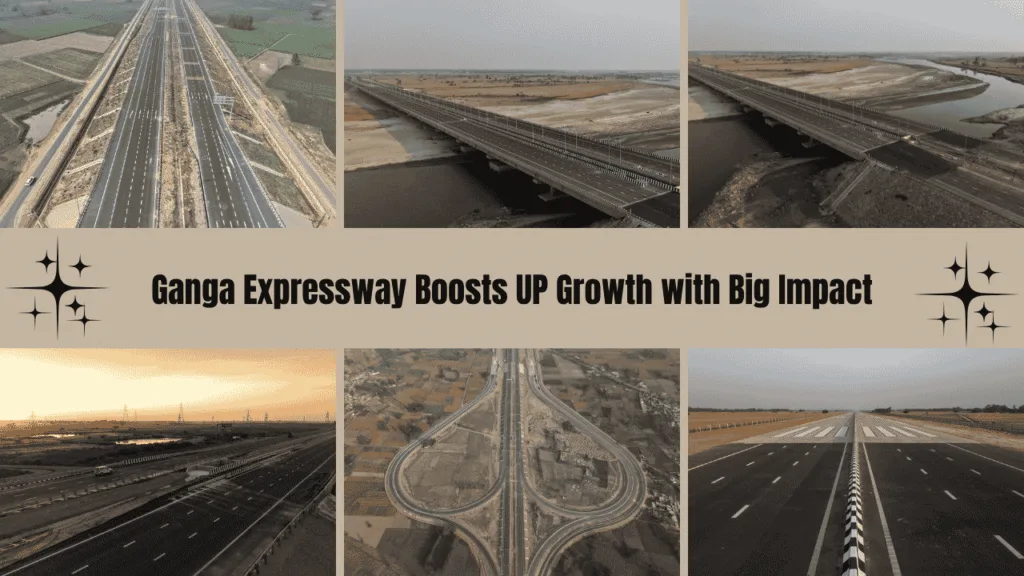
Ganga Expressway Boosts UP Growth with Big Impact
Ganga Expressway Improves Safety with Smart AI Road Systems
Prime Minister Narendra Modi today inaugurated the 594-km Ganga Expressway, one of India’s largest greenfield infrastructure projects that was completed in less than 3.5 years, connecting Meerut in western Uttar Pradesh (UP) with Prayagraj in the eastern region of the country’s most populous state.
This expressway comes at a time when India is putting strong focus on faster roads to drive growth. Over the past decade, studies by NITI Aayog and the World Bank have shown that better highways can raise local incomes and reduce poverty in slower regions. Eastern UP has long faced this gap. Many districts have high populations but limited industrial growth. With this road, goods and people can move faster, which often leads to more factories, warehouses, and small businesses coming up along the route.
For decades, eastern UP has remained underdeveloped despite its demographic and economic potential. The expressway is set to unlock this latent potential by improving access, reducing distances and integrating the region more closely with the state’s growth corridors. The project will reduce travel time from about 11 hours to nearly six hours and open new economic opportunities across the state. The expressway has deployed AI-enabled camera systems to provide advanced alerts and enhance road safety.
Road safety has been a major concern in India. Government data shows that thousands of accidents happen each year due to overspeeding and poor monitoring. The use of AI cameras on this expressway is part of a larger push across India to create “smart highways”. These systems can detect lane cutting, overspeeding, and driver fatigue. Countries like the UK and Japan have used similar systems to reduce accidents over time. If used well, such tools can save many lives on long-distance routes.
A 3.5 km stretch in Shahjahanpur district has been developed as a dedicated Emergency Landing Facility (ELF) for the Indian Air Force (IAF), facilitating aircraft landing and strengthening the corridor’s strategic capabilities.
This feature adds a defence angle to the project. India has been building such airstrips on highways in recent years. Similar landing strips exist on the Lucknow-Agra Expressway and parts of the Rajasthan highways. Defence experts often point out that such facilities help in emergencies or during conflict, as fighter jets can land, refuel, and take off quickly without relying only on airbases.
Spanning 12 districts, the six-lane expressway, expandable to eight lanes, will improve access to markets, healthcare, education and tourism hubs. For families, this means quicker access to essential services, and for businesses, faster connections to markets.
In many parts of eastern UP, people travel long distances for hospitals and colleges. Reports from rural development groups show that better roads often lead to higher school attendance and faster medical help. For example, when highway access improves, ambulance response time drops. This can make a real difference in emergencies. For small traders and farmers, reaching city markets faster often means better prices and less spoilage.
Adani Road Transport Limited (ARTL), the roads arm of Adani Enterprises Limited (AEL), developed 464 km, or nearly 80 per cent of the alignment, deploying over 12,000 workers at peak construction. The remaining stretch was developed by IRB Infrastructure.
Large projects like this also bring short-term economic activity. During construction, thousands of workers get jobs. Cement, steel, and local services see demand rise. Industry reports suggest that highway construction has a strong multiplier effect, meaning every rupee spent can create more economic activity around it.
According to the UP government’s estimates, the expressway is expected to generate ₹25,000–30,000 crore in annual logistics savings, create around 3 lakh jobs over the next decade and contribute over ₹1 lakh crore to the state’s GDP, while improving freight velocity and reducing inventory holding costs across sectors.
India’s logistics costs are still higher than those of many developed countries. Faster highways help trucks move more quickly, which reduces fuel use and storage time. Experts say that cutting logistics costs, even by a few percent, can make Indian goods more competitive in both domestic and global markets. This is especially important for agriculture and small industries.
The trunk corridor will strengthen trade flows by enabling faster movement of agricultural produce and goods. Farmers and small businesses stand to benefit from improved market access and better price realisation.
In states like Punjab and Maharashtra, better road links have helped farmers reach larger mandis and even export hubs. Eastern UP farmers often face delays, which reduce the value of perishable goods. With this expressway, fruits, vegetables, and dairy products can reach cities more quickly, helping farmers earn more.
The expressway also strengthens UP’s industrial and agricultural connectivity and improves access to religious destinations such as Prayagraj and Varanasi, thereby supporting spiritual tourism and local livelihoods.
Tourism plays a big role in UP’s economy. Cities like Varanasi and Prayagraj attract millions of visitors each year. Easier travel often leads to more footfall. This benefits hotels, guides, transport services, and small shops. During events like the Kumbh Mela, better roads help manage large crowds more safely.
Expected to benefit over 8 crore people, the corridor will improve connectivity, shorten journeys, and support sustained economic growth across UP.
Large expressways often shape growth for decades. Areas along the route may see new townships, industries, and service hubs. If planned well, this can bring balanced development across regions that were earlier left behind.