


Gautam Adani Ayodhya Visit Wins Hearts Nationwide
In Ayodhya, Gautam Adani Reaffirms Faith and Seva, Honouring India’s Living Traditions
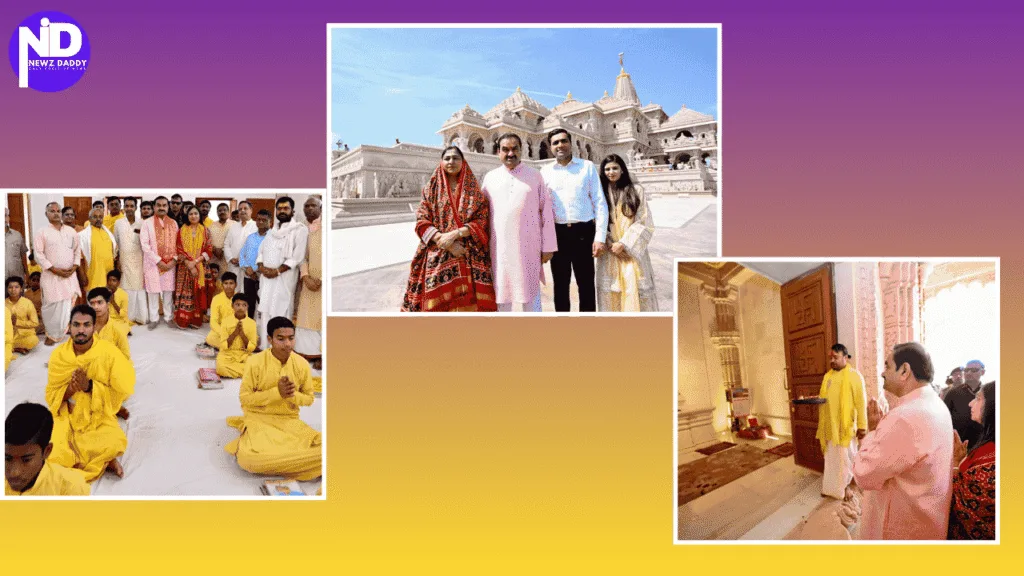
In Ayodhya, the Chairman of the Adani Group undertook a darshan at the Shri Ram Temple with his family, followed by an interaction at a historic gurukul.
The gurukul interaction included the proposed introduction of an AI-enabled laboratory to integrate traditional education with evolving learning opportunities.
The visit reflected India’s enduring knowledge traditions and the continuity between faith and learning.
Ayodhya, 2 April 2026: Mr Gautam Adani, Chairman of the Adani Group, visited Ayodhya for a darshan with his wife Dr Priti Adani, elder son Karan Adani and daughter-in-law Paridhi Adani, to offer prayers and pay respects at the Shri Ram Temple, before proceeding to Shri Nishulk Gurukul Mahavidyalaya for an institutional interaction. The Shri Ram Temple, located at the birthplace of Lord Ram, stands as a symbol of faith, devotion and civilisational continuity.
In recent months, Ayodhya has seen a steady rise in visitors from across India and abroad. Reports from travel and tourism bodies suggest that improved infrastructure, better roads and new rail links have made the city more accessible. Pilgrimage tourism has grown sharply, and many families now combine religious visits with cultural exploration. This growing footfall has also supported local businesses, from small shops to hospitality services.
Mr Adani said his visit, which coincided with Hanuman Jayanti, was a deeply personal moment, blending faith with a broader national narrative.
Across India, Hanuman Jayanti is marked with prayers, processions and community service. In many cities, people organise food distribution drives and temple gatherings. Cultural observers note that such festivals continue to play a strong role in keeping community bonds active, especially among younger generations who are rediscovering traditional practices through family and social media.
Describing the darshan as one of “extreme emotion and pride,” he positioned the shrine as more than a religious landmark, highlighting it as a symbol of India’s cultural continuity, unity and rising self-confidence, while invoking the ideals of Lord Ram — honesty, duty and service — as guiding principles for the nation’s journey ahead.
Scholars of Indian culture often point out that Lord Ram’s story has shaped moral thinking for centuries. Texts like the Ramayana are still taught in schools and discussed in homes. Many leadership experts also refer to these values when speaking about ethics and responsibility in public life.
Carrying this reflection forward, the visit transitioned from a moment of faith to a living expression of India’s knowledge traditions at Shri Nishulk Gurukul Mahavidyalaya, located around 10 minutes from the temple.
Established in 1935 by Swami Tyaganand Ji and rooted in the principles of the Arya Samaj, a reformist movement that emphasises Vedic learning, social upliftment and accessible education, it follows the traditional gurukul system. In this residential model, students live and study under the guidance of teachers.
Education experts have recently shown growing interest in the gurukul model. Studies published in academic journals highlight that such systems focus on discipline, daily routines and close teacher-student bonds. Some educators believe that this approach can help improve focus and emotional strength among students, especially in a time when digital distractions are high.
Mr Adani interacted with students and faculty and observed a learning environment where discipline, inquiry and values come together to preserve and transmit India’s civilisational knowledge systems.
“When learning is rooted in values, it does not just shape individuals; it shapes the future of a nation. Our responsibility is to carry these traditions forward while preparing for the opportunities of tomorrow,” he said. He emphasised the urgency of preserving India’s knowledge systems even as the country accelerates into an AI-driven future. He affirmed that the Adani Foundation, the social welfare and development arm of the Adani Group, will support the gurukul ecosystem by enabling a convergence of tradition and technology through an AI-enabled laboratory.
Across India, there is a growing push to bring technology into education. Government programmes and private initiatives are introducing digital classrooms, coding lessons and AI tools even in rural areas. Experts say that combining modern tools with traditional learning can help students stay rooted while also preparing for future careers.
With around 200 students, the Gurukul offers free education, ensuring that knowledge remains accessible and inclusive. The campus also includes a gaushala, a traditional cow shelter, reflecting the integration of cultural, ecological and rural practices within the learning environment. The institution carries a rich legacy, with Mahatma Gandhi and Subhas Chandra Bose among its early visitors.
Free education models like this have been widely discussed in education forums. Experts say that access to free and value-based education can help bridge gaps for students from rural and low-income families. Institutions that combine academics with life skills often see better long-term outcomes for students.
As students recited Sanskrit shlokas in unison, the cadence of their voices echoed across the campus, reflecting both rigour and reverence. Seated among them, Mr Adani listened closely, engaging with the faculty and observing the rhythm of a system where learning extends beyond the classroom into daily life.
For Mr Adani, these ideals find expression in seva, a philosophy he often describes as “Seva Hi Sadhana Hai,” where service is not an act but a sustained commitment to society, rooted in humility, responsibility and purpose.
Social thinkers often describe seva as a core part of Indian life. From community kitchens to volunteer work during festivals, many people practise service in their daily routines. This idea has also influenced modern corporate social responsibility programmes across India.
Today’s visit builds on Mr Adani’s continued engagement with these traditions, including the Maha Kumbh Mela in Prayagraj and the Jagannath Rath Yatra in Puri last year, which he had described as a moment of collective national fulfilment, and his support for advancing the study of Indology through initiatives that encourage deeper engagement with India’s history, languages, philosophy and cultural heritage.
Experts in cultural studies note that such large-scale festivals attract millions of people and create a strong sense of shared identity. They also support local economies and keep traditional art, music and rituals alive for future generations.