


GREENS 2026 Sparks Hope for Recycling Growth in Gandhinagar
Harsh Sanghavi Backs GREENS 2026 with a Strong Sustainability Message
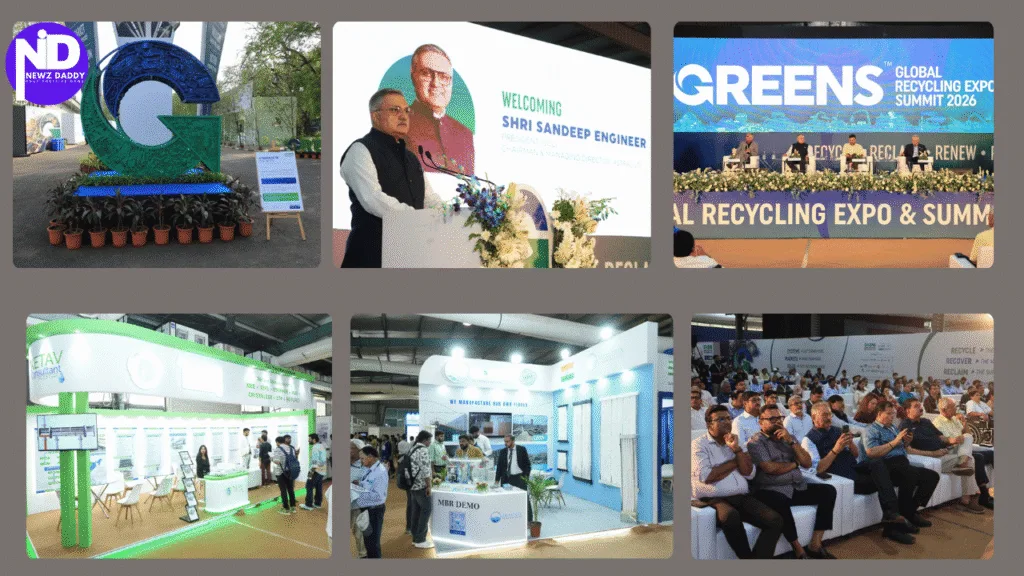
GREENS 2026, a Global Recycling Expo and Summit at the Helipad Exhibition Centre in Gandhinagar, was virtually inaugurated on Thursday by Gujarat Deputy Chief Minister Shri Harsh Sanghavi.
GREENS 2026 is India’s premier dedicated national platform for recycling, circular economy and waste-to-resource transformation. The event is co-organised by SALT Alliances and the Gujarat Chamber of Commerce and Industry (GCCI). The three-day expo is being held from June 4 to 6, 2026, with iNDEXTb as the industry partner and Deloitte India as a knowledge partner, and with knowledge support from the Gujarat Pollution Control Board (GPCB).
Shri Shekharbhai Patel, CREDAI National President and MD and CEO of Ganesh Housing, attended as the Guest of Honour.
GREENS 2026 brings together more than 100 industry leaders, over 70 speakers and exhibitors representing 14 sectors across three days, covering the full spectrum of India’s recycling and circular economy ecosystem. The event is also an official Side Event of the World Circular Economy Forum (WCEF) 2026.
The recognition as a World Circular Economy Forum side event places GREENS 2026 within a growing global movement that is encouraging countries and industries to move away from the traditional model of making, using and discarding products. India is set to host the World Circular Economy Forum later in 2026, making discussions around recycling, resource efficiency and sustainable manufacturing more important than ever. Experts believe that circular economy practices can reduce waste, create jobs and lower pressure on natural resources.
During the keynote address, Shri Harsh Sanghavi said, “India generates at least 150 million metric tonnes of waste every year, and as we proceed to become a net-zero economy, platforms such as Greens 2026 are important for deliberation by experts and industry stakeholders for issues like recycling and waste management. These are not just environment-related issues but are directly linked with our country’s development and progress”.
Waste management has become one of India’s biggest environmental challenges. Various studies show that the country generates tens of millions of tonnes of municipal waste every year, while rapid urban growth continues to increase the burden on cities and local authorities. Experts say that improving waste segregation, collection and recycling systems will be critical if India wants to meet its climate and sustainability goals in the coming decades.
Through its exhibition and plenary sessions, GREENS 2026 has brought together policymakers, industry stalwarts and sector leaders to deliberate on a range of critical subjects. These include solid waste management, plastic recycling, metal recycling, e-waste and battery recycling, rubber and ELT recycling, construction and demolition waste management, solar waste management, wastewater and ZLD, AI and technology in recycling, carbon markets and credits, ELV, waste-to-energy, and sustainable start-ups, among others.
Many of these sectors are now experiencing rapid growth. E-waste has become one of the fastest-growing waste streams in India due to the increasing use of electronics and shorter product life cycles. Industry experts have repeatedly warned that stronger collection networks and formal recycling systems are needed to recover valuable materials and reduce environmental risks. At the same time, construction and demolition waste is emerging as another major challenge, creating opportunities for recycling businesses that can turn discarded materials into useful products.
Each session will focus on a range of pressing challenges and evolving regulatory developments that shape India’s development journey.
“India’s growth story can no longer be built on a linear model of consumption and disposal. The circular economy is no longer a niche conversation; it is rather central to the future of manufacturing and economic growth. With GREENS 2026, we aim to create a collaborative platform that brings together industry, policymakers and innovators for a dialogue on recycling, waste management and circular economy solutions,” said Shri Ketan Prajapati, Director, SALT Alliances.
Industry reports suggest that circular economy practices can help businesses reduce costs, improve resource efficiency and cut greenhouse gas emissions. Recycling materials such as aluminium, plastics and metals often requires far less energy than producing them from raw resources. As India works towards its long-term net-zero commitments, recycling is increasingly being viewed as both an environmental and economic opportunity.
Confirmed speakers include Sandeep Patel (Chairman, NEPRA), Sanjay Mehta (President, MRAI), Sumit Issar (MD and CEO, Mahindra Accelo), Chetan Joshi (President, Global Affairs, Tyre and Rubber Recyclers Association of India), Mani Vajipey (Co-Founder and CEO, Banyan Nation), Anupam Jalote (GM, Rare Earth Projects and Strategic Partnerships, GMDC and CEO, ICEM), Nagaraja Prakasam (Author, Angel Investor, Mentor and Partner, Acumen Fund), and others.
The presence of leaders from recycling, manufacturing, investment and sustainability sectors reflects how circular economy discussions now extend beyond environmental concerns. Investors and businesses increasingly see recycling and resource recovery as areas with strong growth potential, innovation opportunities and job creation benefits. Global forums and industry events have repeatedly stressed that collaboration between government, industry and innovators will be essential for scaling circular economy solutions.
During the opening remarks, Shri Sandeep Engineer, President, GCCI and Chairman and Managing Director, Astral Limited, said, “India’s industrial growth must now be aligned with sustainability, innovation and efficient resource utilisation. This is the only way forward. GREENS 2026 provides a much-needed platform for industry leaders and policymakers to collectively work towards that vision of bringing about a long-term, sustainable transformation.”
GREENS 2026 is a zero-waste-to-landfill and carbon-neutral event, holding itself to the same standard it asks of the industry it convenes. The expo floor features a dedicated Waste-to-Art installation zone, with large-scale sculptures built entirely from recovered industrial waste, making visible what the summit argues in its sessions: that waste is not a problem to be disposed of, but a resource to be designed with.
This approach reflects a growing trend worldwide. Many cities, businesses and institutions are now exploring ways to keep materials in use for longer through reuse, repair and recycling. Waste-to-art projects have also gained popularity because they help people see discarded materials differently and encourage greater public awareness about responsible consumption and waste reduction.
GREENS 2026 is the first edition of what is envisioned as India’s permanent annual platform for recycling and circular economy transformation. As governments, industries and consumers increasingly focus on sustainability, the event signals the growing importance of recycling and circular economy practices in shaping India’s future development path.
Must Read:
Gujarat’s Solar Revolution: How the State is Leading India’s Green Future
Recycling and Circular Economy: Powering a Sustainable Future