


GSFC University Launches IEEE Branch in Vadodara Campus
GSFC University Starts IEEE Student Branch, Giving Students Wider Access to Technical Networks
Students at GSFC University now have access to an IEEE Student Branch, adding a new platform for technical activities, research discussions and contact with professionals working in engineering and technology.
The branch, approved by the Institute of Electrical and Electronics Engineers (IEEE), was formally inaugurated by Prof. (Dr.) Anil K. Roy, President of the IEEE Sensors Council for 2026-27, according to the university.
The new branch comes as GSFC University expands the number of professional and student groups available to its students. The university says it has more than 25 student-managed clubs and professional chapters. Its existing academic activities include an ACM Student Chapter and a Code Club, while the IEEE Student Chapter began in the 2026-27 academic year.

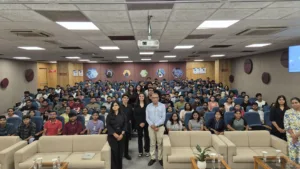
For students, the value of an IEEE branch will depend largely on the activities it conducts. IEEE Student Branches are designed to connect students with other students, faculty members and professionals. Branches can organise technical meetings, workshops, conferences, projects and outreach programmes, giving students opportunities to work outside their regular classroom timetable.
GSFC University plans to use the branch for technical talks, workshops, seminars, competitions, projects and knowledge-sharing programmes. Students will also be able to interact with experts and other student groups working in technology-related fields.
The wider IEEE network gives such student groups access to resources beyond an individual college. IEEE says it has thousands of Student Branches worldwide, with branches spread across more than 100 countries. Its student programmes include competitions, educational support, professional networking and opportunities to take part in conferences and projects.
India has a large IEEE student network. IEEE’s India operation reports more than 700 active Student Branches at educational institutions across the country. It also reports more than 50,000 IEEE members in India and more than 150 technical conferences held in the country each year.
That scale matters for students who want to understand how technical work is discussed outside their university. A student working on artificial intelligence, data science, electronics, sensors, communication systems or another engineering field can use professional societies to meet people working in related areas and learn about conferences, research work and technical competitions.
IEEE also provides support to Student Branches in areas such as event funding, professional awareness programmes, project development and networking. Its student resources include leadership training, technical resources, event reporting tools and programmes such as the IEEEXtreme programming competition.
Prof. (Dr.) Anil K. Roy brings long-standing IEEE experience to the inauguration. He is associated with Dhirubhai Ambani University, formerly DA-IICT, in Gandhinagar. His academic areas include image processing, fibre optics and optical communication, semiconductor devices, nanotechnology and technology applications for humanitarian challenges. His university profile records two terms as Vice President for Technical Operations of the IEEE Sensors Council from 2020 to 2023 and his term as President-elect for 2024-25.
Records from the IEEE Gujarat Section also show his long association with the organisation. He has served in several IEEE positions, including roles connected with the Sensors Council and IEEE India Council. He received the IEEE Sensors Council Meritorious Service Award in 2017 and other IEEE recognitions for his volunteer and leadership work.
The IEEE Sensors Council is particularly relevant to fields where physical devices collect information from the surrounding environment. Sensors are used in areas such as healthcare, manufacturing, transport, communications and connected devices. Roy’s past IEEE work has included subjects such as sensors, the Internet of Things, 5G, image processing and smart-city technology.
GSFC University already has links with professional bodies through other student chapters. Its ACM Student Chapter, for instance, is aimed at students interested in computer science and technology and connects them with a wider community of professionals, researchers and peers. The addition of IEEE gives students another route into technical communities outside the university.
The branch also gives students a chance to take responsibility for organising events. IEEE’s own guidance says a Student Branch normally involves student officers, a faculty adviser and committees handling different activities. Running such programmes can give students experience in organising technical events, working with speakers and managing projects.
For GSFC University, the test will now be in how regularly the branch operates and how many students take part. A student chapter can have a visible effect on campus life when talks lead to projects, projects lead to research work, and students get opportunities to meet people outside their immediate academic circle.
The university’s new IEEE Student Branch therefore places another professional network within the campus. Its first academic year, 2026-27, will show how that network is used by students and faculty and what programmes emerge from it.
Must Read:
GSFC University Convocation Sees Women Lead The Gold Medal Tally
GSFC University Placements 2026 Reach 100% Across Three Courses