


Bhupendra Patel Leads Viksit Bharat Sankalp Sammelan in Ahmedabad
Bhupendra Patel Leads Discussion on India’s Development Roadmap at Viksit Bharat Sammelan
Political leaders, elected representatives and members of the public gathered in Ahmedabad for a ‘Viksit Bharat Sankalp Sammelan’, an event organised as part of a nationwide campaign marking 12 years of the Narendra Modi-led Central Government.
Held under the theme “12 Years of Trust, Development and Public Welfare”, the programme focused on the government’s development record since 2014 and its long-term goal of transforming India into a developed nation by 2047, the year that will mark 100 years of the country’s independence.
Chief Minister Bhupendra Patel addressed the gathering and spoke about changes that have taken place in Gujarat and across India during the past decade. He said development, public welfare and public trust are closely linked and argued that government schemes have strengthened confidence among citizens by delivering benefits directly to beneficiaries.

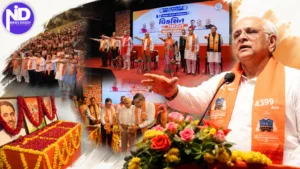
The event formed part of a larger national outreach effort taking place across different states to present achievements claimed by the National Democratic Alliance (NDA) government, which completed 12 years in office this year. The idea of a “Viksit Bharat”, or Developed India, has become a central policy objective of the government, with targets linked to economic growth, infrastructure expansion, manufacturing, digital services and social welfare.
Gujarat’s Development Story
During his address, Bhupendra Patel reflected on Gujarat’s transformation over the past two decades. He referred to improvements in water supply and electricity access, noting that many parts of the state once struggled with basic infrastructure.
Large-scale irrigation projects linked to the Narmada Canal network have expanded water availability in several regions, including areas that historically faced drought conditions. Kutch, once known for its harsh climate and limited water resources, has seen significant agricultural growth in recent years due to irrigation expansion and improvements in rural infrastructure.
The Chief Minister said such changes had altered the economic prospects of many communities and contributed to higher agricultural productivity.
Gujarat’s development model has often been associated with infrastructure-led growth. Since the early 2000s, the state has invested heavily in roads, industrial corridors, ports, power generation and water management systems. These investments have helped Gujarat become one of India’s leading industrial and export-oriented states. Recent government data shows that Gujarat contributes significantly to India’s industrial output and exports.
Focus on Semiconductors and Manufacturing
Patel also pointed to investments in semiconductor and chip manufacturing projects in Gujarat.
India has increased efforts to build a domestic semiconductor industry as global supply chain disruptions and rising demand for electronic products have highlighted the strategic importance of chip production. Gujarat has emerged as a key location for several proposed semiconductor projects because of its industrial infrastructure, port connectivity and policy support.
The sector is viewed as important for India’s ambitions in electronics manufacturing, artificial intelligence, telecommunications, defence systems and advanced technology development.
Patel said the investments reflected growing international confidence in India and Gujarat as manufacturing destinations.
Welfare Schemes and Direct Benefits
Several speakers at the conference highlighted welfare programmes introduced by the Central Government during the past 12 years.
Among the schemes discussed were Ayushman Bharat, which provides health insurance coverage for eligible families, the Pradhan Mantri Awas Yojana housing programme, the Jan Dhan financial inclusion initiative and the free food grain programme for economically weaker households.
State General Secretary and Zone In-Charge Ajaybhai Brahmbhatt said support for poor and vulnerable families has remained a central feature of government policy. He stated that millions of families have received permanent homes through the housing scheme, while financial and healthcare assistance have expanded through Jan Dhan accounts and Ayushman Cards.
Government data over the years has shown a substantial increase in bank account ownership, digital payments and direct benefit transfers, allowing welfare funds to reach beneficiaries without several traditional intermediaries.
Infrastructure Expansion Takes Centre Stage
Member of Parliament Hasmukhbhai Patel focused his remarks on infrastructure development and logistics.
He argued that reducing transportation costs and improving connectivity are essential for industrial growth and economic competitiveness.
India has invested heavily in highways, railway modernisation, freight corridors, airports and port infrastructure over the past decade. Projects such as the Dedicated Freight Corridor between Delhi and Mumbai have been designed to improve cargo movement and reduce transportation delays.
Railway electrification has also expanded significantly, while the National Highways network has grown through new expressways and road projects.
Patel said the development of a modern cargo terminal at Ahmedabad Airport would help agricultural products reach international markets more quickly, potentially benefiting farmers through better market access.
He also referred to the expansion of metro rail systems in Indian cities, the growth of Gujarat International Finance Tec-City (GIFT City), increasing defence exports and the international success of the Unified Payments Interface (UPI).
UPI has become one of the world’s largest digital payment systems, processing billions of transactions every month and expanding into several international markets. The platform is widely regarded as one of India’s most significant digital public infrastructure projects.
Political and Legislative Milestones
Several speakers referred to major policy decisions and legislative measures introduced during the Modi government’s tenure.
These included the abrogation of Article 370 in Jammu and Kashmir, the introduction of the Goods and Services Tax (GST), the Nari Shakti Vandan Act aimed at increasing women’s representation in legislatures, and the implementation of One Rank One Pension for former armed forces personnel.
City BJP President Prerakbhai Shah described the period since 2014 as one of major political and administrative change. He also mentioned the construction of the Ram Temple in Ayodhya, the Kashi Vishwanath Corridor project, redevelopment work at Kedarnath and Badrinath, and the increase in the height of the Sardar Sarovar Dam.
Many of these projects have featured prominently in national political discussions over the past decade, often being presented by supporters as examples of long-pending initiatives that were eventually completed.
Environment and Citizen Participation
The Chief Minister also called attention to environmental programmes such as Mission LiFE and Catch the Rain.
Mission LiFE, or Lifestyle for Environment, encourages individuals to adopt environmentally responsible habits in daily life. Catch the Rain focuses on rainwater harvesting and water conservation measures.
Patel urged citizens to participate in such initiatives and contribute towards the broader goal of a developed India.
The emphasis on public participation reflects a recurring theme in the government’s Viksit Bharat vision, which seeks to combine economic growth with citizen involvement, technology adoption and sustainable development.
Gathering Draws Public Representatives
The event was attended by Minister of State for Urban Development Darshanaben Vaghela, Ahmedabad Mayor Hiteshbhai Barot, Member of Parliament Dineshbhai Makwana, local legislators, Ahmedabad Municipal Corporation office-bearers and a large number of invited citizens.
As political parties prepare for future electoral contests while also promoting long-term development agendas, programmes such as the Viksit Bharat Sankalp Sammelan are likely to remain an important platform for presenting policy achievements, discussing national goals and engaging with the public on the vision of India in 2047.
For supporters of the initiative, the focus remains on sustaining economic growth and expanding infrastructure. For observers and citizens, the coming years will provide a clearer measure of how these ambitions translate into outcomes on the ground as India moves towards the centenary of its independence.
Also Read:
Gujarat Youth Congress Holds Torch Rally Over NEET Paper Leak
Jagdishbhai Vishwakarma Inaugurates New Community Hall in Ahmedabad