


Gujarat Investment Growth Sparks Bold Future in Ahmedabad
Gujarat Investment Growth Lifts Ahmedabad as a Global Hub
More than 100 ‘Fortune 500’ companies currently operate in the state, underscoring Gujarat’s standing as a preferred destination for global capital. This strong presence is not new. Over the past two decades, Gujarat has built a reputation for stable policies, faster approvals, and strong infrastructure. Many global firms have chosen Gujarat because they can set up factories more quickly here than in many other regions of India. Industrial clusters in places like Sanand, Dholera, and Hazira have already attracted large automobile, energy, and engineering companies, which have helped build trust among international investors.
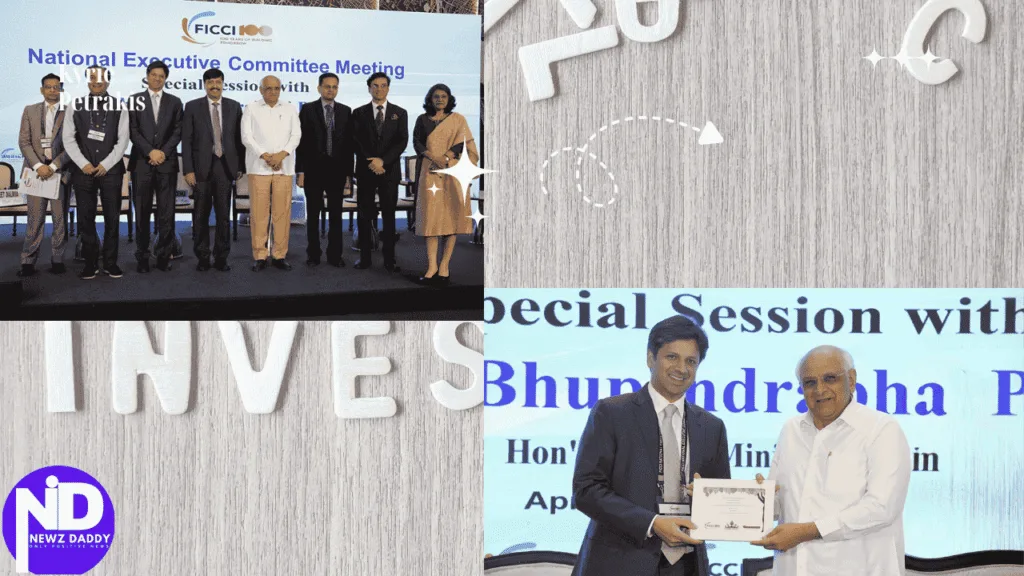
Addressing FICCI’s National Executive Committee Meeting, Gujarat Chief Minister Mr Bhupendrabhai Patel shared the ambitious industrial roadmap for the state, targeting a trillion-dollar economy and raising its share of national GDP to 10 per cent. Economists often point out that Gujarat has been one of India’s fastest-growing states, with strong performance in manufacturing and exports. The state’s focus on ports, roads, and power supply has played a big role. With over 40 ports, including major ones like Mundra and Kandla, Gujarat handles a large share of India’s cargo. This gives industries a clear advantage when it comes to exports.
Honourable Chief Minister Mr Bhupendrabhai Patel alluded to two semiconductor fabrication plants, inaugurated under the Prime Minister’s guidance, as evidence of Gujarat’s emergence as a node in the global semiconductor supply chain, with GIFT City now hosting an AI Centre of Excellence, Data Centres, and fintech infrastructure. Globally, countries are trying to reduce their dependence on a few regions for chips. India has seriously entered this space, and Gujarat has taken the lead. Dholera Special Investment Region is being seen as a future chip hub, with planned smart infrastructure and strong connectivity. Experts believe that such projects can create thousands of high-skilled jobs in the coming years.
The Chief Minister also outlined a suite of enabling policies, covering semiconductors, green hydrogen, IT and ITeS, and Global Capability Centres, as the institutional framework underpinning the state’s ambitions. India is pushing hard on green hydrogen as a clean fuel, and Gujarat’s long coastline gives it an advantage for such projects. At the same time, Global Capability Centres, where companies manage global operations from India, are growing fast in cities like Ahmedabad and Gandhinagar. These centres often bring better jobs and help local talent work on global projects.
He reaffirmed Gujarat’s commitment to carbon neutrality by 2050 and highlighted women-led development as a structural priority, pointing to strong female participation in start-ups under the Mudra Yojana as a marker of inclusive growth. Reports show that women entrepreneurs in Gujarat are increasingly entering sectors like textiles, food processing, and small manufacturing. Government-backed loan schemes have made it easier for them to start businesses with lower risk.
Addressing the Industry Interactive Session at the Le Meridien in Ahmedabad, Gujarat’s Dy. Chief Minister Mr Harsh Sanghavi identified data centres, semiconductors, Global Capability Centres, defence, and aircraft manufacturing as the sunrise sectors anchoring Gujarat’s next phase of industrial expansion. Across the world, demand for data storage is rising fast due to AI, streaming, and digital services. India is expected to double its data centre capacity in the next few years, and Gujarat aims to capture a large share of that growth because of its land availability and reliable power supply.
On data infrastructure, Mr Sanghavi asserted that Gujarat will install more data centre capacity over the next two to three years than the rest of India combined. On semiconductors, the deputy chief minister confirmed that Asia’s largest fabrication plant is coming up in Dholera, a 920-square-kilometre greenfield industrial zone, while a large assembly, test, marking, and packaging ecosystem is taking shape at Sanand. Industrial infrastructure of comparable scale, he added, is also ready across Becharaji, Vadodara, and South Gujarat, ensuring that no single corridor becomes a bottleneck. This multi-location strategy is important. In the past, over-dependence on one industrial belt has caused delays in other states. Gujarat is trying to avoid that by spreading development.
Deputy Chief Minister Mr Harsh Sanghavi outlined a vision for Ahmedabad that extended well beyond industrial estates. New concert venues are being constructed near Narendra Modi Stadium, with capacities ranging from 15,000 to 1.25 lakh, designed to make the city a destination for large-scale entertainment events. Cities like Mumbai and Delhi have long hosted global concerts. Ahmedabad is now preparing to enter that space, which can boost tourism, local business, and hospitality.
Hotel plots are being allocated in the stadium precinct to catalyse hospitality investment, and new policies for concerts, expos, and hotels are expected within days. Industry experts say that event tourism can bring strong revenue if supported by good transport, safety, and accommodation.
FICCI President Mr Anant Goenka reinforced the statistical case for Gujarat’s leadership, underscoring the state’s outsized economic contribution. Despite accounting for roughly 5 per cent of India’s population, Gujarat generates over 8 per cent of national GDP, contributes more than 30 per cent of merchandise exports, and handles 40 per cent of the country’s cargo throughput. Over the past decade, the state’s nominal gross state domestic product has expanded at an annualised rate exceeding 10 per cent. Such numbers show consistent growth, which is why investors often see Gujarat as a safe long-term bet.
“Gujarat’s performance continues to inspire,” Mr Goenka said. “The scale of industrial ambition from semiconductor fabrication units in Dholera and Sanand to the C295 aircraft manufacturing plant in Vadodara is positioning Gujarat as a hub for high-value manufacturing.” Defence manufacturing is another area where India is focusing on self-reliance, and Gujarat has secured a strong position in that plan.
Mr Gokul Jaykrishna, Chair of the FICCI Gujarat State Council and Managing Director and CEO of Asahi Songwon Colours, struck a collaborative note in his opening remarks. “Gujarat has consistently translated vision into action, setting benchmarks for the rest of the nation,” he said, adding that the state’s launchpad of enterprise and infrastructure offered particular promise to MSMEs and young entrepreneurs. MSMEs form the backbone of Gujarat’s economy, especially in sectors like chemicals, textiles, and engineering.
As part of its centenary agenda, FICCI identified four priority pillars for the coming phase: manufacturing excellence, research and development, ease of doing business, and trade and supply chain security. Experts agree that research will play a key role in moving from basic manufacturing to high-value production.
Mr Vijay Sankar, Senior Vice President, FICCI and Chairman of The Sanmar Group, delivered the vote of thanks, noting that Gujarat had “set a landmark for all other states” through the combination of policy clarity, infrastructure provision, and a proven model for attracting foreign direct investment.
FICCI Past President and Chairman, Zydus Lifesciences Limited, Mr Pankaj Patel, averred that “the only way to grow from where we are today is through research,” highlighting the need for a strong and supportive ecosystem that fosters research. This reflects a wider trend in India, where companies are increasing their spending on innovation.
Mr Pranav Adani, Director, Adani Enterprises, highlighted the group’s copper smelter set to be the world’s largest single-location copper production facility as a testament to Gujarat’s manufacturing credentials. With an investment of close to a billion dollars, the facility is nearing production. On clean energy, he pointed to the group’s 30-gigawatt renewable energy project at Khavda on the India-Pakistan border, a site that, at full capacity, will be the world’s largest renewable energy production facility. Such mega projects place Gujarat at the centre of India’s clean energy push.
FICCI Secretary General, Mr Anant Swarup, moderated the discussion during the Special Session with the Chief Minister, while Mr Gokul Jaykrishna moderated the interactive session with the Deputy Chief Minister.
Must Read:
FICCI Workshop Promotes Energy-Efficient Technologies in Gujarat