


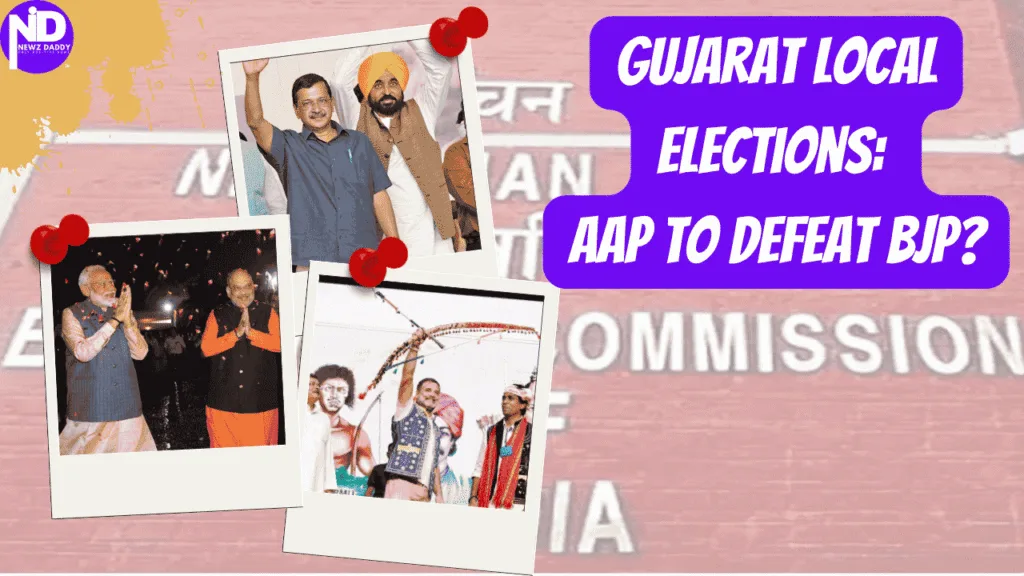
Gujarat Local Elections: AAP to Defeat BJP?
Gujarat Local Elections: 9,000 Seats at Stake in a High-Stakes Political War.
Gujarat local elections: The local self-government elections in Gujarat have officially been announced, sparking a wave of political energy across the state. In a recent statement, Manoj Sorathiya, the General Secretary of the Aam Aadmi Party (AAP) in Gujarat, declared that his party is in “action mode” and fully prepared to take on the Bharatiya Janata Party (BJP). According to Sorathiya, the AAP has been working tirelessly on the ground for the past six months, and he believes the people of Gujarat are ready to embrace a new alternative.
The State Election Commission (SEC) has confirmed that polling will occur on 26 April 2026, with the results to be declared on 28 April. This is a massive exercise in democracy, covering more than 9,000 seats across various levels of local government.
The 15 Municipal Corporations Heading to Polls
One of the most significant parts of this election is the contest for the municipal corporations. While there are 17 such bodies in Gujarat, only 15 will be going to the polls this time, as Junagadh and Gandhinagar have different election cycles. These 15 corporations include the major urban hubs and several newly upgraded cities. They are:
- Ahmedabad
- Surat
- Vadodara
- Rajkot
- Bhavnagar
- Jamnagar
- Anand-Karamsad (Newly formed)
- Gandhidham (Newly formed)
- Nadiad (Newly formed)
- Navsari (Newly formed)
- Porbandar-Chhaya (Newly formed)
- Mehsana (Newly formed)
- Morbi (Newly formed)
- Vapi (Newly formed)
- Surendranagar-Wadhwan (Newly formed)
The addition of nine new municipal corporations makes this election unique. It shows how Gujarat is becoming more urban and how the needs of these cities are growing.
Manoj Sorathiya highlighted that the Aam Aadmi Party is ready to defeat the BJP on all fronts in Gujarat local elections. He mentioned that the party has been active on the ground for the last six months. My research shows that the AAP has been focusing on “Jan Samvad” (people’s dialogue) programmes and booth-level strengthening. After their performance in previous local polls and the assembly elections, they have built a base of dedicated workers.
Sources indicate that the AAP is trying to present a “Delhi-Punjab Model” of governance, focusing on schools, hospitals, and free electricity. This message seems to be finding an audience in Gujarat, especially in urban pockets where people are looking for better services. Sorathiya claims that people’s trust in the AAP has increased because they see the party as a hardworking alternative that stays connected to the local issues of common citizens.
The AAP leader was quite sharp in his criticism of the ruling BJP, stating that the people of Gujarat will teach them a lesson. He accused the BJP of doing nothing but “looting and troubling people” over their 30-year rule. In my investigation of local reports and social media trends, it is clear that issues like inflation, local corruption in civic projects, and the recent bridge and fire safety tragedies in the state are being used by the opposition to question the BJP’s track record.
Sorathiya described this election as a “fight of the common man against power.” This narrative is designed to appeal to middle-class and lower-income voters who feel the pinch of rising costs. By framing the election as a battle against “hooliganism and atrocities,” the AAP is attempting to position itself as a protector of the ordinary person’s rights.
A New Chapter for Gujarat Politics
With the announcement of elections for 34 district panchayats and 260 taluka panchayats alongside the 15 municipal corporations and 84 municipalities, the entire state is turning into a political battlefield. A major factor in this election is the implementation of a 27% reservation for Other Backward Classes (OBC), up from the previous 10%. This change, following the Jhaveri Commission’s suggestions, will likely change how parties pick their candidates and how voters respond.
The AAP is banking on the so-called “honest politics” and its image as an “alternative.” While the BJP remains a formidable force with a deep-rooted organisation, the AAP’s “action mode” suggests they are not going to make it easy for the ruling party. As the nomination process begins on 6 April, all eyes will be on how these two parties, along with the Congress, navigate the complex landscape of Gujarat’s local politics. This election will truly show if the people are ready for a shift or if they will continue with the long-standing status quo.