


Gujarat SEZ Exports Reach New High as Trade Growth
Gujarat’s SEZ Growth Mirrors India’s Expanding Export Ambitions as New Industrial Policy Targets Long-Term Manufacturing Push
India’s export sector has nearly doubled in size over the past decade, growing from about USD 441 billion to a record USD 863 billion in 2025-26, according to the Ministry of Commerce and Industry. Officials say Special Economic Zones (SEZs), manufacturing investments, and trade reforms have played a major role in that growth, with Gujarat emerging as one of the country’s strongest export centres.
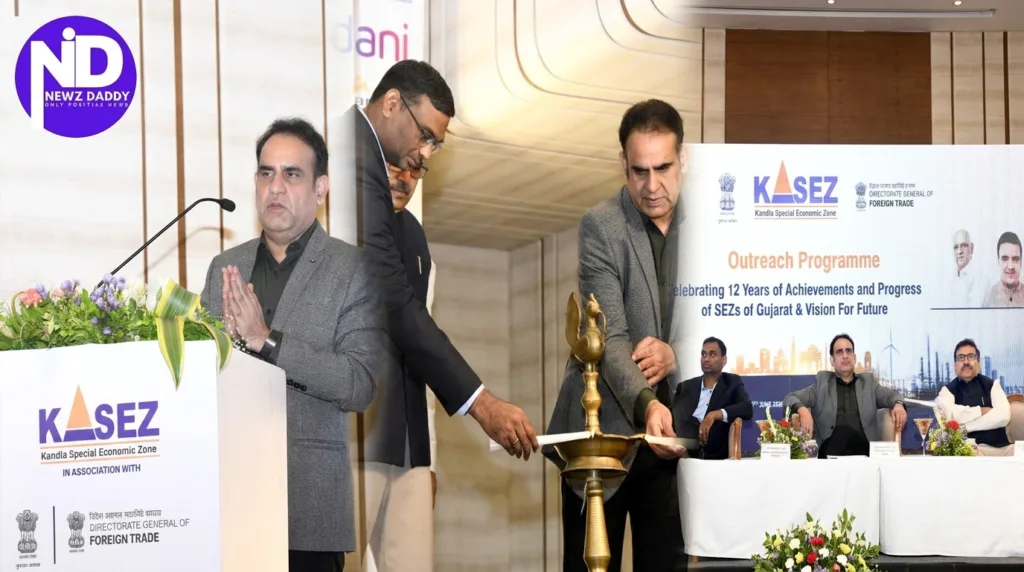
The figures were discussed during an outreach programme in Ahmedabad that reviewed the performance of Gujarat’s SEZ sector over the past 12 years and examined plans for industrial development. The event was organised jointly by the Government of Gujarat and the Directorate General of Foreign Trade (DGFT), Ministry of Commerce and Industry.
The programme was attended by Shri Ajay Bhadoo, Additional Secretary, Ministry of Commerce and Industry, Government of India; Shri Gyaneshwar B. Patil, Zonal Development Commissioner of Kandla Special Economic Zone (KASEZ); and Shri P. Swaroop, Industries Commissioner, Government of Gujarat, along with representatives from industry and trade bodies.
Addressing the gathering, Shri Ajay Bhadoo said India’s export growth has been driven by engineering products, petroleum products, electronics, pharmaceuticals, gems and jewellery, and chemicals. Gujarat alone contributes around USD 110 billion to the country’s exports, making it one of India’s most important export-oriented states.
India’s export performance has gained attention in recent years because it has continued to expand despite disruptions in global trade, including supply chain challenges, geopolitical tensions, and changing tariff structures in several international markets. Government officials have described the latest export figures as evidence of the resilience of India’s export ecosystem.
Shri Bhadoo pointed to Gujarat’s long-standing role in export-led industrial development. He noted that the state established Free Trade Zones as early as 1965, making it one of the first regions in Asia to experiment with policies designed to attract investment and promote exports.
Those early initiatives eventually evolved into the SEZ framework that operates across India today. SEZs are designated areas where businesses receive infrastructure support and policy benefits aimed at encouraging manufacturing, services, and exports. Over the last two decades, these zones have become important contributors to India’s external trade.
Referring to the country’s broader manufacturing goals, Shri Bhadoo said, “Made in India, Make for the World” remains a key national objective. He highlighted several digital initiatives introduced by the Government of India to simplify trade procedures and support exporters. These include Trade Connect, the Trade Intelligence and Analytics (TIA) Portal, and the Merchandise Imports Monitoring Portal (MIMP).
He also said the India Brand Equity Foundation (IBEF) has helped promote India’s business image internationally and improve visibility for Indian products in global markets.
Trade agreements have become another major part of India’s export strategy. According to Shri Bhadoo, India has signed Free Trade Agreements (FTAs) with Mauritius, the United Arab Emirates (UAE), Australia, and the United Kingdom. Discussions with the European Union and New Zealand are continuing.
These agreements are designed to reduce trade barriers and improve market access for Indian goods and services. Economists believe such arrangements can help Indian manufacturers compete more effectively in overseas markets, particularly in sectors where tariff reductions create cost advantages.
The Additional Secretary also referred to the Government’s Export Promotion Mission, which has an outlay of ₹25,600 crore for the period from 2025-26 to 2030-31. The mission aims to strengthen export infrastructure, support micro, small and medium enterprises (MSMEs), and increase India’s participation in Global Value Chains (GVCs), where products are manufactured across multiple countries before reaching consumers.
For Gujarat, the numbers presented during the event suggest that SEZs have become increasingly important to the state’s economy.
According to Shri Gyaneshwar B. Patil, exports from Gujarat’s SEZs rose from ₹1,79,808 crore in 2014-15 to ₹3,00,793 crore in 2025-26, representing a growth of nearly 67 per cent. Gujarat now contributes about 21 per cent of India’s total SEZ exports.
Investment levels within Gujarat’s SEZs have also increased substantially. During the same period, investments grew from ₹1,22,654 crore to ₹2,28,624 crore. Employment expanded from 63,475 jobs to more than 2.22 lakh jobs.
“SEZs have emerged as key drivers of investment, employment, innovation, and exports, and are playing a crucial role in realising the visions of ‘Make in India,’ ‘Atmanirbhar Bharat,’ and ‘Viksit Bharat 2047,’” Shri Patil said.
The growth of semiconductor manufacturing featured prominently in discussions about Gujarat’s future industrial direction.
Shri Patil said four semiconductor SEZs have been approved in the state. These include projects by CG Semi Technologies, Kaynes Semicon, Tata Semiconductor Manufacturing, and Micron Technology.
Semiconductors are regarded as one of the most strategically important industries in the world because they are used in products ranging from mobile phones and computers to automobiles, defence systems, and medical equipment. India has recently increased efforts to build domestic chip manufacturing capacity to reduce dependence on imports and strengthen supply chains.
Gujarat has emerged as a major location for these investments due to its industrial infrastructure, port connectivity, land availability, and policy support.
The discussion also focused on the recently announced “Viksit Gujarat Industrial Policy 2026,” unveiled by the Government of Gujarat on June 15.
The policy forms part of the state’s wider ambition to become a USD 3.5 trillion economy by 2047. Officials say it seeks to expand manufacturing, encourage innovation, attract large-scale investments, and promote environmentally responsible industrial growth.
Explaining the policy framework, Industries Commissioner Shri P. Swaroop said the new policy identifies 21 priority sectors that are expected to play a major role in Gujarat’s future economic growth. These sectors include advanced manufacturing and other high-value industries that can generate investment, employment, and exports.
Recent announcements by the state government indicate that the policy also seeks to attract significant private investment over the coming years while strengthening Gujarat’s position in areas such as semiconductors, clean energy, electronics, and technology-driven manufacturing.
Industry representatives attending the programme shared examples of how SEZ-based operations have expanded over the years. Representatives from Zydus SEZ, INOX, KASEZ, and Micron SEZ spoke about their experiences and the role of infrastructure and policy support in driving industrial growth.
The event served as both a review of Gujarat’s progress over the last decade and a discussion about the next phase of industrial development. With exports reaching record levels nationally, new trade agreements under negotiation, and large investments flowing into manufacturing sectors such as semiconductors, policymakers see Gujarat as an important part of India’s effort to increase its share in global trade and strengthen its manufacturing base in the years ahead.