


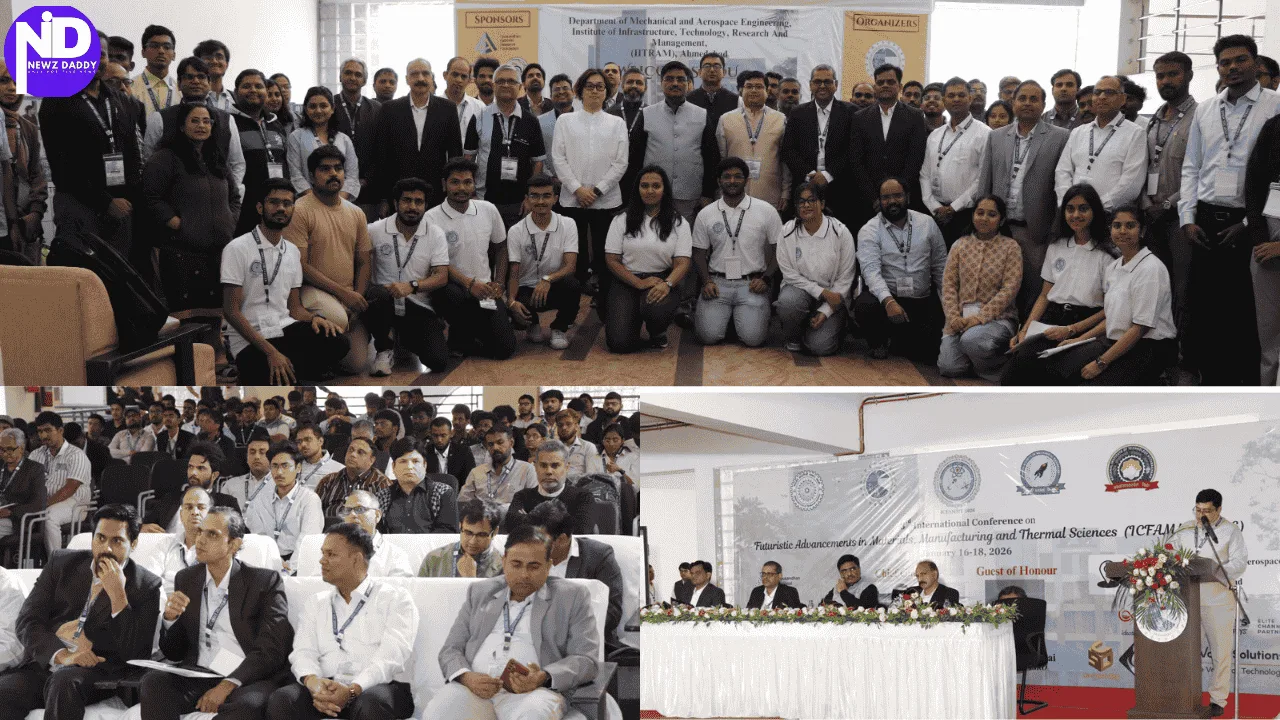
ICFAMMT Conference 2026: Global Science Breakthroughs in India
ICFAMMT-2026 at IITRAM Witnesses Wide International Participation and Cutting-Edge Research
The 3rd International Conference on Futuristic Advancements in Materials, Manufacturing and Thermal Sciences (ICFAMMT-2026) was successfully held from January 16–18, 2026, at the Department of Mechanical and Aerospace Engineering, Institute of Infrastructure, Technology, Research and Management (IITRAM). The conference was jointly organised by the Department of Mechanical and Aerospace Engineering, IITRAM, Department of Mechanical and Industrial Engineering, IIT Roorkee, SSME, Space Applications Centre (SAC), ISRO, and NIT Uttarakhand. Conferences of this kind play a key role in bringing together academic institutions, government bodies and research organisations. In recent years, India has placed a strong focus on advanced materials, smart manufacturing and thermal systems, as these areas directly support sectors such as space research, defence, clean energy and infrastructure development.
The inaugural session of ICFAMMT-2026 took place on January 16, 2026, in the esteemed presence of the Chief Guest, Dr Shivkumar Kalyanraman, CEO, Anusandhan National Research Foundation (ANRF), Government of India, and Guest of Honour, Prof Gajanan P. Chaudhary, IIT Roorkee. The event was further graced by Prof Pramod Kumar Jain, Director General, IITRAM, and Prof M. S. Barua, Director, IITRAM. The presence of senior leaders from national research bodies highlights the growing link between academic research and national policy. ANRF, in particular, has been set up to support long-term research and innovation, aiming to make India a global knowledge leader.
During the inaugural address, Dr Shivkumar Kalyanraman highlighted various Government of India initiatives and schemes promoting technological advancement, while Prof P. K. Jain emphasised the critical role of materials, manufacturing, and thermal sciences in achieving the objectives of the Viksit Bharat Mission. These science fields are central to national goals such as sustainable growth, reduced dependence on imports and development of indigenous technologies. Advanced materials help in making lighter and stronger products, modern manufacturing improves efficiency and quality, and thermal sciences support better energy use and climate-friendly solutions.
Over the three-day conference, 295 participants attended the event, with 246 research papers presented by researchers from India and abroad. Such high participation reflects the strong interest among young researchers and experienced scientists in applied engineering research. Research papers presented at international conferences often lead to journal publications, patents and real-world applications. They also help researchers receive feedback and improve their work before it is used in industry or government projects.
The technical programme featured 11 keynote lectures and 19 invited talks, delivered by eminent experts from Japan, Malaysia, the United Kingdom, and India. International speakers bring global perspectives and share how similar challenges are handled in other countries. Japan is known for precision manufacturing, the UK for advanced materials research, and Malaysia for applied engineering solutions. Exposure to such expertise helps Indian researchers align their work with global standards.
A total of 29 technical sessions were conducted across four tracks (Design and Automation, Manufacturing Science, Materials and Metallurgy and Thermal Engineering), with 27 distinguished session chairs overseeing the sessions, ensuring high-quality technical deliberations and scholarly discussions. Dividing sessions into focused tracks allows deeper discussion on specific problems. Session chairs play an important role by guiding discussions, maintaining academic quality and encouraging meaningful questions, which helps both presenters and listeners gain a better understanding.
The valedictory function was graced by Prof Ramesh Babu, IIT Madras, and Prof Masahiro Motosuke, Tokyo University of Science, Japan. During the concluding session, Best Paper Awards were announced across all four conference tracks, recognising outstanding research contributions. Awarding the best papers motivates researchers to maintain high standards and rewards original thinking. Such recognition often supports academic careers and encourages further research funding and collaboration.
ICFAMMT-2026 successfully provided a global platform for researchers, academicians, and industry professionals to exchange knowledge, foster collaborations, and discuss emerging trends in materials, manufacturing, and thermal sciences. Events like this help bridge the gap between theory and practice by connecting universities with industry and government agencies. They also inspire students and early-career researchers to work on problems that have a real impact on society, industry and national development.
Must Read:
Varvee Global Limited boosts non-denim capacity, eyes big growth