


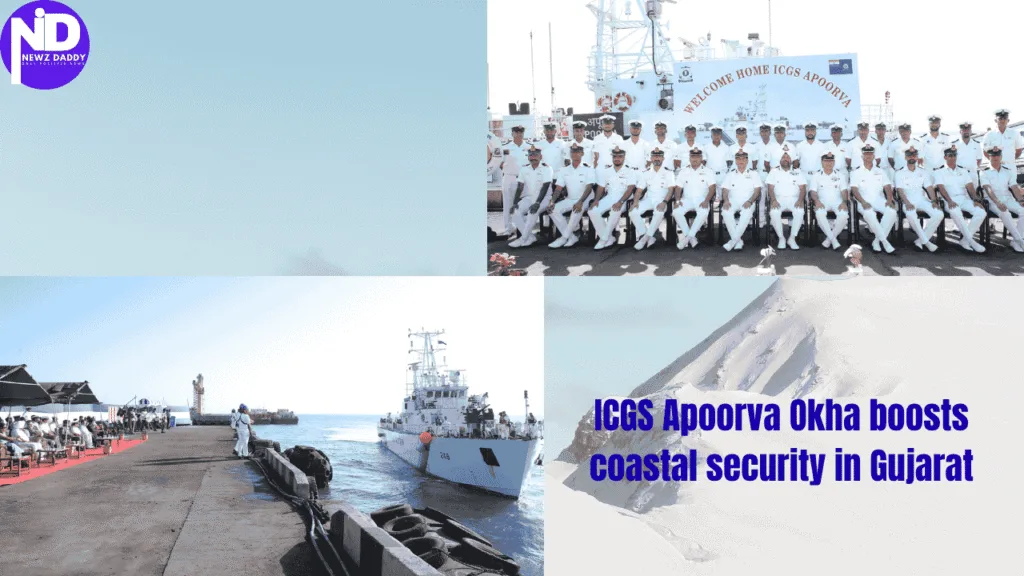
ICGS Apoorva Okha boosts coastal security in Gujarat
ICGS Apoorva Okha Adds a Powerful and Vital Boost to Gujarat Security
Indian Coast Guard Ship Apoorva has reached Okha at an important time, when India is putting more focus on sea safety. Experts say the North-West coast, especially near Gujarat, has become one of the most sensitive maritime zones in the country. This is because it lies close to busy shipping routes and also near international waters. Over the years, security agencies have increased patrols here to stop smuggling, illegal fishing, and possible threats from across the sea.
ICGS Apoorva, a Fast Patrol Vessel of the Indian Coast Guard, arrived at Okha and was received in a befitting welcome ceremony on 27 March 2026. The ceremony was graced by distinguished dignitaries from the Indian Navy, Border Security Force, Customs, Fisheries and the State Administration. Joint presence of these agencies reflects how coastal security today is not handled by one force alone. Reports from defence journals show that coordination between different agencies has improved a lot after past security gaps were identified. Today, data sharing, joint exercises, and coordinated patrols are becoming common.
Addition of the vessel to the Coast Guard Region (North West) fleet marks the significant focus accorded by the Government of India towards Coastal Security, particularly off Gujarat, Daman and Diu. Studies from maritime security institutes suggest that this region sees heavy fishing activity and commercial movement, making it both economically important and sensitive. After the 2008 Mumbai attacks, India made major changes in coastal surveillance. More radar stations, better tracking systems, and faster vessels have been added to prevent any misuse of sea routes.
Equipped with state-of-the-art navigation, communication and surveillance systems, the ship is capable of expeditious, sustained and mission-based operations at sea. Defence experts often highlight that modern patrol vessels like Apoorva can track multiple targets, operate in rough weather, and stay at sea for longer periods without support. These ships are also designed to quickly intercept suspicious boats. According to reports, such vessels play a key role in search and rescue missions, anti-smuggling operations, and pollution response.
ICGS Apoorva’s basing at Okha, a strategically sensitive location along the North Gujarat coast near the notional International Maritime Boundary Line (IMBL), significantly strengthens the Maritime Security architecture in the AoR of ICG Region North West. The IMBL is not a physical line in the sea, but it is very important for fishermen and security forces. Many fishermen from both sides unknowingly cross this line and get detained. With more patrol ships like Apoorva, authorities can monitor such movements better and also help fishermen avoid entering restricted waters.
Its deployment will enhance persistent surveillance and enable rapid response to contingencies at sea. Maritime analysts say that response time is very important in sea operations. Whether it is a distress call, illegal activity, or an environmental issue like an oil spill, reaching the spot quickly can make a big difference. Fast patrol vessels are specially built for this purpose, as they can move quickly and act without delay.
It will also add to ICG’s efforts towards robust protection of maritime borders, fishermen and national interests. The safety of fishermen has been a key concern for the Indian Coast Guard. Many fishermen depend on the sea for their daily income, and they often face risks like bad weather, engine failure, or drifting into foreign waters. Coast Guard ships regularly assist them with medical help, fuel, and safe escort back to shore when needed.
This accretion in force level reaffirms the Indian Coast Guard’s steadfast commitment to safeguarding the nation’s maritime domain and maintaining a safe, secure and vigilant coastal environment in the North West Maritime sector. In recent years, India has been steadily increasing its coastal strength with more ships, aircraft, and coastal stations. Experts believe that such steps are important not just for security, but also for supporting trade, protecting marine resources, and ensuring safe sea lanes for future growth.