


IDE Bootcamp 2026 Ahmedabad Ignites Young Minds Fast
IDE Bootcamp 2026 Ahmedabad Leads New Student Revolution
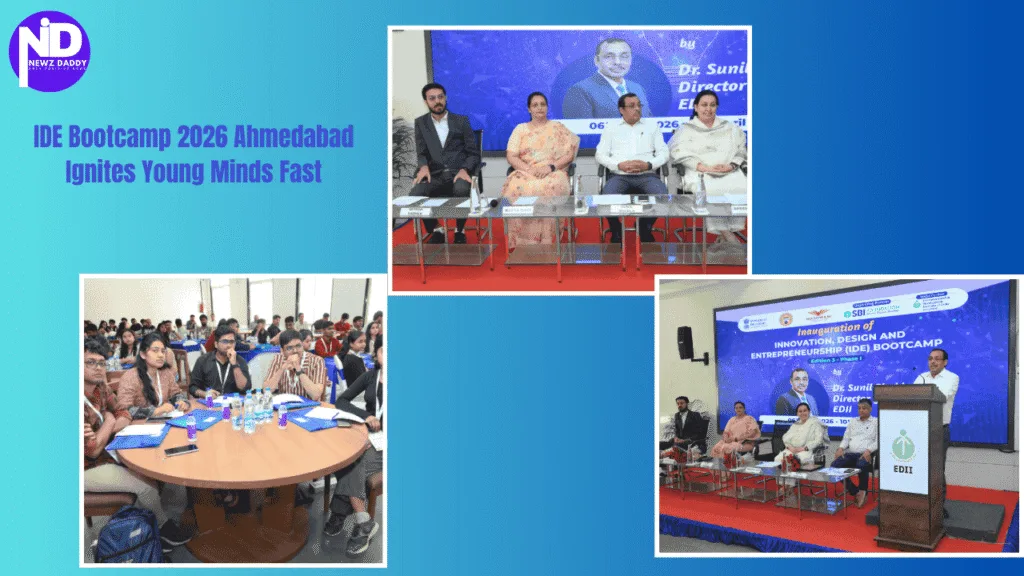
To foster innovation, design thinking, and entrepreneurial capabilities among students across India, Entrepreneurship Development Institute of India (EDII), Ahmedabad, hosts the 3rd Edition of the bootcamp on ‘Innovation, Design and Entrepreneurship’ (IDE) during April 6 and April 10, 2026. The bootcamp is organised by the All India Council for Technical Education, Ministry of Education Innovation Cell. The bootcamp is being implemented in collaboration with the Wadhwani Foundation, with support from the SBI Foundation as the Organisation Partner.
This kind of national-level programme has grown strongly in recent years. Reports from education bodies show that India now has one of the largest student startup ecosystems in the world. Colleges are pushing students to think beyond textbooks. Bootcamps like this help students test ideas early and learn by doing, which is often missing in regular classroom learning.
The inauguration session of the bootcamp was organised on 6th April, 2026. The inauguration was graced by the Chief Guest, Dr Sunil Shukla, Director General, EDII. Also present on the occasion were Shri Mitesh Vadher, Centre In-Charge & Innovation Fellow, Ahmedabad Indovation Centre, Innovation Cell, AICTE, Ministry of Education, Govt. of India; Dr Sheenu Jain, Master Trainer, Wadhwani Foundation; Dr Kavya Saini, Master Trainer, Wadhwani Foundation and Dr Satya Ranjan Acharya, Director, Dept. of Entrepreneurship Education, EDII.
Industry experts often say that direct interaction with mentors is one of the biggest benefits for students. Many successful founders in India, including those from startup hubs like Bengaluru and Hyderabad, have shared that early guidance from mentors helped them avoid costly mistakes. Events like this create that same space for young minds.
The inaugural session witnessed participation from over 200 students representing higher education institutions across 14 states, including Jammu and Kashmir, ensuring inclusive representation from geographically diverse regions, including Tier-II and Tier-III cities.
This wide participation shows a clear shift. Earlier, startup activity was mostly seen in big cities. Now, smaller towns are also producing strong ideas. Government-backed programmes such as Smart India Hackathon have already shown that students from smaller cities can solve real problems with simple but effective solutions.
Encouraging students to pursue entrepreneurship, Dr Sunil Shukla stated, “Entrepreneurship is a mindset and a life skill. In the last decade or so, this discipline has grown significantly, with increasing student interest. Both entrepreneurial successes and failures impart lessons. The students must have a keen eye for comprehending the competencies that make successful entrepreneurs. I urge all students to actively learn from their faculty-mentors, as well as fellow students.”
This idea matches what many global studies say. Research published in business journals shows that failure is often a key step in building strong businesses. Founders who fail early tend to make better decisions later. Learning from peers also plays a big role, as students often understand problems faced by people in their own communities better than anyone else.
Highlighting the scale and impact of the initiative, Shri Mitesh Vadher said, “The first two editions of the IDE Bootcamp have trained over 10,000 participants across 46 locations in India. This five-day bootcamp will now be conducted in three phases across 30 locations, ensuring wider outreach and regional diversity. The theme reflects our belief that design can be a powerful driver of development. Launched in 2023 by the Hon’ble Minister of Education, Shri Dharmendra Pradhan, the programme has since created a significant impact across the country.”
Design thinking is now used by many large companies and startups. It helps people solve problems by focusing on real user needs. Companies like tech startups and even banks use this method to improve products. Teaching this early gives students a strong advantage when they enter the job market or start their own ventures.
This IDE Bootcamp witnesses participation from approximately 6,500 students, primarily comprising teams from higher education institutions, including Smart India Hackathon (SIH) participants and winners, Institution’s Innovation Council (IIC) institutions, and students with innovative ideas or prototypes requiring design improvement, ergonomic enhancement, and guidance for investment-ready pitching. Faculty mentors will accompany and guide the student teams throughout the IDE Bootcamp
Pitch training is now a key skill. Investors often decide within minutes whether to support an idea. Many startup founders have shared that a clear and simple pitch helped them secure early funding. Training students at this stage prepares them for real-world investor meetings.
The IDE Bootcamp is an initiative envisioned by the Hon’ble Prime Minister Shri Narendra Modi, aimed at nurturing innovation, design, and entrepreneurial skills among student innovators. The programme is carefully designed to equip participants with critical skills and an adaptive mindset required in today’s fast-paced and competitive business environment.
India’s startup ecosystem has grown rapidly under such initiatives. According to government data, the country now has over 100,000 recognised startups. Many of these began as small student ideas. This shows how early exposure can lead to real business success.
Focused on fostering creativity, innovation, and entrepreneurial thinking, the IDE Bootcamp encourages students and faculty to explore new approaches to problem-solving. Through exposure to real-world challenges, hands-on activities, and collaborative learning, participants are prepared to confidently navigate the complexities of the innovation and startup ecosystem.
Hands-on learning has proven to be more effective than theory alone. Studies in education research show that students remember more when they work on real problems. Group learning also improves communication skills, which are essential for any entrepreneur.
The vision of the IDE Bootcamp is to create an inspiring and immersive environment where students and faculty emerge as future-ready leaders. By nurturing resilience, creativity, and entrepreneurial spirit, the programme empowers participants to develop impactful solutions and contribute meaningfully to business, technology, and society.
Experts believe that resilience is one of the most important traits in entrepreneurship. Startups often face financial pressure, market changes, and competition. Training students to stay strong during challenges prepares them for long-term success.
The IDE Bootcamp also includes expert sessions by startup founders, incubation leaders, and domain experts, who will also serve on the jury panel during the final pitching session on Day 5. Participating teams will present their refined ideas, and the top 5 teams at each location will be recognised with appreciation certificates and non-monetary awards.
Recognition at early stages often boosts confidence. Many young founders say that even small awards or feedback helped them keep going. It builds belief in their ideas and motivates them to improve further.
Key highlights of the programme include:
Day 4: Local exposure visits to innovation ecosystems and cultural landmarks
Day 5: Session on grants, funding opportunities, and Intellectual Property Rights (IPR)
Exposure visits play a key role in learning. Visiting startup hubs or innovation centres helps students see how ideas turn into real businesses. Sessions on funding and IPR are equally important, as many startups fail due to a lack of knowledge about funding options or protecting their ideas.
After the success of the first two editions of the IDE Bootcamp, many participants have gone on to launch startups, enhance their products, and implement innovative solutions in real-world scenarios across various sectors and ministries.
This outcome reflects a larger trend in India. Student-led startups are now solving real problems in areas like agriculture, healthcare, and education. With the right support, many of these ideas are turning into scalable businesses that create jobs and drive growth.