


India Energy Resilience: Bold Strategy Revealed in Delhi
India Energy Resilience Vision Highlights the Urgent Need for Power Expansion
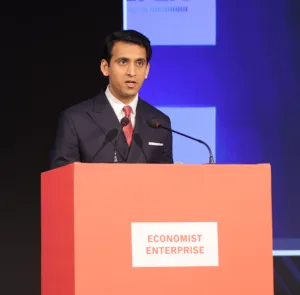
Mr Sagar Adani’s address at The Economist: Resilient Futures Summit
Good morning, and thank you for having me.
It is truly a privilege to speak in front of such a distinguished audience.

I don’t think this summit, and its central theme, could come at a more important time. With everything we have learnt in the last few weeks, it is clear that in this century, access to energy will define resilience.
Recent global events have shown this clearly. The Russia–Ukraine conflict pushed oil and gas prices up across Europe and Asia. Many countries faced sudden shortages. Even a short disruption led to higher fuel bills and inflation for millions of people.
Today, resilience is no longer a concept confined to classrooms or simulated in war rooms. It is real.
It is present.
And it is affecting all of us, right now.
In 2023 alone, global energy demand rose by around 2%, while supply struggled to keep pace. This gap caused price shocks and forced governments to rethink their energy strategies.
We’ve all seen how conflict in one region can disrupt supply chains across continents.
We’ve all seen how shocks in energy markets can ripple through economies overnight. And in that world, the question for every nation is no longer just how fast you can grow
It is: How well can you withstand disruption
During the COVID-19 period, supply chains for coal, gas, and even solar panels were badly hit. India also faced temporary power shortages in some states due to coal supply issues.
And nowhere is that question more relevant, or more consequential, than in India.
India today is a nation defined by aspiration.
You see it everywhere, in young people stepping into a new economy, in farmers adapting to new realities, in entrepreneurs building with quiet confidence.
India adds nearly 10 million young people to its workforce every year. This creates both an opportunity and a huge demand for reliable electricity and jobs.
There is a deep, collective belief that the future can be better than the present.
But aspiration, by itself, does not build nations. It needs a foundation.
And that foundation is energy.
If you step back and look at India’s development challenge, almost every major constraint converges into one:
Energy.
Water security needs energy for desalination, treatment, and distribution.
Food security needs energy for fertilisers, irrigation, and logistics. Digital leadership needs energy—for data centres, AI, and computing infrastructure.
Economic stability needs energy to ensure that growth remains affordable for the common citizen.
India’s data centre market alone is expected to grow at over 20% annually, driven by AI and digital services, which means power demand will rise sharply.
So if resilience is the goal, then abundant, reliable, and affordable energy is the foundation.
Let’s put the scale of India’s challenge into perspective.
On a per capita basis, India’s energy consumption is about one-third of the global average, and roughly one-fifth of China’s.
For example, the average Indian uses about 1,300 units of electricity per year, while in China it is over 5,000 units.
So if India is to become a developed economy by 2047, we are not talking about incremental growth.
We are talking about a structural leap.
We are talking about adding nearly 2,000 gigawatts of new capacity over the next two decades—
India currently has around 450 GW installed capacity, which shows how massive this expansion needs to be.
All while ensuring that this energy remains affordable, accessible, and increasingly clean.
That is the scale of the opportunity. And that is India’s defining challenge.
When you look globally, countries that have built resilience at scale have always done one thing exceptionally well:
They have secured their energy foundations.
Most developed and prosperous nations are either energy independent or have built deep, strategic energy partnerships.
The United States, for instance, became a net energy exporter after investing heavily in domestic oil and gas production.
But we don’t have to look far to find a more relevant example.
China, despite being constrained in oil and gas, systematically invested in domestic capacity across coal, hydro, nuclear, and renewables, while simultaneously building strategic reserves and supply chains.
China today leads the world in solar and wind installations and controls a large part of the global battery supply chain.
Yes, it remains dependent on global energy flows.
But the level of resilience it has built over the past two decades is remarkable.
And the outcome is not just energy security.
It is industrial strength, economic stability, and global competitiveness. For India, the path forward is clear.
We must electrify everything.
We must reduce structural dependence on imported energy.
And we must build an energy backbone anchored in resources that are available within the country.
India still imports over 80% of its crude oil needs, which puts pressure on its economy during global price spikes.
Because electrification is not just more efficient
It is India’s most credible path to long-term stability.
But electrification at scale demands one thing above all else: Massive growth in electricity supply.
And this is where we must be pragmatic.
Renewables will, and must, scale rapidly. Storage technologies will continue to evolve.
India has already crossed 180 GW of renewable energy capacity and aims for 500 GW by 2030.
But there are real constraints—particularly around land and intermittency.
Solar power works only during the day, and wind power depends on the weather. This makes storage and backup power necessary.
Which means that to truly close the gap, India must adopt a portfolio approach.
We must fully leverage every energy source available to us:
Renewables.
Hydro.
Efficient thermal.
And nuclear.
Countries like France generate over 60% of their electricity from nuclear power, ensuring a steady supply.
Because without firm, scalable baseload power, the math simply does not work.
This is not optional for India. It is inevitable.
It would also be incomplete not to recognise the role that the government and the country’s leadership have played in enabling this journey.
Over the past decade, India’s leadership has played an exceptional role in cutting red tape, getting rid of unnecessary and outdated regulations, revitalising public undertakings and encouraging private enterprises. Countless macro and micro policy changes by the government have resulted in an environment where business can grow, flourish and prosper.
India has improved its ranking in the Ease of Doing Business index and has seen record foreign investment in infrastructure.
India has seen a clear, consistent, and increasingly execution-oriented policy direction.
From accelerating infrastructure development to expanding renewable capacity, strengthening transmission networks, and enabling long-term investments.
India now has one of the largest transmission networks in the world, helping move power across states efficiently.
There has been both clarity of intent and continuity of action. And that continuity is a critical enabler of resilience.
Coming to the role of industry, and specifically, the Adani Group.
At our core, we see ourselves not just as operators of infrastructure, but as builders of India’s energy backbone for the next several decades.
Our Chairman, Gautam Adani, has committed over $100 billion towards the energy transition, one of the largest private-sector commitments globally.
But more importantly, this is not a set of isolated investments. It is an integrated strategy.
We are building one of the world’s largest renewable energy portfolios. Investing in large-scale energy storage.
Expanding transmission networks to move power efficiently across the country.
And developing green hydrogen ecosystems.
India’s green hydrogen mission aims to make the country a global hub for clean fuel exports in the coming years.
Beyond energy, our presence across ports, logistics, airports, and data centres is part of the same vision.
Because resilience is never built in silos. It is built through integrated systems.
Energy powers industry. Logistics enables trade.
Digital infrastructure drives productivity.
And when these systems work together, you don’t just create growth, you create durable resilience.
So if I were to leave you with one thought, it would be this: The real question is not whether India will need more energy. That is already clear.
The real question is: How fast can we build it?
Because in the end, resilience is not built through intent alone. It is built through execution.
Through the ability to create infrastructure at scale, at speed, and with purpose.
And if India gets this right, if we can deliver abundant, affordable, and clean energy at the scale required
We will not just secure our own future. We will not just elevate 1.4 billion people.
We will help stabilise the future of the global economy. Because India does not operate in isolation.
What happens here increasingly matters everywhere. That is the opportunity. And that, my friends, is our collective responsibility.
Thank you.