


India–Japan Higher Education Gains Powerful New Boost
Newz Daddy Educational Updates
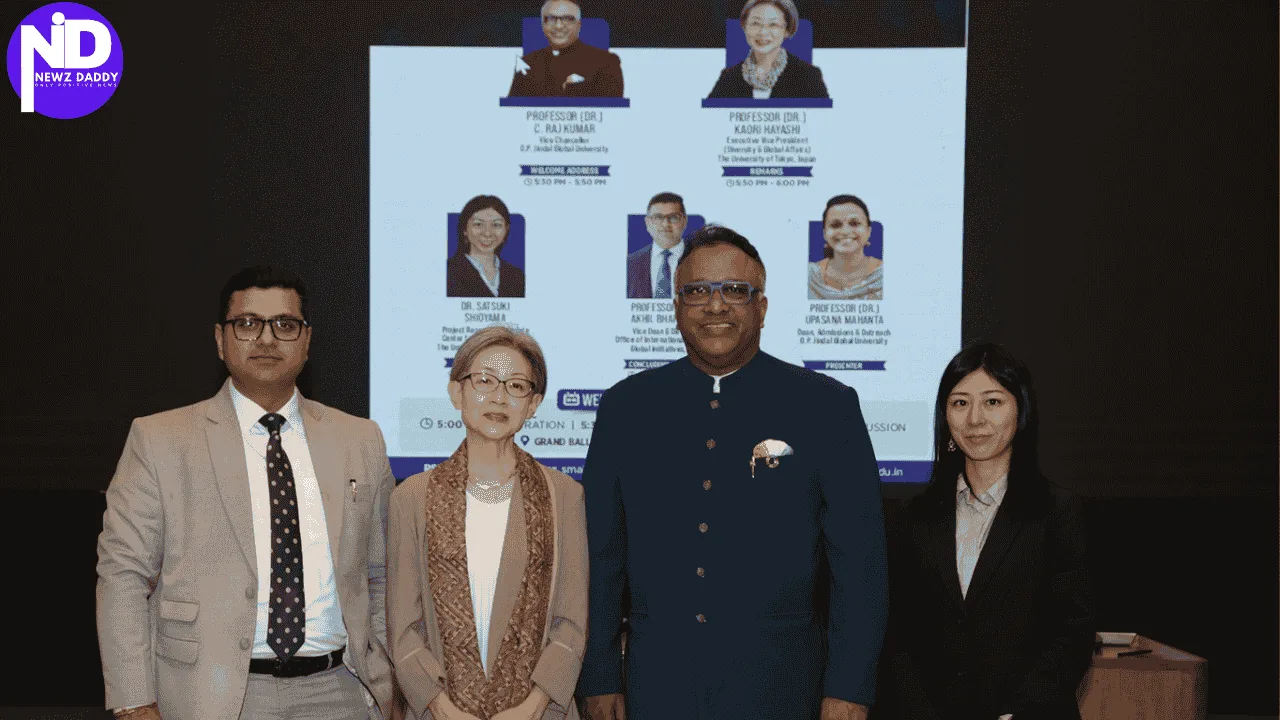
O.P. Jindal Global University (JGU) welcomed the senior delegation from the University of Tokyo for the India-Japan Higher Education Conclave 2025 in Ahmedabad. The visit took place on 10 December 2025 and focused on the theme “Future of Global Education: India and Japan as Leaders of Knowledge and Innovation”. The University of Tokyo delegation was led by Professor Kaori Hayashi, the Executive Vice President in charge of Global and Diversity Affairs, and Professor Satsuki Shioyama, Project Research Associate at GlobE. Their presence reflects Japan’s continued interest in deepening its education ties with India, which has grown steadily over the last decade. Japan has already been increasing student exchanges and research visits with many Indian universities as part of its Indo-Pacific cooperation plans.
This visit is an important part of JGU’s Act East mandate. The mandate aims to build strong higher education links with countries in East and Southeast Asia. India and Japan share a long history of cultural and academic ties, and both governments have been encouraging more exchanges in science, technology and innovation. Japan is known for its strong research culture and high-ranking global universities, while India has become one of the world’s fastest-growing hubs for higher education and skilled graduates. JGU is the only Indian university with an institutional partnership with the University of Tokyo. Over the years, JGU has signed more than 25 partnerships with Japanese universities. These partnerships cover student mobility, joint teaching, shared research, seminars and academic training. Japanese universities are keen to work with India due to its young population, strong English-medium education, and growing research output.
At the inaugural session, JGU’s Founding Vice Chancellor, Professor C. Raj Kumar, spoke about the importance of this partnership. He said the India Tour strengthens long-term goals in higher education, technology and innovation. India and Japan already collaborate in areas such as digital education, clean energy, engineering and public policy. Their universities act as bridges between societies by encouraging learning and joint thinking. Professor Kumar highlighted that both countries share a belief in liberal democracy, academic freedom and international cooperation. These values form a strong base for long-term partnerships in knowledge exchange.
The Vice Chancellor also spoke about the historical ties between India and Japan. These include cultural links, spiritual understanding and decades of diplomatic cooperation. Japan has supported India in areas such as infrastructure, skill development and technical education. India, in return, continues to be a key partner for Japan’s Indo-Pacific goals. This shared history makes academic partnerships even more meaningful.
JGU and the University of Tokyo signed a new agreement to launch a Short-Term Study Abroad Programme. Under this programme, 40 JGU students will travel to Japan every summer for three weeks. They will learn about Japanese culture, society, research and teaching practices. Such programmes help students gain global exposure at a young age. Japan has been encouraging international students through various government-supported programmes, which include cultural immersion, language learning and joint research. The University of Tokyo is one of Japan’s most respected institutions, known for its Nobel Prize-winning research and strong science and engineering departments.
The India-Japan Higher Education Conclave brought together leaders, policymakers, scholars and students. They discussed how universities can work together more closely in the future. The tour included policy discussions, visits to key institutions, media interactions and networking events. These activities aimed to create a long-term roadmap for joint research, academic innovation and stronger student mobility. India is pushing for internationalisation of higher education, and Japan is doing the same. Both countries want to create more global learning opportunities for their students.
The University of Tokyo delegation shared its interest in strengthening cooperation with Indian institutions. They discussed topics such as diversity, inclusion, sustainability and the future of global education. Professor Kaori Hayashi said she was impressed by JGU’s commitment to diversity and inclusion. She also noted the new Museum of Constitution and the Moot Court Hall at JGU. These academic spaces allow students to learn through real-world examples and interactive teaching.
The delegation also spoke about the value of friendships formed through student exchanges. They said students who study together often build lifelong bonds that help both countries work together peacefully in the future. They expressed excitement about expanding the partnership and sending more UTokyo students to India.
Professor Satsuki Shioyama brought in perspectives related to South Asian education systems, gender sensitivity and equitable exchange. She focused on how academic mobility can be made fairer and accessible to all students. She also spoke about making knowledge-sharing more inclusive and long-lasting.
Throughout the tour, leaders from both universities explored new models of cooperation. They looked at dual degrees, short-term exchanges, joint seminars, hybrid learning and collaborative research. These frameworks help students understand different education systems and build skills that are needed in the global world today.
Professor Akhil Bhardwaj from JGU said the tour would strengthen long-term links between the two nations by connecting universities, industry and government stakeholders. By focusing on mutual respect and co-design, both institutions hope to create learning pathways that benefit students and researchers in India and Japan.
The visit will lead to a forward-looking roadmap for deeper cooperation between JGU and the University of Tokyo. Their shared aim is to build strong, future-ready higher education ties that support global knowledge, innovation and cultural exchange.