


India-Russia Strategic Partnership: United for Humanitarian Impact
Newz Daddy Educational Updates
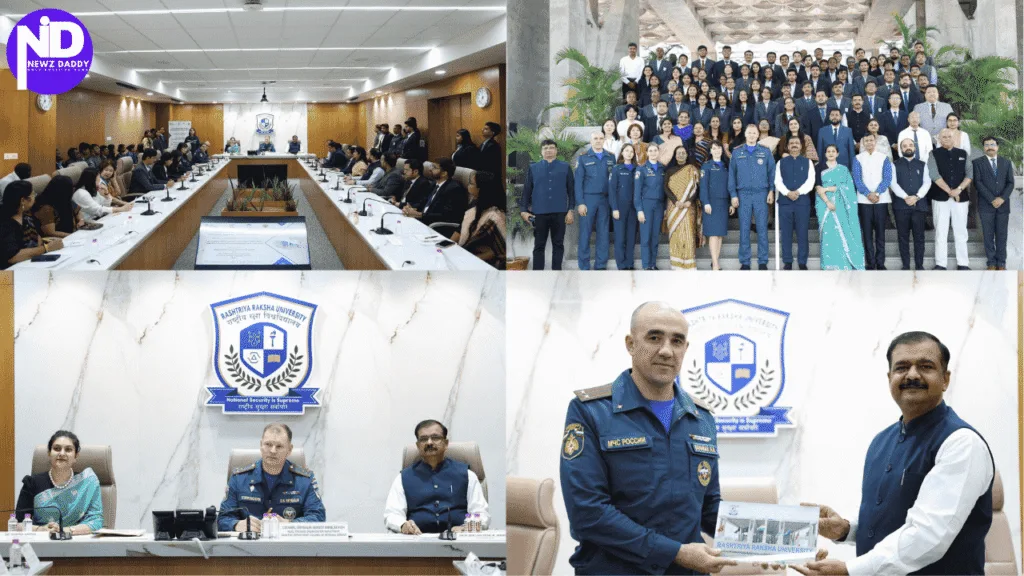
School of International Cooperation, Security and Strategic Languages (SICSSL) at Rashtriya Raksha University (RRU) in Gandhinagar organised an international conclave on “India–Russia Bilateral Relations: Emergency Preparedness and Humanitarian Cooperation”. This event was held at Lavad, Gandhinagar, marking a key moment in the 25-year strategic partnership between India and Russia.
A delegation from the Russian Ministry of Emergency Situations took part, including Colonel Smygalin Sergey Nikolaevich (Head, Training Organisation Department), Colonel Valman Andrey Andreevich (Head, Mountaineering and Parachute Training Department), Colonel Rizhenko Lilia Mansurovna (Senior Inspector, Planning & Support of International Activities), Captain Kirillova Olga Leonidovna (Senior Inspector, Medical & Psychological Support) and Izmailova Zulfiya Rashitovna (Senior Inspector-Expert, Department of Information Policy). This strong Russian participation highlights the depth of cooperation being explored. The conclave was supported by the Rossotrudnichestvo Representative Office in India.
In her address, Dr Aparna Varma (Director, SICSSL) emphasised how India–Russia cooperation in security, emergency response and humanitarian assistance is increasingly relevant given evolving global challenges. She highlighted that this conclave reflects RRU’s commitment to bridge academic policy work with strategic partnerships.
Prof (Dr) Kalpesh H. Wandra, Pro-Vice-Chancellor of RRU, delivered the keynote and underlined that the India–Russia relationship has adapted over decades while preserving “strategic depth” in areas like defence, energy-security, science & technology, and people-to-people links. He noted that cooperation in emergency preparedness and humanitarian aid opens new pathways for joint capacity-building and institutional collaboration.
The visiting Russian delegation was introduced to RRU’s multidisciplinary ecosystem and mission to build skilled professionals across security domains. SICSSL’s role and the larger RRU infrastructure were familiarised with the guests. The conclave included expert sessions and discussions on best practices, frameworks and cooperative mechanisms for emergency preparedness, crisis response and humanitarian cooperation between India and Russia. These conversations drew on the broader journey of 25 years of strategic partnership and emphasised continuity of trust, especially in multilateral forums like the UN, BRICS and SCO.
The event saw attendance from school directors, faculty, students, and officers from the Indian Army and Indian Air Force, who engaged actively with the delegation on mutual areas of interest. The concluding part of the conclave included a cultural event, signalling the people-to-people aspect of strategic ties.
The broader context is important. The India–Russia Strategic Partnership, inaugurated with a declaration in October 2000, evolved into a “Special and Privileged Strategic Partnership” in 2010. Over 25 years, this partnership has become an anchor of bilateral cooperation in defence supplies, energy, science & technology, and diplomacy.
From the strategic perspective of emergency preparedness and humanitarian cooperation, the conclave reflects a shift from purely military or economic ties into new domains. India and Russia are exploring shared training modules, institutional link-ups, and coordinated responses to disasters and emergencies. These new domains signal a deeper, evolving relationship that aligns with changing security landscapes.
This conclave at RRU offers a fresh, modern chapter in the long-standing India–Russia relationship. It signals that beyond weapons or energy deals, both countries are building joint mechanisms for resilience, responsiveness and humanitarian action—anchored in trust, structured cooperation and shared global responsibilities.
Must Read:
Maldives Police Get High-Impact Digital Forensics Training
Elevating international law, shaping tomorrow’s defenders of global security