


India Shines as Tri Services Exercise Trishul Hits Peak
Newz Daddy Defence Updates
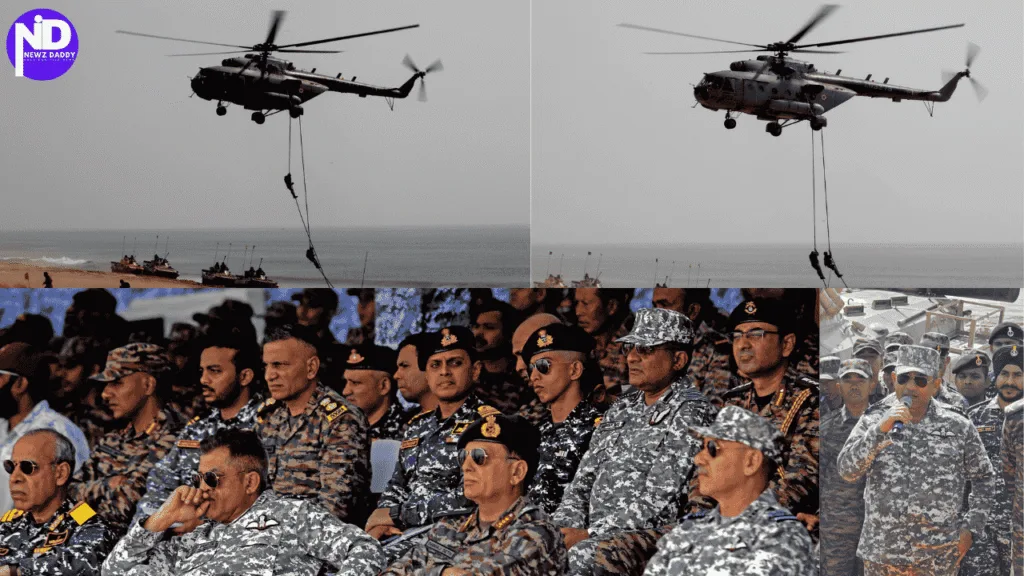
Air Marshal Nagesh Kapoor, Air Officer Commanding-in-Chief, South Western Air Command, addressing the media at a demonstration at Madhavpur on 13 November 2025, marking the culmination of the Tri-Services Exercise (TSE-2025) “Trishul”.

This closing event drew strong attention because “Trishul” was one of the key joint drills of the year. The South Western Air Command plays a major role in air defence of the western borders, and its presence at the beach event showed how the Air Force works closely with the Navy and Army for missions that need teamwork. Large exercises like this help the forces test quick planning, fast movement and real-time response during emergencies.
The exercise was conducted by the Indian Navy as the lead service, jointly with the Indian Army and Indian Air Force, in early November 2025. The operations, which have been conducted over the past few days, followed months of planning and preparation. Upon completion of this interaction, a demonstration of amphibious operations was conducted, showcasing the pinnacle of joint planning and execution involving elements of all three services.
The Navy often leads amphibious drills because it handles ships, landing craft and sea-based operations. Amphibious missions need very close teamwork as troops move from the sea to land. Such training is important because India has a long coastline and must stay ready for both natural disasters and security threats. The Army brings ground strength, while the Air Force supports with transport aircraft, helicopters and air cover. When the three services work together, they can move heavy equipment, vehicles and soldiers quickly to any location.
TSE-2025 was led by the Western Naval Command of the Indian Navy, along with the Southern Command of the Indian Army and the South Western Air Command of the Indian Air Force, as the principal participating formations. The exercise featured large-scale operations across the creek and desert sectors of Rajasthan and Gujarat, alongside comprehensive maritime operations, including amphibious operations in the North Arabian Sea.
The Western Naval Command is the Navy’s biggest operational command, responsible for the Arabian Sea region. The Southern Command of the Army covers vast desert and border areas, making it ideal for testing land warfare. The South Western Air Command supports air defence and quick response across western India. Conducting drills in the creek and desert zones helps the forces prepare for complex terrains, where movement, communication and coordination must be precise. The North Arabian Sea is also a key trade route, so training there helps improve maritime security and coastal defence.
The major focus of the exercise was to enhance synergy between the defence forces and validate and synchronise multi-domain integrated operational procedures across the three services, enabling joint effect-based operations. Modern defence forces must work together across land, sea, air, cyber and space. Such multi-domain operations improve response speed and reduce mistakes. By practising joint command and control, the forces learn how to share intelligence fast, plan missions better, and support each other during real-life situations. India’s shift towards integrated theatre commands makes such training even more important.
The Press Conference was addressed by the GOC-in-C, SC, AOC-in-C, SWAC, and FOC-in-C, WNC, in the afternoon on 13 November 2025, giving perspectives on the operations of the respective services during the exercise. These senior leaders explained how their formations worked together and why repeated joint drills strengthen national security. Press meetings like this help the public understand the importance of defence readiness. They also show transparency about how national resources are used to protect borders, coastal areas and key infrastructure.
The Tri-Services Exercise “Trishul” ended with a clear message: India’s armed forces are improving joint preparedness, modernising their equipment and building stronger teamwork to respond to any challenge on land, sea or in the air. Such exercises help the services stay ready for humanitarian missions, natural disasters and security needs across the western coast.