


Indian Army Launches Bharat Rice for Troops in Remote Areas
Indian Army Introduces Bharat Rice for Troops, With Direct Supplies to Ladakh and the North-East
The Indian Army has introduced Bharat Rice for defence personnel, with supplies set to reach Army Supply Depots directly, including those in Ladakh and the North-East. The initiative was announced in New Delhi on 12 October 2026 in the presence of Defence Minister Rajnath Singh and Union Minister for Consumer Affairs, Food and Public Distribution Pralhad Joshi.
The launch coincided with the signing of a memorandum of understanding (MoU) between the Indian Army and the Food Corporation of India (FCI). The agreement allows the Army to use identified FCI warehouses, manpower and material-handling equipment during operational emergencies.
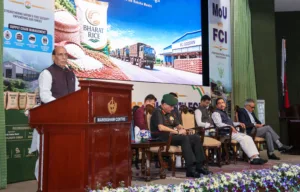

The new arrangement is intended to improve the quality of rice supplied to troops and reduce the work involved in moving food stocks to remote military depots. Under the existing process described by the government, Army depots collect supplies from local FCI facilities. Direct delivery will change this arrangement, particularly in areas where moving goods can take considerable time and effort.
The Bharat Rice programme has been developed under the Directorate General of Supplies and Transport, following feedback from Army personnel about the quality of their rations.
The rice will be milled to defence specifications and supplied through the National Agricultural Cooperative Marketing Federation of India Limited (NAFED) during the 2026-27 financial year. Quality checks will be carried out before dispatch. The rice must be free from foreign matter and unwanted admixtures, with broken, damaged and discoloured grains kept to a minimum.
The Army will procure the rice in 10 kg and 30 kg bags. These pack sizes are intended to make handling and transport easier, particularly at forward posts where soldiers may have to move supplies across difficult terrain.
The initiative follows nearly 18 months of coordination among the Army, FCI, NAFED and the Department of Food and Public Distribution.
Rajnath Singh said the scheme reflects the connection between agricultural production and the needs of the armed forces. He described it as an expression of the principle of ‘Jai Jawan, Jai Kisan’, with farmers’ work helping to meet the food requirements of soldiers serving far from home.
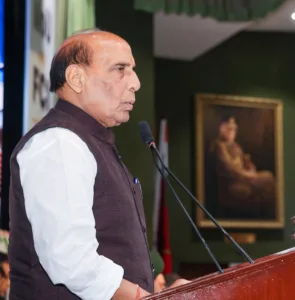

He also said the rice would meet standard specifications and that its packaging had been designed to reduce the physical burden on troops handling rations in remote locations.
The agreement with FCI addresses another concern: the Army’s ability to maintain food supplies when military operations begin at short notice or continue for extended periods.
FCI, the government agency responsible for food-grain procurement, storage and distribution, operates warehouses and modern grain silos across India. Its facilities, transport arrangements and trained workforce could help the Army store supplies closer to operational areas and move them quickly when required.
Under the MoU, Army formations will coordinate with FCI’s regional and divisional offices. The arrangements will become part of military logistics plans, allowing the two organisations to identify suitable storage facilities and organise the movement of supplies during emergencies.
The agreement will remain valid for five years and can be extended if both sides agree.
The arrangement also allows for the storage and forward positioning of rations, equipment and other stores. This could help the Army maintain supplies when normal transport routes face disruption or when additional stocks are needed near operational areas.
Speaking at the event, Rajnath Singh said the experience of Operation Sindoor had shown why military supply arrangements must be ready to respond to changing conditions.
“The strategic analysis of Operation Sindoor indicated that warning times could be extremely short in future conflicts. Scenarios involving zero-warning situations and the integration of technology into warfare could severely test our preparedness. Such conflicts could also put the endurance of our logistics chains and supply networks to the test. Therefore, we must build logistics resilience to sustain our operations. This MoU with FCI represents a significant step in that direction,” said Shri Rajnath Singh.
He added that military readiness depends on the ability to store, transport and replace supplies as required. Food, fuel and other essential items must reach personnel serving in difficult locations, even when operational demands change quickly.
The Defence Minister also spoke about the role of food in maintaining the health and morale of soldiers. Personnel serving in harsh weather and remote border areas need suitable rations to meet the demands of their duties.
He said the government was working to improve the quality of food, clothing, equipment and training available to troops. The Army has also taken steps in recent years to revise ration scales, provide additional rations for Agniveer recruits and bring greater uniformity to ration allowances across the three armed services. The introduction of organic rations has also been proposed.
Pralhad Joshi said providing good-quality food to military personnel was a duty of his ministry. Chief of the Army Staff General Dhiraj Seth, Secretary for Food and Public Distribution Sanjeev Chopra and senior officials from the Defence Ministry, FCI, NAFED and the cooperative sector attended the launch.
The use of existing civilian infrastructure for military purposes is another part of the plan. Singh cited the use of expressways for fighter aircraft landings and roads and bridges built by the Border Roads Organisation that also serve local communities. He said FCI storage facilities could similarly support both civilian food management and military requirements.
The approach is linked to the government’s PM Gati Shakti programme, which seeks to improve coordination in infrastructure planning.
Bharat Rice was first introduced for retail sale to ordinary consumers in February 2024, when the government set an initial maximum retail price of ₹29 per kg. The scheme used agencies such as NAFED, the National Cooperative Consumers’ Federation of India and Kendriya Bhandar to sell rice through shops and mobile outlets.
The Army’s new programme serves a separate purpose. It focuses on defence-grade rice, military packaging and direct deliveries to supply depots rather than household retail sales.
The government has not announced the total quantity of rice to be supplied under the Army programme or provided a detailed delivery schedule. These figures will help establish the scale of the scheme as supplies begin during 2026-27.
For troops stationed in Ladakh and the North-East, the practical test will be whether the new arrangements deliver the required rice on time and reduce the work involved in collecting and moving rations. The five-year agreement with FCI will give the Army and the food agency a formal basis for planning such support during normal operations and emergencies.
Must Read:
EME Expedition Starts Road Journey to Promote Army Careers
Defence Exports Rise as Adani Wins SIDM Award in New Delhi