

Indian National Congress

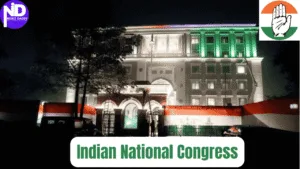
The Indian National Congress (INC) is the oldest political party in India. Founded in 1885 by Allan Octavian Hume, it initially led modern nationalist movements across Asia and Africa against British rule.
After 1920, under the leadership of Mahatma Gandhi, the Congress became the main face of the Indian independence movement, powerfully inspiring anti-colonial struggles worldwide.
The Party Today
Today, the Congress is one of India’s two major political parties, with the Bharatiya Janata Party (BJP) as its main rival. As a “big tent” party, its political stance generally leans towards the centre or centre-left. On social issues, the party promotes:
- Secular policies
- Civil liberties
- The welfare of minorities and weaker sections of society
By 2021, the Congress had won a solo majority in seven out of the 17 general elections held since independence, leading the central government for over 54 years. Out of its six prime ministers, Jawaharlal Nehru was the first (1947–1964), and Dr Manmohan Singh was the most recent (2004–2014).
Post-Independence and the Nehru Era
After India gained independence, the Congress grew into a broad, catch-all party under Jawaharlal Nehru. It dominated Indian politics for the next two decades. Following Nehru’s death and a brief term by Lal Bahadur Shastri, Indira Gandhi took charge, steering the party further towards left-wing policies.
Splits and Shifts (1969–1979)
In 1969, internal tensions caused the party to split under Indira Gandhi. She formed the Congress (R), while the remaining faction became the Congress (O). Congress (R) established its dominance by winning the 1971 general election.
Following the Emergency, the party lost the 1977 election. Another split occurred in 1979, leading to the creation of Congress (I).
Power Shifts from 1984 to 2014
1984: Following the assassination of Indira Gandhi, her son Rajiv Gandhi led the party to a major victory.
1989: The Congress lost power to the National Front, led by V. P. Singh.
1991: The party returned to government under P. V. Narasimha Rao.
1996: The Congress faced defeat in the general election.
2004: After an eight-year gap, the party won the general election and formed the United Progressive Alliance (UPA) coalition.
2004–2014: Led by Prime Minister Manmohan Singh, the UPA government remained in power for a decade.
2014: The Congress faced a heavy defeat, shrinking to just 48 seats in the general election.
During these decades, Sonia Gandhi became the party’s longest-serving president, holding the position for over twenty years.
How the Party is Organised
The Congress operates through a structured network across the country:
State Level: Every state has a Pradesh Congress Committee (PCC).
National Level: Representatives from the local districts and the PCCs join together to form the All India Congress Committee (AICC).
The party’s daily operations are managed through various internal committees and specialised wings.