


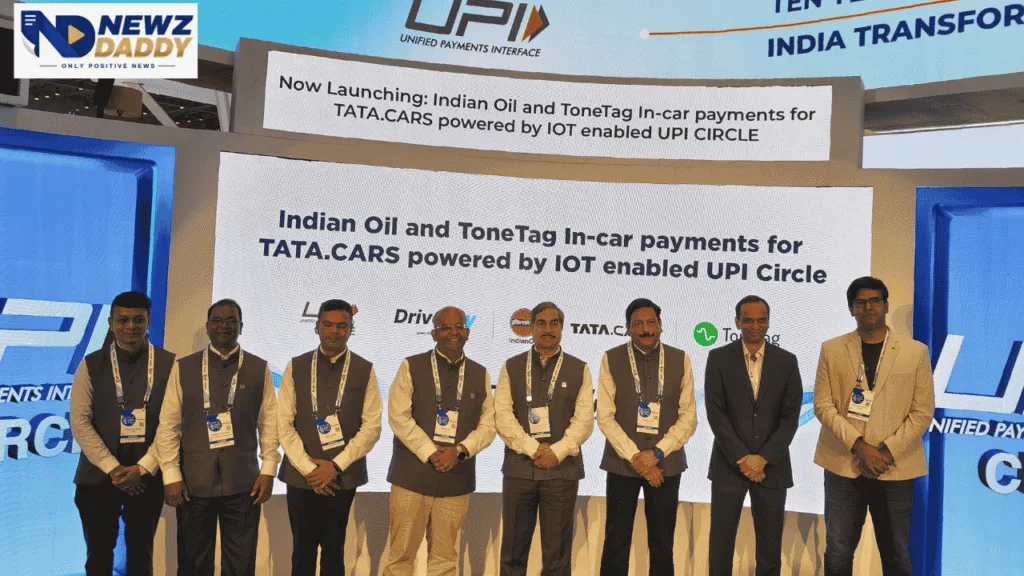
IndianOil Brings In-Car Payment to Tata Cars in Mumbai Now
IndianOil Brings Fuel Payments to Tata Car Dashboards Through UPI
Drivers of compatible Tata cars will soon be able to pay for fuel through their vehicle’s connected dashboard, under a new payment service launched by IndianOil in partnership with the National Payments Corporation of India (NPCI) and ToneTag.
The service was announced at the Global Fintech Fest (GFF) 2026 in Mumbai. It is designed to allow customers to complete a fuel payment from inside the car after refuelling, without opening a separate payment app or using a physical card.
The move comes as India’s digital payment system expands beyond mobile phones. NPCI had already introduced provisions for UPI payments through connected devices, including cars, smart TVs and wearables. The organisation’s October 2025 guidelines allow a UPI user to link certain Internet of Things (IoT) devices or software profiles to their account for authorised payments.
Under those rules, IoT payments must be based on an explicit action by the user. The framework also sets a maximum monthly delegation limit of ₹15,000 and a maximum transaction value of ₹5,000 for an IoT device or software profile.
The IndianOil-Tata Cars service brings that payment system into the fuel station setting.
After a customer refuels at a participating IndianOil outlet, the payment can be completed through the connected vehicle interface. The arrangement is being developed with ToneTag, a company that works on digital payment and proximity technology, while NPCI provides the UPI payment infrastructure.
For customers who use IndianOil’s XTRAREWARDS programme, the transaction will also connect with the company’s loyalty system. IndianOil says eligible customers can earn reward points without giving their mobile number during the transaction.
That detail matters because XTRAREWARDS has traditionally used a registered mobile number as a customer identifier. IndianOil’s current programme information says members earn points on fuel and lubricant purchases and can redeem them for fuel and other rewards. The programme is available across IndianOil retail outlets in India.
IndianOil has already been moving towards number-free reward transactions. Its retail communications have promoted QR-based XTRAREWARDS transactions in which customers can earn points without sharing their mobile number.
The new car-based system takes that process a step further by moving both payment and the reward transaction into the vehicle interface.
The technology is being introduced at a time when UPI has become a major part of India’s everyday payment system.
NPCI describes UPI as an instant payment system developed by the organisation under the regulatory framework of the Reserve Bank of India. UPI was first piloted in April 2016. It allows customers to make bank-to-bank payments through participating applications and supports merchant payments through methods such as QR codes and payment requests.
The next stage is moving some of those transactions away from the smartphone.
At the Global Fintech Fest in 2025, the Reserve Bank of India announced IoT Payments with UPI. NPCI said the system could allow connected devices such as cars, smart glasses and smart TVs to make payments for services including fuel and electric vehicle charging, subject to user authorisation and defined limits.
The 2026 IndianOil launch is therefore part of a wider shift in how UPI can be used. The phone remains important, but the payment system can now be built into other devices that people already use.
For Tata Motors, the project adds a payment function to an existing connected-car environment.
The company has been offering connected vehicle services through its iRA platform. Tata Motors’ current connected-car services include vehicle status, remote commands, safety and security features, navigation, driving information, alerts, trip information and fuel or charging assistance and history.
Tata Motors introduced iRA with connected features several years ago. The company said its Altroz i-Turbo, launched in 2021, included iRA connected-car technology with 27 connected features and voice technology.
The addition of fuel payment changes what the connected dashboard can do. Instead of displaying information about fuel or helping with vehicle services, the system can also become a point from which a customer completes a financial transaction.
The exact range of Tata models covered by the new fuel-payment service was not specified in the announcement provided for this report. Connected features can depend on the hardware and software fitted to a particular vehicle.
IndianOil has a very large retail network. Its annual report for 2025-26 says the company had 42,818 retail outlets as of March 31, 2026, after adding 2,635 outlets during the financial year.
The company’s current corporate information puts its fuel-station network at more than 42,000 outlets and says the stations serve more than 3.6 crore customers each day.
That scale gives a connected payment system a large potential setting, although the announcement does not say that every IndianOil outlet or every Tata connected car will support the service immediately.
IndianOil has also been expanding digital services around its retail business. In 2021, the company partnered with Google Pay to bring XTRAREWARDS to the payment app and offered fuel-related rewards at more than 30,000 IndianOil petrol pumps at the time.
The latest arrangement changes the point of payment again. Instead of moving from a physical card to a phone, the transaction can take place through the vehicle itself.
The launch was announced during GFF 2026, which is being held in Mumbai from September 8 to 11 at the Jio World Centre. The event is organised around developments in financial technology and includes policymakers, regulators, financial institutions and technology companies.
The wider event agenda includes topics such as artificial intelligence, tokenisation, digital public infrastructure and connected financial services.
Against that backdrop, the IndianOil-Tata Cars project shows how payment technology is moving into everyday physical services.
For drivers, the immediate use is simple: pay for fuel from the car and collect eligible XTRAREWARDS points without sharing a mobile number at the outlet. For the companies involved, the project provides a working use case for UPI payments through connected vehicles.
The bigger question will be how widely such services are adopted and what other purchases may eventually be made from a car dashboard. The IndianOil announcement says the system could provide a base for further in-vehicle payments, commerce and digital services.
For now, fuel is the first clearly identified use. The next step will depend on how the technology is rolled out across compatible Tata vehicles and IndianOil outlets.