


Infrastructure Cybersecurity Workshop Powers IITRAM’s Digital Push
IITRAM Successfully Concludes INFRA CYBERWISE–2026: A Two-Day Workshop on Infrastructure Cybersecurity
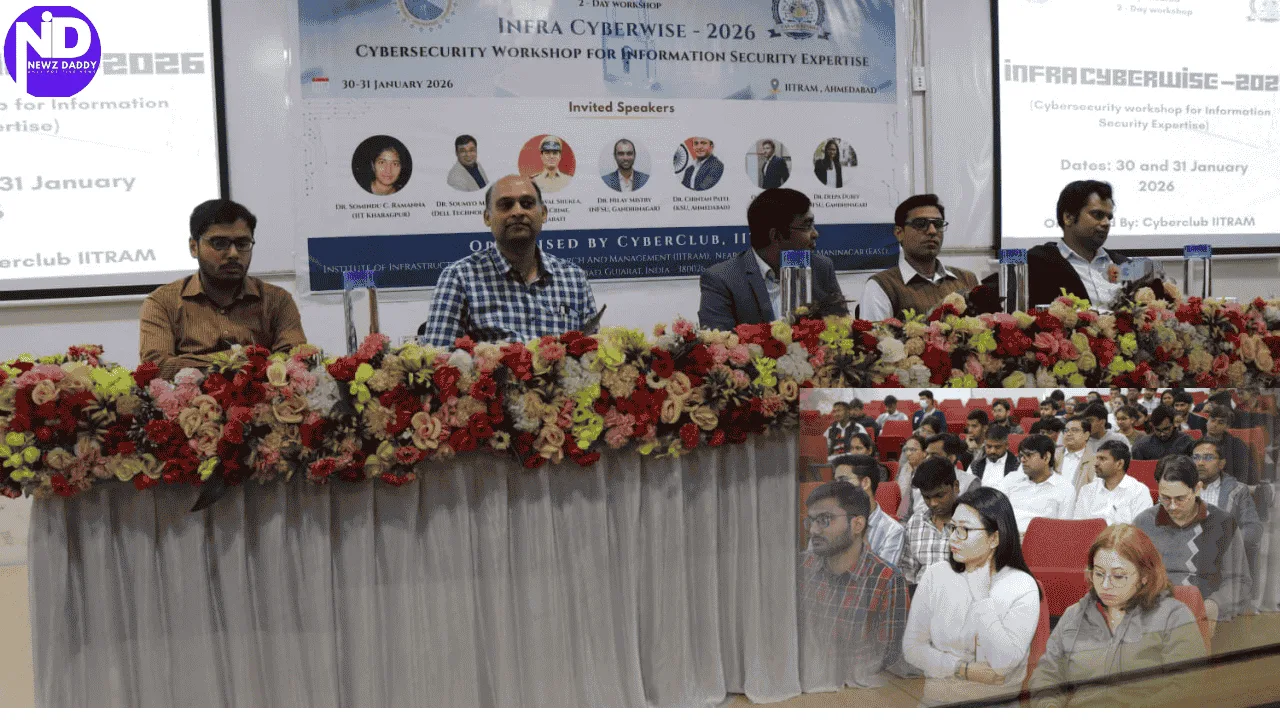
INFRA CYBERWISE–2026, a two-day workshop on Infrastructure Cybersecurity supported by CAWACH Kendra, Government of Gujarat, was successfully organised by the Cyber Club of the Institute of Infrastructure, Technology, Research and Management (IITRAM), Ahmedabad. The workshop brought together leading researchers, industry professionals, academicians, and cybersecurity practitioners to deliberate on emerging threats, best practices, and recent innovations in securing critical digital and physical infrastructures.
In recent years, infrastructure cybersecurity has become a serious national and global concern. Power grids, transport systems, water supply networks, hospitals, and communication systems now depend heavily on digital platforms. Even a small cyber breach can disrupt essential services and affect public safety. Workshops like INFRA CYBERWISE–2026 play an important role in spreading awareness and building practical knowledge, especially among students and young professionals who will shape the future of digital security. Support from government-backed centres such as CAWACH Kendra highlights the growing focus on strengthening cyber readiness at the state level.
The workshop commenced with a dignified inaugural ceremony. Dr Prasun Tripathi, Coordinator of the Cyber Club at IITRAM, warmly welcomed the delegates and outlined the workshop’s objectives and vision. Prof. Axay Mehta, Dean (Academic Affairs), IITRAM, addressed the gathering and highlighted the institute’s academic achievements and research initiatives in digital and cyber technologies.
Such opening sessions help set the tone for technical learning while reminding participants of the larger purpose of cybersecurity education. Across India, academic institutions are increasingly being encouraged to combine classroom learning with real-world problem solving. By promoting cyber clubs and research-based learning, institutes like IITRAM are helping students move beyond theory and understand how cyber risks affect real infrastructure systems used by millions every day.
The Chief Guest, Dr Soumya Maity, Distinguished Product Security Leader at Dell Technologies, delivered an insightful inaugural address emphasising contemporary cybersecurity challenges, infrastructure resilience, and the growing demand for skilled cybersecurity professionals.
Industry experts often bring practical experience that bridges the gap between textbooks and real threats. Today, cyber attackers use advanced tools such as artificial intelligence, social engineering, and automated malware. This has created a strong demand for trained professionals who understand both technology and risk management. Industry leaders also stress that cybersecurity is no longer only an IT issue but a core part of business continuity, national security, and public trust.
The Guest of Honour, Mr Dhaval Shukla, PSI, Cyber Crime Branch, Government of Gujarat, discussed real-world cybercrime cases and demonstrated effective prevention mechanisms to combat cyber frauds.
Real-life examples of cybercrime help audiences clearly understand how cyber attacks actually happen. In India, cases related to online fraud, fake links, identity theft, and digital payment scams have increased sharply. Law enforcement officers play a key role not only in investigation but also in public education. Sharing prevention methods, such as verifying sources, avoiding unknown links, and reporting suspicious activity, helps citizens protect themselves in daily digital lives.
The inaugural session concluded with a formal vote of thanks proposed by Dr Ravi Bhandari, Associate Head of Computer Science and Engineering Discipline, IITRAM, who expressed sincere gratitude to the dignitaries, speakers, faculty members, students, and volunteers for their valuable contributions to the successful organisation of the workshop.
Such acknowledgements reflect the collective effort required to organise knowledge-driven events. From planning sessions to managing technical arrangements, student volunteers and faculty members play a vital role. These experiences also help students develop teamwork, leadership, and organisational skills, which are equally important in professional careers.
The technical sessions featured eminent speakers from academia, industry, and government agencies, who delivered expert talks on a wide range of topics, including infrastructure cybersecurity fundamentals, cyber threats to critical infrastructure, safe online and email practices, phishing and ransomware prevention, mobile and social media security, data privacy, and emerging trends in cybercrime.
These topics address some of the most common and dangerous cyber risks faced today. Phishing emails and ransomware attacks remain among the top threats worldwide, often targeting both individuals and large organisations. Sessions on mobile and social media security are especially relevant, as smartphones have become primary tools for banking, communication, and work. Discussions on data privacy also help participants understand their rights and responsibilities in handling personal and sensitive information.
The speakers shared practical insights, real-world case studies, and hands-on perspectives, making the sessions highly engaging and informative for students, faculty members, and professionals alike.
Hands-on learning is widely recognised as one of the most effective ways to understand cybersecurity. Case studies show how small mistakes can lead to major breaches, while practical guidance helps learners apply safe practices immediately. By combining expert knowledge with real examples, INFRA CYBERWISE–2026 contributed meaningfully to building a stronger, more aware cyber community focused on protecting critical infrastructure and public systems.