


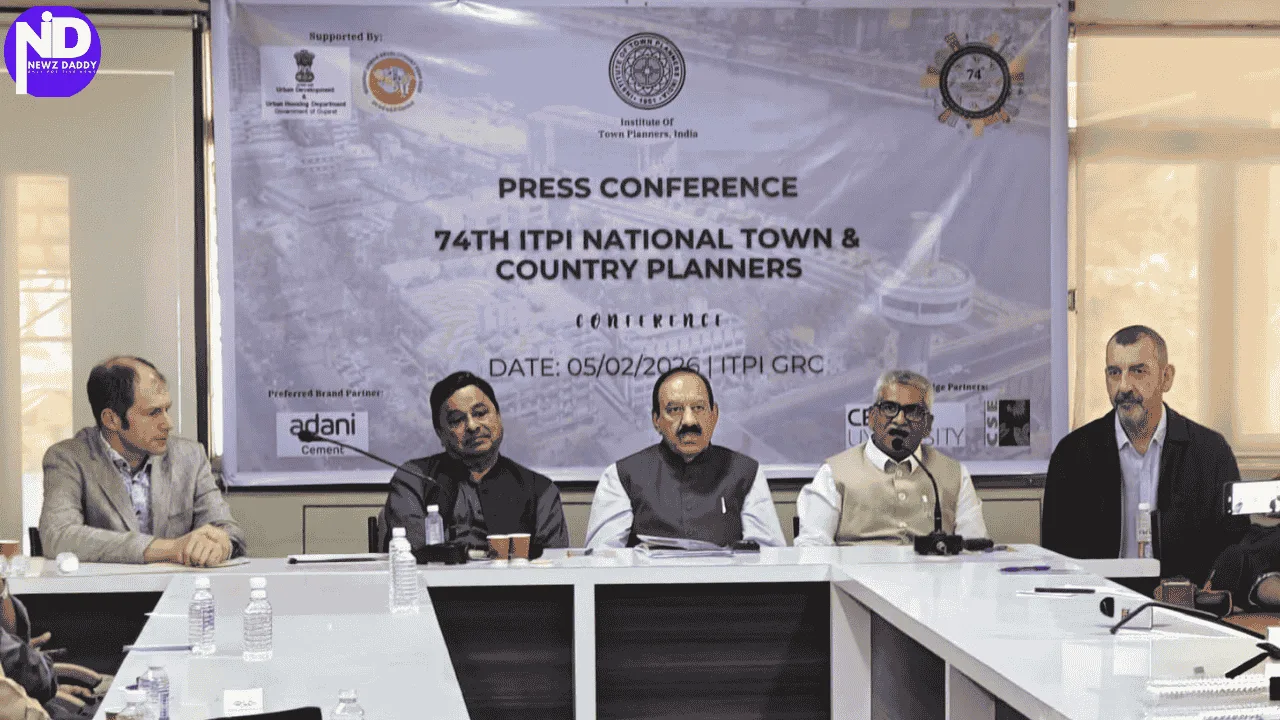
Proactive Regional Planning Takes Centre Stage in Ahmedabad
Institute of Town Planners, India’s (ITPI) Proactive Regional Planning Aims To Balance Growth, Jobs And Liveable Cities
Details of Conference:
- Dates: 6 and 7 February
- Time: 9:00 am to 6:00 pm
- Venue: Karnavati Club, Ahmedabad
After a long gap of 13 years, Ahmedabad is once again becoming the meeting point for India’s top minds in urban and regional planning. From February 6 to 8, the city will host the National Town and Country Planners Conference organised by the Institute of Town Planners, India, with the support of the Gujarat government’s Urban Development Department. More than 500 town planners, policymakers, academicians and urban experts from across the country are expected to attend, making it one of the most significant planning events in recent years.
This conference comes at a crucial time for India. Cities are growing faster than ever before. Government projections show that India’s urban population could reach nearly 600 million by 2031. That means about four out of every ten Indians will live in cities. At the same time, at least 68 Indian cities are expected to have populations of more than 10 lakh. This rapid growth puts heavy pressure on housing, transport, water supply, jobs and the environment. Experts agree that without strong regional planning, cities can become overcrowded, unequal and unsafe.
The theme of the conference, “Proactive Regional Planning and Development to Usher Viksit Bharat,” reflects this concern. The idea of Viksit Bharat by 2047 is not just about economic growth. It is also about a better quality of life, cleaner cities, strong infrastructure and fair development across regions. Regional planning helps connect cities with nearby towns and villages so that growth does not remain limited to a few urban centres.
One of the key highlights of the conference is the focus on new technologies. Sessions will discuss how Artificial Intelligence and GIS-based models can help planners make better decisions. These tools are already being used in many countries to map land use, predict traffic, manage floods and plan public services. In India, their wider use can help reduce errors, save time and improve transparency in urban projects.
ITPI – Institute of Town Planners, India was started in the year 1951 with just 15 town planners who came back to India after studying town planning in foreign countries. Today, ITPI has 24 regional chapters across the country.
High-speed rail, including the bullet train, will also be discussed as part of regional planning. Such transport systems do more than move people quickly. They reshape entire regions by opening new areas for housing, business and industry. Planners will look at how these projects can be aligned with local development needs rather than creating uneven growth.
The presence of senior leaders adds weight to the event. K Srinivas, Secretary of the Union Ministry of Housing and Urban Affairs, will attend as the Chief Guest, highlighting the Centre’s focus on planned urbanisation. Ahmedabad Mayor Pratibha Jain and former municipal commissioner Keshav Verma will join as Guests of Honour, bringing local governance experience into national discussions.
Gujarat, and especially Ahmedabad, offers a strong learning ground. The metropolitan region will be used as a live case study during the conference. Projects like Dholera Special Investment Region, GIFT City and the Delhi–Mumbai Industrial Corridor show how large-scale planning can attract investment and create jobs when done carefully. At the same time, these projects also raise questions about land use, environmental balance and social inclusion, which planners must address.
Discussions will also cover metro rail connectivity, industrial hubs like Sanand and Becharaji, and the Gujarat government’s recently announced satellite town policy. Satellite towns can reduce pressure on main cities by offering affordable housing and jobs nearby, but only if they are well-connected and properly planned. Experts will examine how such towns can grow without repeating the mistakes of unplanned urban sprawl.
Another important area is climate-resilient infrastructure. Indian cities are facing more heatwaves, floods and water shortages due to climate change. Planning for drainage, green spaces and resilient buildings is no longer optional. It is necessary for safety and long-term sustainability. The conference will look at how regional planning can help cities prepare for these risks together rather than acting alone.
Urban-rural linkages will also be discussed through initiatives like AMRUT 2.0. Strengthening these links can help villages access better services while reducing migration pressure on cities. Economic corridors such as the Delhi–Mumbai and Chennai–Bengaluru corridors show how coordinated planning can boost regional economies when transport, industry and housing are planned together.
With a presence in 26 states and more than 10,000 town planners as members, ITPI plays a major role in shaping India’s planning thinking. As Adani Cement supports the conference as a preferred brand partner, the event also reflects growing cooperation between planners, government and industry. Together, the discussions in Ahmedabad aim to move beyond ideas and focus on practical solutions that can guide India’s cities and regions towards balanced, inclusive and sustainable growth.
Also Read:
HORIBA acquires Pristine Deeptech, boosts India R&D power
Ambuja Cements Q3 FY26 Results Prove Cost Control Is Paying Big