


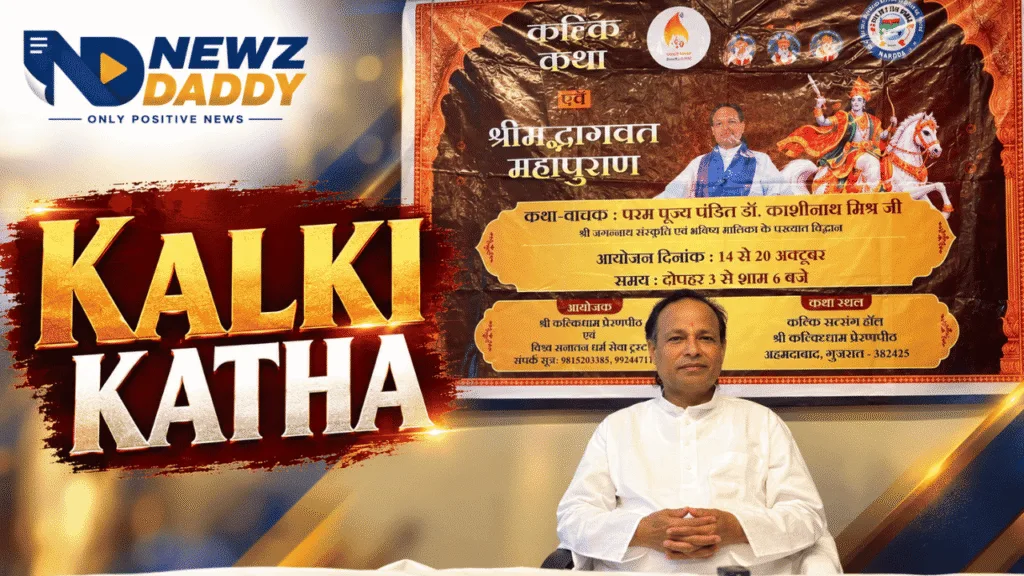
Kalki Katha Ahmedabad: Dr Kashinath Mishra to Lead Discourses
Ahmedabad to Host Seven-Day Kalki Katha on Ancient Hindu Prophecies
The programme at Sri Kalkidham Prernapeeth from October 14 to 20 will examine Lord Kalki, the Bhavishya Malika tradition and Hindu beliefs about the transition from Kali Yuga to Satya Yuga.
A seven-day religious programme centred on Lord Kalki, regarded in Hindu tradition as the tenth incarnation of Lord Vishnu, will begin at Sri Kalkidham Prernapeeth in Ahmedabad on October 14. The event, titled Sri Kalki Katha and Srimad Bhagavata Mahapurana, will run until October 20, with daily sessions from 3 pm to 6 pm at Kalki Sangam Hall.
The discourses will be delivered by Param Pujya Pandit Dr Kashinath Mishra Ji, whom the organisers describe as a researcher and exponent of Jagannath culture and the Bhavishya Malika Purana. Sri Kalkidham Prernapeeth and the Vishwa Sanatan Dharma Seva Trust are organising the programme, which is open to devotees, religious scholars, saints, young people and followers of Sanatan Dharma.
The central theme is the religious understanding of Kali Yuga, the age in Hindu belief associated with a decline in righteousness, and the expected arrival of Satya Yuga, an age traditionally linked to truth and virtue.
The programme will examine the Bhavishya Malika, a collection of prophetic writings associated with the Panchasakha saints of Odisha. These saints include Achyutananda Das, Balarama Das, Jagannatha Das, Shishu Ananta Das and Yashobanta Das. Their religious and literary traditions developed during the medieval period and remain part of Odisha’s spiritual heritage.
Achyutananda Das is particularly associated with writings that discuss future events, changes in religious life and the arrival of Lord Kalki. The Bhavishya Malika tradition describes the decline of Dharma, conflict, natural disasters and wider human suffering before the restoration of righteousness.
The organisers describe the text as a 600-year-old scripture. Its predictions and interpretations have attracted attention among sections of the Hindu religious community, particularly those interested in the future of Kali Yuga. However, the age and interpretation of individual passages require careful examination, as historical scholarship has yet to establish a single, agreed textual history for the entire body of Malika writings.
The event will examine these traditional accounts and their meaning for present-day audiences.
The idea of Lord Kalki’s arrival also appears in the Srimad Bhagavata Mahapurana, an important Hindu religious text. In its first canto, the scripture describes Kalki as an incarnation of Vishnu who will appear when rulers have turned towards wrongdoing. Its twelfth canto links his appearance with the beginning of Satya Yuga.
Hindu cosmology describes four repeating ages: Satya Yuga, Treta Yuga, Dvapara Yuga and Kali Yuga. Each age is associated with a different state of Dharma and human conduct.
Traditional interpretations of the Srimad Bhagavata place the duration of Kali Yuga at 432,000 human years. This means that claims about the age ending in the near future depend on particular interpretations of religious texts rather than a universally accepted reading of Hindu scripture.
The Bhavishya Malika tradition has its own interpretations of the timing of these changes. The Ahmedabad programme is expected to discuss the differences and connections between these religious accounts, including the relationship between Lord Jagannath and the Kalki incarnation.
Questions about whether present-day wars, environmental disasters and social problems represent signs of the end of Kali Yuga form part of the wider public interest in these writings. Such connections remain matters of religious interpretation, rather than established scientific predictions.
According to the organisers, Dr Kashinath Mishra has studied Jagannath culture and the Bhavishya Malika tradition for more than four decades. They state that he has worked to explain the texts’ symbolic verses and prophetic accounts to audiences in around 30 languages worldwide.
He is also said to have received an honorary doctorate for his research in these fields. The programme will allow attendees to hear his explanations of the writings and their place in Hindu religious thought.
The sessions will also cover Naam Smaran, or the chanting of God’s name, Trikal Sandhya, a traditional practice of prayer at three times of the day, and the recitation of the Srimad Bhagavata. Moral conduct, devotion and the practice of Dharma will form part of the discussions.
These subjects have a wider place in Hindu religious life, where prayer, scriptural study and personal conduct are often presented as ways to maintain spiritual discipline.
The organisers say the purpose of the Katha is to encourage spiritual awareness rather than fear about future events. They intend to discuss how religious teachings can guide individuals and families through periods of uncertainty.
For visitors, the programme offers an opportunity to learn about Odisha’s Panchasakha tradition and the place of Lord Kalki in Hindu beliefs. It also brings a regional religious tradition to an audience in Gujarat.
The seven-day event will take place at Kalki Sangam Hall, Sri Kalkidham Prernapeeth, Ahmedabad, Gujarat, PIN 382425. Sessions will be held daily from 3 pm to 6 pm, from October 14 to October 20, 2026.
The programme will centre on the spiritual meaning of the Bhavishya Malika and the Hindu belief that righteousness will return at the end of Kali Yuga. For attendees, the main focus will be how these teachings relate to devotion, ethical choices and everyday life.