


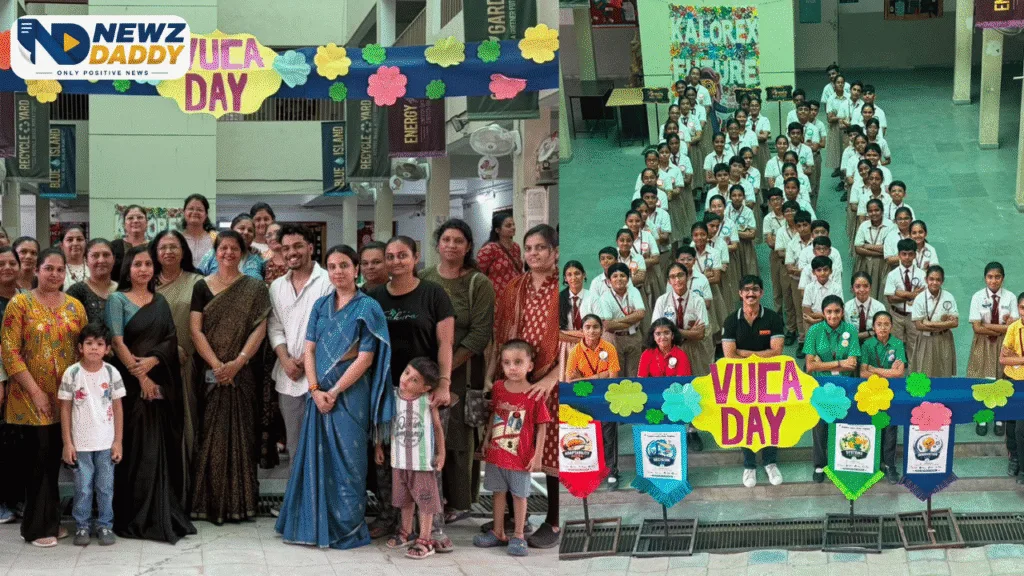
Kalorex Future School holds VUCA Day in Ghatlodia, Ahmedabad
Kalorex Future School event puts students in charge as parents learn about VUCA
More than 100 parents took part in a learning event at Kalorex Future School, Ghatlodia, where students became guides and facilitators for activities built around four difficult ideas: Volatility, Uncertainty, Complexity and Ambiguity, commonly grouped under the term VUCA.
The school organised VUCA Day as an activity-based programme involving students and their parents. Instead of leaving the children to complete the exercises, students helped their parents work through a series of tasks in four activity areas named Adaptability Arena, Decision Lab, Systems Studio and Innovation Hub.
The format gave students a different role inside the classroom. They were expected to explain activities, guide participants and help parents work through problems linked to adapting to change, making decisions, understanding how different parts of a situation are connected, and developing new ideas.
The VUCA term has been used for years to describe situations where conditions can change quickly and where people may not have complete information before making decisions. The idea has also found a place in education as schools look beyond academic results and give children opportunities to practise skills such as problem-solving, communication and adaptability.
For parents taking part at Kalorex Future School, the activities offered a chance to see these skills in practice. The school said the four zones were designed around different responses to uncertain or complicated situations. The emphasis was on participation rather than a conventional classroom lesson.
The approach fits with the direction of India’s National Education Policy 2020, which calls for school learning to become more holistic, interactive and connected to students’ experiences. The policy specifically encourages experiential learning and says students should have opportunities to learn through activities, discovery and practical experiences.
The Central Board of Secondary Education has also promoted experiential learning through arts-integrated, sports-integrated and storytelling-based teaching. Its guidance says such methods can help students connect classroom subjects with their own lives, while also supporting critical thinking, social and emotional skills and learning through mistakes.
Kalorex Future School, Ghatlodia is a CBSE–affiliated senior secondary school in Ahmedabad. The CBSE’s official school records list the institution under affiliation number 430202 and give its location as K.K. Nagar Road, Ghatlodia. The school first opened in 2007 and was founded in 2011, according to the CBSE record.
The school describes its teaching approach as focused on interactive and participative learning. Its published information also refers to the importance of adapting to change and developing skills that can help students deal with new situations.
The event also moved beyond decision-making and problem-solving. For students in Grades 1 to 5, the school held a Noon Shift celebration built around the theme “Attitude of Gratitude”.
Students presented a skit inspired by Yali Moral Tales, with the performance centred on kindness and appreciation. Younger students also performed on “Thank You”. Parents were invited to take part in a Gratitude Game Activity.
The focus on gratitude placed a social and emotional element alongside the practical exercises of VUCA Day. For younger children in particular, activities based on kindness and appreciation can give parents and teachers a way to discuss everyday behaviour in a setting that is less formal than a normal lesson.
Value-based and activity-based learning have also become part of wider education programmes in India. The Ministry of Education’s PRERANA programme, for example, uses hands-on activities and value-based learning for selected school students. The programme is based in Vadnagar, Gujarat, and is designed around themes including self-awareness, cultural heritage and a sense of responsibility towards the country.
That wider shift matters because children are being asked to develop skills that are difficult to build through memorisation alone. A child may know the meaning of adaptability from a textbook, for example, but an activity that requires a quick change of plan can show what adapting actually involves.
The same applies to decision-making. Real situations rarely provide all the information at once. Students may need to compare choices, explain why they selected one option and accept that another person may reach a different conclusion. Activities involving parents can make these lessons easier to discuss at home as well as at school.
The event also changed the usual student-parent relationship. Students who normally receive instructions from teachers were placed in the position of explaining tasks to adults. That required them to understand the activity well enough to guide someone else through it.
For the school, VUCA Day therefore brought together two parts of its educational programme: practical learning and values-based activities. Parents experienced the activities alongside their children, while students had to communicate what they had learnt.
Kalorex Future School’s public information states that it works with families and the wider community as part of its approach to education. The school also says its programme includes life skills and communication skills alongside academic learning.
The August 26 event gave those ideas a practical setting. More than 100 parents participated, students led activities across four zones, and younger pupils used performances and games to explore gratitude.
For families, the most useful part may continue after the event ends. Adaptability, careful decision-making, understanding connections between problems and showing gratitude are behaviours children encounter at home, in school and later in working life. Activities like these give parents a chance to see how schools teach those behaviours alongside regular academic subjects.