


Kusha Missile Passes Maiden Flight Test by DRDO
Kusha Missile Adds Another Milestone To India’s Indigenous Defence Technology Efforts.
DRDO’s ‘Kusha’ Missile Clears Maiden Flight Test, Strengthening India’s Indigenous Air Defence Programme
India has taken another step towards strengthening its home-grown air defence capability after the Defence Research and Development Organisation (DRDO) successfully carried out the maiden flight test of the ‘Kusha’ Long Range Surface to Air Missile (LRSAM) on 23 July 2026. The trial was conducted from Dr APJ Abdul Kalam Island off the coast of Odisha, where the missile successfully intercepted an electronic target designed to simulate a high-speed, high-altitude aerial threat. The successful interception marked the first flight test of the system and met the planned objectives, according to the Ministry of Defence.

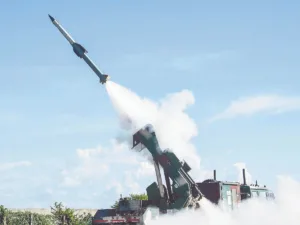
The Kusha missile system has been designed to protect against a wide range of aerial threats. According to DRDO, it can engage fighter aircraft, missiles, unmanned aerial vehicles (UAVs), and large enemy aircraft across different ranges and altitudes. The complete weapon system, including the interceptor missiles, radar network, and command and control centre, has been developed by several DRDO laboratories working with Indian industry partners.
The programme is part of India’s wider effort to expand self-reliance in advanced defence technology. Air defence systems of this class have traditionally been supplied by only a small number of countries, making indigenous development an important strategic goal. The successful first flight is expected to lead to additional developmental trials before the system is considered for operational induction.
Reacting to the achievement, Raksha Mantri Shri Rajnath Singh said, “The successful test-flight of ‘Kusha’ marks an important milestone in Indian defence R&D, highlighting the capability in developing a long-range surface-to-air missile system, possessed only by a handful of nations. This, he added, will also eliminate the import dependency for such systems and signify a giant leap in the air defence capability of the nation.”
The launch was monitored by the Defence Secretary and Secretary, Department of Defence R&D and Chairman, DRDO Shri Rajesh Kumar Singh, who congratulated the scientists, engineers and industry teams involved in the project after the successful test.
The Kusha programme forms part of India’s plan to build a layered air defence network capable of protecting military bases, critical infrastructure and strategic locations from modern aerial threats. Defence experts note that future variants of the system are expected to cover longer engagement ranges, creating multiple defensive layers against aircraft, cruise missiles and other airborne targets. Reports indicate that planned versions of the missile family are intended to offer interception ranges extending up to 350 to 400 kilometres, although each variant will undergo separate testing before entering service.
India has steadily expanded its indigenous missile development over the past two decades through programmes such as Akash, Akash NG, Quick Reaction Surface to Air Missile (QRSAM), Medium Range Surface to Air Missile (MRSAM), Pinaka, and the Long Range Land Attack Cruise Missile (LRLACM). These projects aim to reduce dependence on imported defence equipment while strengthening domestic manufacturing under the country’s broader defence production strategy.
Modern conflicts have demonstrated the growing importance of strong air defence systems as armed forces face increasingly complex threats from drones, precision-guided missiles, cruise missiles and advanced combat aircraft. Countries are investing heavily in layered air defence networks that combine surveillance radars, command systems and interceptor missiles capable of responding quickly to multiple targets at different altitudes.
For India, the successful maiden flight of Kusha represents an important technical milestone rather than the completion of the programme. The missile system will undergo further testing to validate its performance under different operational conditions before it is considered ready for deployment. If future trials are successful, Kusha is expected to become a key element of India’s expanding indigenous air defence architecture while reducing long-term dependence on imported long-range missile systems.