


MAHASAGAR Academy Raises Hope for India’s Sea Safety
Rashtriya Raksha University Inaugurates MAHASAGAR Academy as a Strategic Platform for Maritime Security, Law and Capacity Building
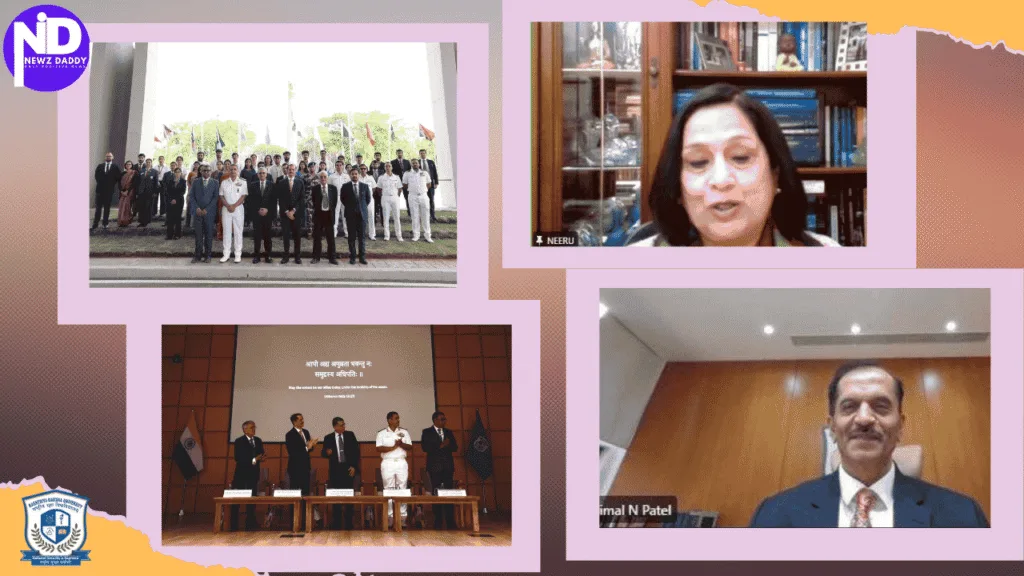
Rashtriya Raksha University (RRU) inaugurated the MAHASAGAR Academy on 20 April 2026 at its Gandhinagar campus, in partnership with the Indian Maritime University (IMU). Conceived as a forward-looking platform for education, research, policy dialogue and executive capacity building, the Academy reflects India’s expanding maritime vision under MAHASAGAR – Mutual and Holistic Advancement for Security and Growth Across Regions.
The launch comes at a time when global maritime trade carries nearly 90 per cent of the world’s goods. Experts across journals and policy platforms have often pointed out that any disruption at sea, whether due to conflict, piracy or climate change, can affect daily life on land. India, with a coastline of over 7,500 kilometres and key shipping routes passing through the Indian Ocean, has a strong need for trained professionals who understand both law and security at sea.
The inaugural day of the Academy brought together distinguished leadership from international adjudication, maritime security, maritime law enforcement and academia, including Vice Admiral Biswajit Dasgupta, PVSM, AVSM, YSM, VSM (Retd.), National Maritime Security Coordinator, India; H.E. Judge Tomas Heidar, President of the International Tribunal for the Law of the Sea (ITLOS); H.E. Judge Neeru Chadha, Vice President of the International Tribunal for the Law of the Sea (ITLOS); Rear Admiral Sritanu Guru, VSM, Flag Officer Commanding Gujarat, Daman and Diu Area, Indian Navy; Shri Satish D. Kamath, Senior Deputy Director General (Technical), Directorate General of Shipping; and Prof. (Dr.) Bimal N. Patel, Vice-Chancellor, Rashtriya Raksha University. The occasion marked the formal launch of an academic and strategic initiative dedicated to strengthening maritime law, governance, operations and regional cooperation.
Such gatherings are often seen in global maritime forums where countries share best practices. Research papers from organisations like the International Maritime Organisation have stressed that cooperation between nations is key to stopping illegal fishing, piracy and smuggling. The presence of both Indian and international leaders at this event reflects that same need for shared learning.
Delivering the Chief Guest Address (In-person), Vice Admiral Biswajit Dasgupta described MAHASAGAR as a vision that must be translated into concrete action through academic reflection, professional dialogue, coherent policy, robust legal frameworks and long-term strategic planning. He emphasised that maritime security is deeply tied to economic resilience, national security and comprehensive national power. He drew attention to the evolving security landscape in the Indian Ocean, marked by supply chain disruptions, hybrid threats, illicit trafficking, IUU fishing, cyber vulnerabilities and the growing strategic significance of maritime domain awareness.
In recent years, reports have shown a rise in illegal, unreported and unregulated fishing in the Indian Ocean, which harms both marine life and coastal livelihoods. Cyber threats to ports and shipping systems have also increased, with some global ports facing hacking incidents. These risks make it clear why better training and awareness are needed.
Vice Admiral stressed the future of maritime governance, which will depend upon the ability of institutions to integrate policy, law, technology and operational readiness. He underscored the importance of evidence gathering, maritime forensics, trained prosecutors to address maritime crime in the court of law, and academic examination of emerging technologies such as AI and autonomous systems. He expressed confidence that institutions such as Rashtriya Raksha University can play a leading role in shaping a vibrant maritime knowledge ecosystem for India and the wider Indian Ocean region.
Studies from defence think tanks have also noted that AI-based tracking systems and satellite monitoring are already helping countries detect suspicious vessels faster. This shows how law and technology must work together.
In his Chief Guest address, H.E. Judge Tomas Heidar offered a reflection on the enduring role of international adjudication in strengthening the rule of law at sea. He underscored that ITLOS has contributed to the development of international law by bringing clarity and consistency to the interpretation of UNCLOS. He highlighted that such clarity strengthens confidence among States and supports peaceful cooperation.
Legal experts have often pointed out that clear rules reduce conflict at sea. When countries understand boundaries and rights better, disputes can be handled without force. This builds trust and stability.
Judge Heidar drew attention to the Tribunal’s 2024 Advisory Opinion on climate change, which recognised greenhouse gas emissions as pollution of the marine environment. This has gained attention in environmental journals, as rising sea temperatures and pollution are already affecting fish stocks and coastal communities.
In her address, H.E. Judge Neeru Chadha explained the Tribunal’s urgent procedures under UNCLOS, including prompt release and provisional measures. She noted that these allow quick legal action when needed.
This is important because delays in such cases can lead to loss of resources or damage to the environment. Legal studies show that faster decisions help protect both rights and ecosystems.
Prof. (Dr.) Bimal N. Patel stated that the MAHASAGAR Academy carries a larger purpose. He said it aims to connect law, policy, security and technology practically. He described it as a link between classroom learning and real-world action.
Education experts agree that hands-on learning and real case studies improve understanding, especially in complex fields like maritime law.
Rear Admiral Sritanu Guru highlighted that maritime security is a key part of national strength. He pointed to the Indian Navy’s role in keeping sea lanes safe and supporting regional peace.
India has been active in anti-piracy operations and disaster relief missions, earning global recognition.
Shri Satish D. Kamath described the Academy as a timely step, noting that maritime challenges today require better coordination between research and practice.
Many policy reports have stressed that training future leaders in this field is essential for long-term growth and safety.