


Marengo CIMS Hospital’s 3D-Printed Hip Reconstruction
A Medical Milestone in Ahmedabad: 3D Printing Saves an International Patient’s Mobility
In a quiet recovery room at Marengo CIMS Hospital, a woman named Ms Basirath is taking her first steps in months. These steps are not just a personal victory; they represent a massive leap forward for medical science in India. Surgeons here have successfully performed a rare and life-saving hip reconstruction using a custom-made 3D-printed pelvic cage, a procedure so complex it is rarely seen anywhere in the world.
Ms. Basirath’s journey to this moment began with a nightmare. Four months ago, she underwent a revision hip surgery in Africa. However, something went terribly wrong. Instead of staying in place, the metal socket of the artificial hip began to “migrate,” or move, deep into her pelvic cavity. This left her in constant, agonising pain and completely unable to walk. More dangerously, the stray metal was pressing against her major blood vessels, including the external iliac vein. If these vessels had burst, the situation would have been fatal.

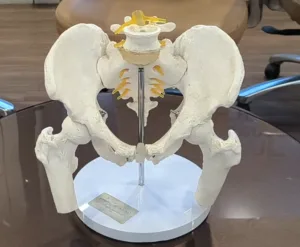
Seeking a miracle, she reached out to Dr Pranav Shah, the Director of Orthopedic Trauma and Hip Replacement at Marengo CIMS. After looking at her scans, Dr Shah knew that a standard surgery would not work. The bone in her pelvis was so damaged that there was nothing left to hold a normal hip replacement in place. To solve this, the team turned to the future of medicine: 3D printing.
Modern medical journals often highlight how 3D printing is changing the way we treat “unfixable” injuries. By taking a CT scan of a patient’s body, engineers can create a digital map of the bone. In Ms Basirath’s case, this allowed doctors to print a “pelvic cage” made of titanium that fit her unique body perfectly. This cage acts like a bridge, filling in the holes where bone is missing and providing a solid foundation for a new hip.
The operation was performed in two careful stages. First, surgeons had to go through the abdomen to gently move the blood vessels away and pull out the old, displaced implant. This is a high-stakes task that requires the steady hands of a master surgeon. Once the danger to her internal organs was gone, the second stage began. The team fitted the custom 3D-printed cage into her pelvis and then placed a cemented hip joint over it.
The success of this surgery is a testament to what experts call “multidisciplinary care.” This is a fancy way of saying that many different types of doctors, heart specialists, bone surgeons, and high-tech engineers all worked together as one team. Dr Keyur Parikh, the Chairman of the hospital, noted that combining this level of expertise with cutting-edge technology allows them to take on cases that other hospitals might turn away.
For Ms Basirath, the results were almost immediate. Within just three to four days after the surgery, she was back on her feet with the help of a walker. In the world of orthopaedic surgery, this is an incredibly fast recovery for such a major operation. As her bone continues to knit with the titanium cage, she will eventually be able to walk completely on her own, without any pain.
This case is being talked about in medical circles across India because it shows how technology can solve the most difficult human problems. While 3D-printed implants are becoming more common for simple tasks, using them to rebuild a shattered pelvis is still very rare. By completing this reconstruction, the team at Marengo CIMS has proven that India is now a global hub for advanced medical tourism, offering hope to patients who have run out of options in their home countries.
As Ms. Basirath prepares to return home, she leaves behind a legacy at the hospital. Her story will likely be studied by future medical students and shared in journals as a perfect example of how 3D printing can give a person their life back. It is a reminder that in the hands of skilled doctors, technology is more than just “gadgets”, it is a pathway to a second chance at walking.
Also Read:
Marengo CIMS Hospital’s New Centre Leads the Fight Against Obesity in Gujarat