


Mission Sudarshan Chakra: India’s New Missile Shield Plan
Rajnath Singh Unveils Advanced Weapon System Complex in Hyderabad, Highlights India’s Growing Missile Defence Ambitions
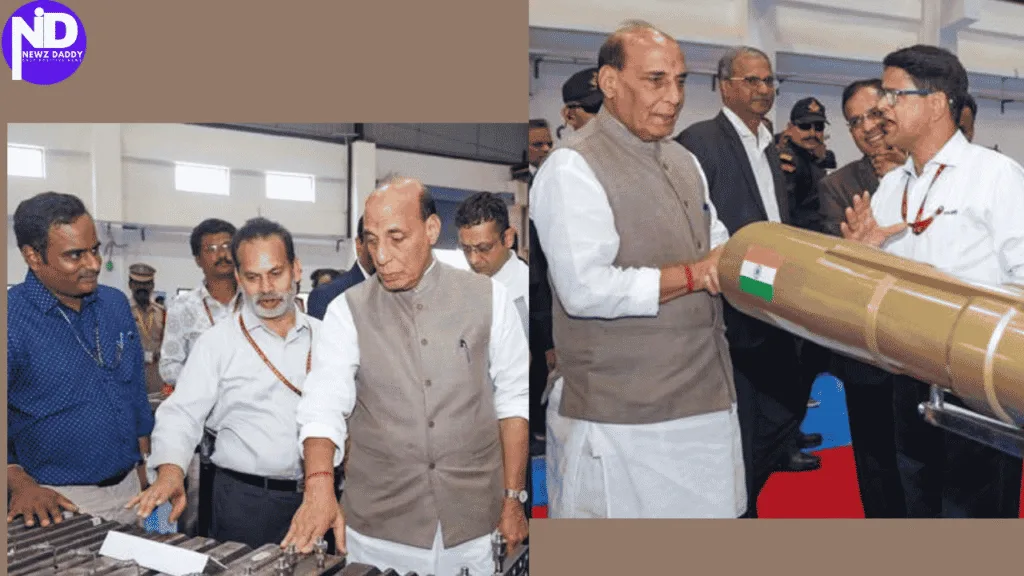
Defence Minister Rajnath Singh on Friday inaugurated an Advanced Weapon System Complex at the Defence Research and Development Organisation’s (DRDO) Defence Research and Development Laboratory (DRDL) within the Dr APJ Abdul Kalam Missile Complex in Hyderabad, marking another step in India’s efforts to strengthen indigenous defence technology and missile development capabilities.
During his visit to Telangana, Singh praised DRDO’s Missile Systems and Strategic Systems Cluster for its role in advancing India’s defence research, missile technology and strategic preparedness. He said the performance of indigenous missile systems during Operation Sindoor reflected the growing capabilities of India’s defence research and development ecosystem.
“The systems developed by DRDO, such as Akash and BrahMos, proved that India possesses the capability to compete in the global defence technology ecosystem. Strength is essential for peace, and self-reliance is the most reliable foundation for that strength. It is a fact proven by DRDO,” said Shri Rajnath Singh.
The inauguration comes at a time when India is increasing investments in defence modernisation, indigenous manufacturing and advanced weapons development. Over the past decade, the country has focused heavily on reducing dependence on imported military equipment while expanding domestic research, design and production capabilities under initiatives such as Make in India and Aatmanirbhar Bharat.
A major theme of the Defence Minister’s address was the growing importance of missile defence systems in modern warfare. Referring to Operation Sindoor, Singh said India’s air defence network played a crucial role in protecting the country from aerial threats.
“When aerial threats loomed over borders, our air defence system completely thwarted the enemy’s intentions,” he said.
He linked this experience to the government’s long-term missile defence plans, particularly the proposed Mission Sudarshan Chakra, which was announced by Prime Minister Narendra Modi during his Independence Day address in 2025.
According to Singh, the initiative is intended to create a multi-layered missile defence architecture capable of protecting military facilities, strategic assets, critical infrastructure and civilian establishments.
“‘Mission Sudarshan Chakra’, announced by PM Modi during his 2025 Independence Day address, is set to become a multi-level missile defence system of modern India. It will not only protect military installations and critical infrastructure, but also ensure the safety of civil infrastructure & key establishments. The system will possess the capability to deliver a decisive punch whenever needed. Its three-layered protection will ensure minimal inconvenience to citizens and prioritise their safety. It is a system designed to provide a robust protective shield for all assets of vital importance,” said Shri Rajnath Singh.
While detailed specifications of the programme have not yet been made public, defence analysts have noted that modern missile defence systems typically combine long-range radar networks, interceptor missiles, command-and-control centres and layered protection mechanisms designed to counter a variety of airborne threats.
The Defence Minister also pointed to ongoing conflicts around the world, particularly in the Middle East, as evidence of the increasing importance of integrated air defence systems.
Modern battlefields are rapidly changing due to the emergence of precision-guided weapons, drones, hypersonic missiles, electronic warfare systems and artificial intelligence-powered military technologies. Countries across the world are investing heavily in air defence and missile interception capabilities to protect both military and civilian infrastructure.
India has been pursuing similar capabilities through programmes led by DRDO and other defence organisations. Indigenous systems such as the Akash surface-to-air missile have already been inducted into the armed forces, while the BrahMos supersonic cruise missile programme has become one of the country’s most successful defence collaborations.
The BrahMos missile, developed jointly by India and Russia, has attracted international attention and export interest. The Akash missile system, meanwhile, has become a key component of India’s air defence network and represents one of the most prominent examples of indigenous military technology developed by DRDO.
Speaking about the changing global security environment, Singh stressed the importance of both resilience and deterrence in national defence planning.
“Precision-strike capabilities, Integrated air defence systems, hypersonic weapons, autonomous platforms, artificial intelligence, electronic warfare, and advanced sensor technologies are redefining the nature of modern warfare. The international order is undergoing a period of tension and transformation, where old assumptions are crumbling, and new alliances & challenges are taking shape. In such an environment, there is a need to possess ‘resilience’ – the capacity to absorb any shock and bounce back; and ‘deterrence’ – the ability to instil fear in the mind of the aggressor that a befitting reply would be given if a hostile eye is cast,” he said.
The concept of deterrence has remained central to defence policy worldwide, particularly as countries face increasingly complex threats involving missiles, drones, cyber operations and electronic warfare systems.
Singh said DRDO’s work was helping India strengthen both resilience and deterrence while improving confidence in the country’s defence preparedness.
“Today’s inauguration is a symbol of our resolve to become alert, capable, and self-reliant in tackling every challenge,” he said.
Founded in 1958, DRDO has become India’s premier defence research organisation, overseeing hundreds of projects ranging from missiles and combat vehicles to radar systems, unmanned platforms and advanced materials.
The Dr APJ Abdul Kalam Missile Complex in Hyderabad is one of the country’s most important missile research centres. It houses several laboratories involved in the design, testing and development of strategic and tactical missile systems.
Singh said DRDO must continue to focus not only on present-day requirements but also on technologies that could shape future battlefields.
“DRDO’s responsibility is not limited to merely adapting to technological changes, but also anticipating future needs. It has accepted this challenge with confidence. In recent years, it has achieved numerous milestones in the field of indigenous missile technologies. Advanced missile systems have been successfully tested, and continuous progress is being made in strategic and tactical weapon programmes. These achievements are not just technological milestones; they also demonstrate India’s growing self-reliance, self-confidence, and strategic capabilities,” he said.
A key issue highlighted by the Defence Minister was the need to speed up the transition from research laboratories to large-scale production.
He said modern conflicts require not only advanced technology but also the ability to manufacture equipment quickly and in sufficient numbers.
Singh urged DRDO, the armed forces and industry partners to function as a unified ecosystem capable of rapidly converting technological achievements into operational systems. He also called for shorter development timelines, simpler manufacturing processes and greater use of indigenous components.
His remarks reflect a broader policy shift in India’s defence sector, where collaboration between DRDO, Defence Public Sector Undertakings, private industry, start-ups, micro, small and medium enterprises, and academic institutions has expanded significantly over the past decade.
The government has introduced several reforms aimed at encouraging domestic defence manufacturing, increasing private sector participation and supporting innovation-driven defence start-ups.
As part of the visit, the Defence Minister also toured a technical exhibition displaying advanced defence technologies, indigenous missile platforms and weapon systems developed by DRDO.
Senior officials present at the event included Director General (Missile and Strategic Systems) U Raja Babu, DRDL Director Dr Ankathi Raju and other senior scientists and defence officials.
The inauguration of the Advanced Weapon System Complex adds to a series of recent defence infrastructure and manufacturing initiatives across India as the country seeks to strengthen its domestic defence industrial base, expand research capabilities and improve preparedness for emerging security challenges.
With missile defence, advanced weapons development and indigenous production now central to India’s defence strategy, facilities such as the new Hyderabad complex are expected to play an increasingly important role in shaping the next generation of military technologies for the armed forces.
Must Read:
Rajnath Singh’s Bold AMCA Defence Move Stuns India