


Mundra Port Sets India’s New Container Handling Record
Adani Ports’ Mundra Port Sets New Indian Record After Handling More Than 21,000 Containers on One Ship
Adani Ports and Special Economic Zone Ltd. (APSEZ) has announced that its flagship Mundra Port has handled 21,085 Twenty-foot Equivalent Units (TEUs) on a single container vessel, setting a new operational record for an Indian port.
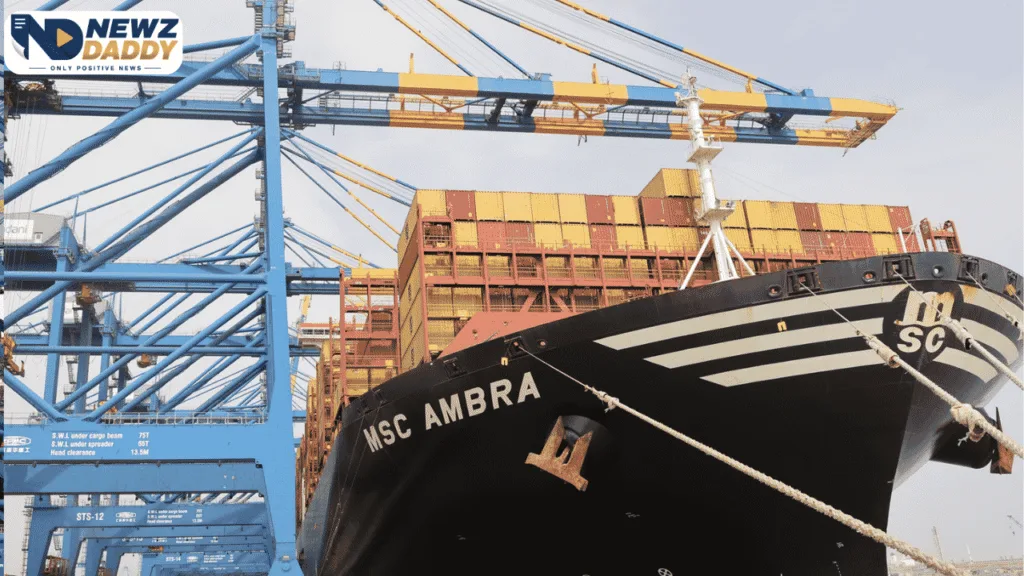
The record was achieved during the arrival of MSC AMBRA, one of the world’s largest container ships. According to Adani Ports, no Indian port has previously handled such a large number of containers from a single vessel. The previous national record stood at 16,569 TEUs, achieved by MSC LIVORNO at Mundra Port in January 2024. The latest operation exceeded that figure by 4,516 TEUs, representing an increase of about 26.9 per cent.
Container traffic has become one of the strongest indicators of global trade because most manufactured goods, electronics, machinery, textiles, chemicals and consumer products move in standard shipping containers. As India expands its exports and imports, ports capable of handling the world’s biggest vessels are becoming increasingly important to international supply chains.
MSC AMBRA is among the largest container ships currently operating in international trade. The vessel is 400 metres long and 61.54 metres wide. To put its size into perspective, its length is roughly equal to four football fields placed one after another. The ship has a displacement of 256,228 metric tonnes, comparable to the combined weight of around 42,700 adult elephants. When it reached Mundra Port, it had a forward draft of 15.10 metres and an aft draft of 15.15 metres, requiring deep-water access and specialised marine infrastructure.
Handling a vessel of this scale involves far more than simply providing a berth. Port authorities must prepare detailed schedules before arrival, assign cranes, organise container yards, coordinate pilots, tugboats and marine staff, and maintain continuous communication between terminal operators and shipping companies. Any delay can affect shipping schedules across several countries because ultra-large container vessels operate on fixed international routes.
Commenting on the achievement, Rakshitbhai Shah, Executive Director of Adani Ports Mundra, said:
“The handling of 21,085 TEUs on MSC AMBRA is a proud and historic achievement for Mundra Port and India’s maritime sector. Surpassing the previous national record by 4,516 TEUs demonstrates the strength of our world-class infrastructure, advanced technology and operational capabilities. This milestone is a testament to the meticulous planning, seamless coordination and unwavering commitment to safety and service excellence demonstrated by Team Mundra Port and all supporting teams. As global shipping moves towards larger vessels and greater cargo consolidation, Mundra Port remains committed to building future-ready capabilities and strengthening India’s position as a competitive global trade and logistics hub.”
Mundra Port, located on Gujarat’s northern coast along the Gulf of Kutch, has grown into India’s largest commercial port over the past two decades. Operated by Adani Ports and Special Economic Zone Ltd., it serves cargo moving to and from industrial centres across northern, western and central India through an extensive rail and road network. The port handles a wide range of cargo, including containers, crude oil, coal, fertilisers, automobiles, agricultural products and liquefied natural gas.
India’s maritime sector has received increased policy attention in recent years as the country seeks to reduce logistics costs and strengthen its position in global trade. Government initiatives such as the Sagarmala Programme have encouraged investment in ports, coastal shipping and transport links connecting ports with manufacturing centres. Industry analysts believe larger and more efficient ports can reduce transit times, improve supply chain reliability and make Indian exports more competitive in overseas markets.
The shipping industry has also undergone significant changes over the last decade. Container shipping companies have steadily introduced larger vessels to improve operating efficiency and reduce transport costs per container. Ships measuring around 400 metres in length have become common on major international trade routes linking Asia, Europe and North America. However, only ports with sufficient water depth, long berths, high-capacity cranes and advanced cargo management systems can accommodate these vessels safely.
According to Adani Ports, the operation at Mundra demonstrated the port’s ability to manage these increasingly large ships efficiently. The company said extensive planning was carried out before the vessel’s arrival, including berth allocation, crane deployment and yard management. Modern cargo-handling equipment, digital operational systems and coordination between multiple teams were used throughout the operation while maintaining safety standards.
India’s container traffic has continued to rise alongside growth in manufacturing, retail trade and e-commerce. Gujarat remains one of the country’s leading maritime states because of its long coastline and concentration of major ports. Mundra plays a central role in this network by handling a substantial share of India’s container movement and serving shipping lines operating international services.
For exporters and importers, the ability of Indian ports to accommodate ultra-large container vessels can translate into fewer cargo transfers, improved shipping schedules and lower transportation costs over time. Direct calls by larger vessels may also reduce dependence on foreign transhipment hubs, an objective that policymakers have supported through continued investment in domestic port infrastructure.
The latest record at Mundra Port marks another milestone in India’s growing maritime sector. While records are symbolic, the operation demonstrates the increasing capacity of Indian ports to handle some of the largest container ships operating in global commerce. As shipping companies continue to deploy bigger vessels, ports with deep-water facilities, efficient cargo handling systems and strong transport connections are expected to play an increasingly important role in supporting India’s international trade and economic growth.