


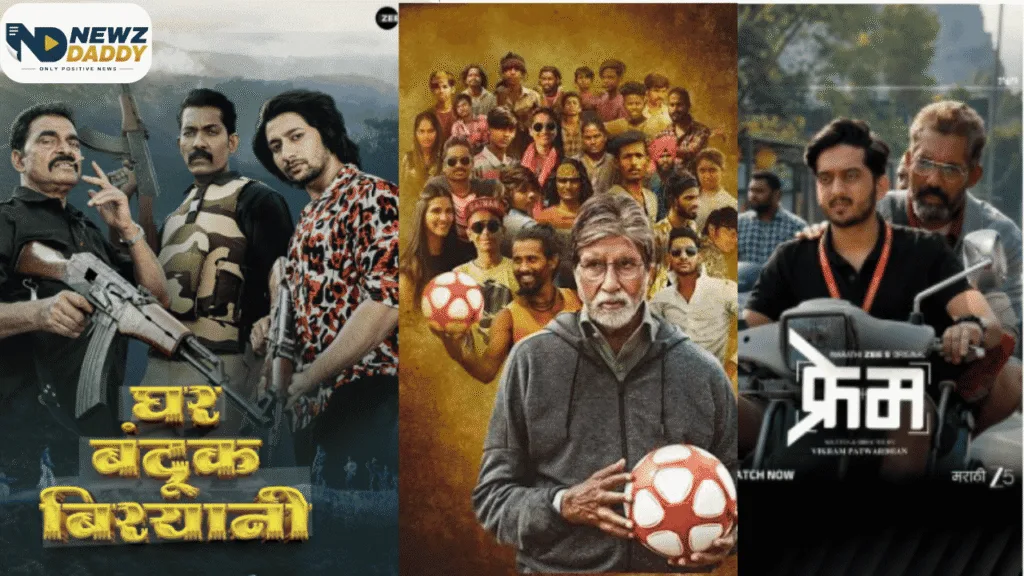
Nagraj Manjule Movies: Five Roles That Defined His Acting
Nagraj Manjule’s Performances Reflect the Versatility Behind One of Marathi Cinema’s Leading Filmmakers
For many film lovers, Nagraj Manjule is best known as the writer and director behind socially conscious films such as Fandry, Sairat and Jhund. His work has earned widespread recognition for addressing caste, inequality and social justice through realistic storytelling. Yet, alongside his achievements as a filmmaker, Manjule has quietly built an impressive body of work as an actor, taking on characters that differ greatly in personality, background and emotion.
His latest acting project, Frame, is now streaming on Marathi Zee5, placing him in his first full-length lead role. The film adds another chapter to a career that has seen him portray fathers, journalists, outlaws and supporting characters with a natural style that reflects his roots in rural Maharashtra.
Here is a closer look at five performances that illustrate the breadth of Manjule’s acting career.
A Photojournalist Facing Difficult Choices in Frame
In Frame, Manjule plays veteran photojournalist Chandu Pansare, a man who believes that documenting events must come before personal emotions. His professional rule of “click first” repeatedly tests his sense of compassion as he covers difficult situations.
The film pairs Manjule with actor Amey Wagh and explores questions that have become increasingly important in modern journalism. As mobile phones, social media and 24-hour news cycles place greater pressure on reporters to capture dramatic moments, journalists often face criticism over where to draw the line between recording an event and helping those involved.
Rather than relying on dramatic speeches, Manjule presents Chandu as someone shaped by years of experience in the field. Small gestures and restrained expressions carry much of the emotional weight, reflecting the ethical conflicts that many journalists encounter during their careers.
A Feared Outlaw in Ghar Banduk Biryani
In Ghar Banduk Biryani, Manjule portrays Raya Patil, an outlaw whose reputation inspires fear across rural Maharashtra.
The film blends crime, social commentary and dark humour while examining violence, political influence and survival in neglected communities. Raya is presented as more than a conventional villain. His decisions reveal the pressures of his surroundings as well as moments of humanity, making the character more complex than a simple criminal figure.
Manjule’s measured performance allows the audience to understand the emotional struggles beneath the character’s hardened exterior, adding depth to a story rooted in rural life.
A Caring Father in Naal
Among Manjule’s quieter performances is Shankar in Naal, a film centred on childhood, family relationships and emotional belonging.
As the father of a young boy, Shankar expresses affection through everyday actions rather than lengthy conversations. The performance depends on silence, body language and ordinary family moments to communicate love and sacrifice.
Naal received critical praise for its sensitive portrayal of family life and childhood emotions. Manjule’s role supports the film’s emotional core by presenting parenthood in a realistic and understated manner, avoiding melodrama while remaining deeply affecting.
A Supporting Role in Jhund
Although Jhund is primarily remembered as one of Manjule’s directorial projects starring Amitabh Bachchan, he also appeared in the film as Hitler Bhai.
Inspired by the work of social activist Vijay Barse, Jhund tells the story of young people from disadvantaged communities who find purpose through football. The film examines issues such as poverty, discrimination and opportunity while showing how sport can influence lives.
Within an ensemble cast, Manjule’s appearance feels authentic and unforced. His familiarity with the world he created helps him fit naturally into the story, complementing its broader message about hope and social inclusion.
A Memorable Appearance in Fandry
Manjule’s breakthrough as a filmmaker came with Fandry, released in 2013. The film received widespread acclaim at national and international film festivals for its honest portrayal of caste discrimination in rural Maharashtra. It later won the National Film Award for Best Feature Film in Marathi and remains one of the defining works of contemporary Indian regional cinema.
Alongside directing the film, Manjule appeared as Chankeshwar “Chankya” Sathe. Although his screen time is limited, the performance contributes to the film’s realistic atmosphere.
His portrayal reflects the same commitment to authenticity that defines his filmmaking. Every appearance serves the story rather than drawing attention to the performer, reinforcing the grounded style that has become closely associated with his work.
A Filmmaker Who Brings Realism To Acting
Born in Jeur in Maharashtra’s Solapur district, Nagraj Manjule has become one of the most influential voices in Indian regional cinema. His films frequently focus on people whose stories have received limited attention in mainstream entertainment, combining social issues with deeply personal narratives.
This background appears to influence his acting as well. Whether portraying a journalist struggling with professional ethics, a father quietly supporting his family or an outlaw shaped by difficult circumstances, his performances rely on observation instead of theatrical display.
With Frame marking his first leading role, audiences now have an opportunity to see another side of a filmmaker who has already reshaped Marathi cinema through his work behind the camera. His acting career may not be as widely discussed as his directing, but these five roles demonstrate a performer capable of bringing credibility and emotional depth to a wide variety of characters.
Must Read: